
Wilmer in the Community
From Baltimore to Southeast Asia, Wilmer clinicians are leading groundbreaking initiatives to address critical needs in both developed and underserved regions.
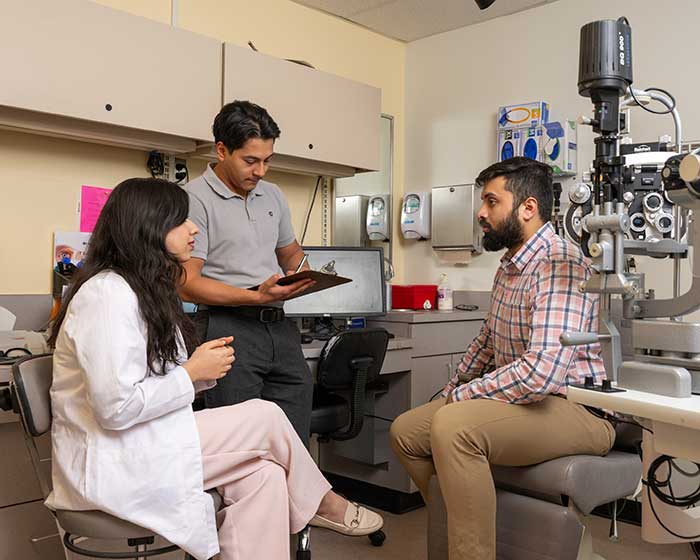
Research fellow Zainab Rustam, left, sees patients as part of the free diabetic screening program.
Since its founding, the Wilmer Eye Institute, Johns Hopkins Medicine, has worked to meet the growing demand for eye care by expanding its services and accessibility. Today, Wilmer’s modern “satellite system” features 10 clinical locations including, most recently, at Johns Hopkins Care in Arlington, Virginia. In 2024, Wilmer clinicians provided more than 15,000 same-day appointments for patients with urgent needs. Wilmer’s clinician-scientists are studying applications of artificial intelligence to reach an ever-larger number of patients — in clinics, patient homes and rural villages — having demonstrated AI’s ability to screen for eye and other diseases, predict disease progression, measure visual acuity and more.
From neighborhoods in Baltimore to Latin America and Southeast Asia, Wilmer’s clinicians are leading groundbreaking initiatives to address critical needs in both developed and underserved regions.
Screening At-Risk Patients for Diabetic Eye Disease
On the first Thursday of every month in Wilmer’s Patient Access Center for the Eye (PACE), retina specialist Cindy Cai, M.D., the Jonathan and Marcia Javitt Rising Professor of Ophthalmology, provides eye exams to some 20 patients with diabetes as part of a free diabetic screening program. People with diabetes are at increased risk of developing cataracts, glaucoma and diabetic retinopathy — the leading cause of vision loss in adults in the U.S. — so it’s crucial to provide an avenue for patients who are uninsured and diabetic to have a screening eye exam, says Cai, whose team members include a research coordinator, four undergraduate students, an ophthalmic technician, a resident and a research fellow.
As a graduate of the Wilmer residency program herself, Cai says she is privileged to mentor and contribute to the education of young ophthalmologists. “It’s a great opportunity for them to learn how to do diabetic retinal screening, as well as improve their triage skills,” says Cai.
Vision Screenings in Our Neighborhoods
Vision Screenings in Our Neighborhoods (ViSION), an organization driven by Johns Hopkins University School of Medicine students, conducts free vision screenings for community members. Collaborating with organizations such as the Esperanza Center and CASA (Court Appointed Special Advocates), a nonprofit organization that provides services to immigrant and working-class families, ViSION typically conducts eight or nine vision screening events per year, bringing them right to the community. The program — which includes faculty sponsors and about 70 medical student volunteers annually — screens over 400 patients each year. Some are referred to Wilmer for follow-up evaluation or eyeglasses.
ViSION co-director Patrick Nnoromele, an M.D./ Ph.D. candidate at Johns Hopkins, says the group would like to expand its reach to include young people. “While there are school-based programs for children, once they reach high school they’re out of luck,” says Nnoromele, who hopes to change that through additional outreach efforts.
Caring for the Most Vulnerable Among Us
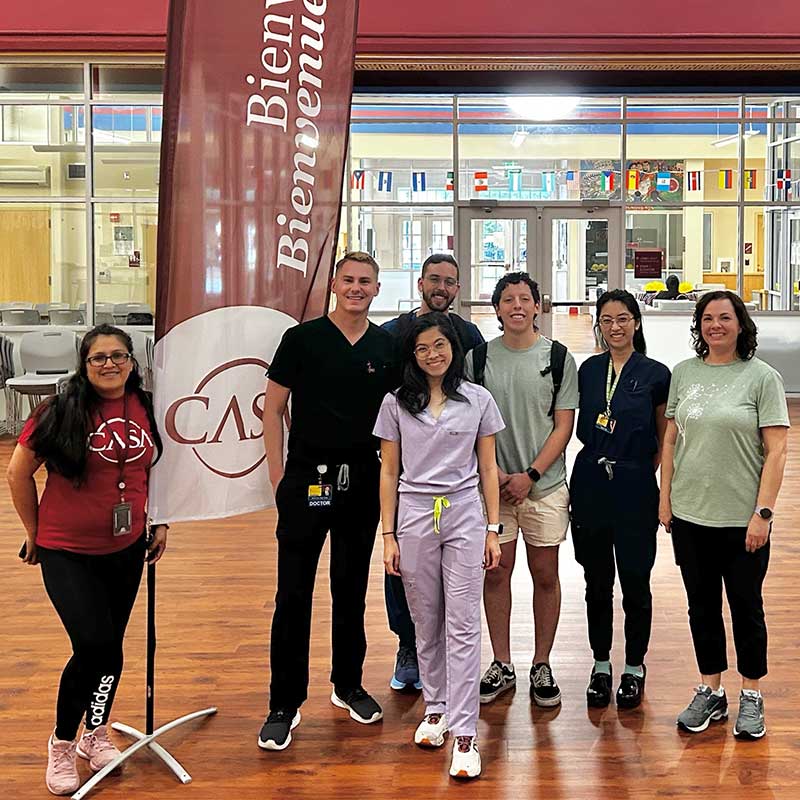 Bryce St. Clair, second from left, with optometry resident May Eiampikul (in scrubs) and students at CASA.
In 2023, Wilmer optometrists launched a free comprehensive community eye clinic that has now served more than 400 immigrants and refugees. Working with CASA and the Maryland Optometric Association, Bryce St. Clair, O.D., M.P.H., secured volunteers and donated exam equipment so he could convert a storage closet at CASA’s Baltimore office into a full-fledged clinic for performing comprehensive eye exams. Together with fellow Wilmer optometrists and optometry and preoptometry students from The Johns Hopkins University, the group screens patients and the doctors advise them about whether they need glasses, a second opinion about conditions such as glaucoma or referrals to Wilmer specialists for surgical intervention.
St. Clair says an eye screening can also help identify larger health issues, such as diabetes and high blood pressure, that disproportionately impact underserved communities. “Now more than ever, we need to ensure the availability of eye care for the most vulnerable among us,” he says.
Vision for Baltimore — and Beyond
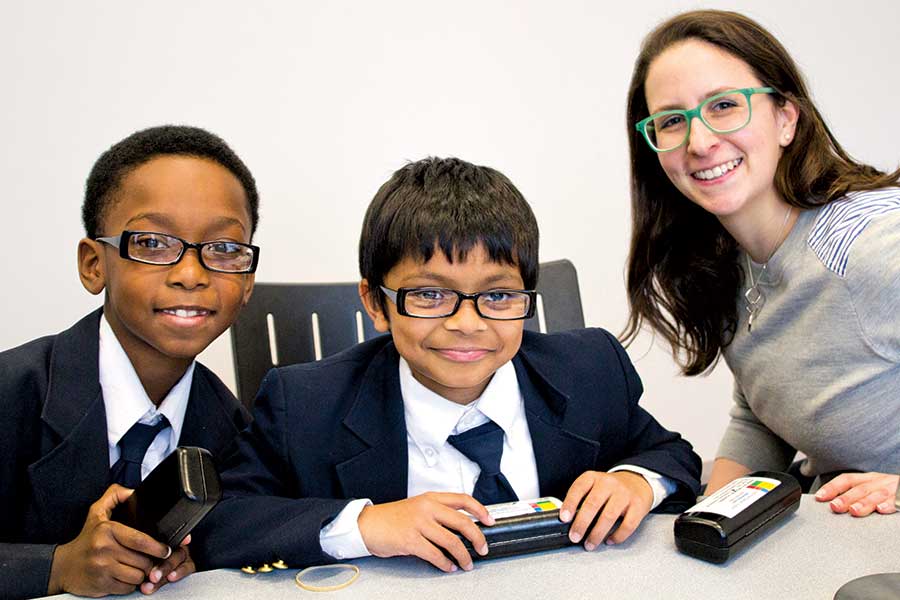 Megan Collins, right, is working to roll out the successful Vision for Baltimore model nationwide.
Under the direction of Megan Collins, M.D., M.P.H., the Allan and Claire Jensen Professor of Ophthalmology, a highly collaborative program that began in Baltimore in 2016 is now poised for implementation in underserved communities throughout the U.S.
Vision for Baltimore is a districtwide, school-based program operated in partnership with Baltimore City Public Schools, the Baltimore City Health Department, The Johns Hopkins University, Vision to Learn and Warby Parker. To date, the program has provided free screenings, eyeglasses if needed and eye exams to some 20,000 Baltimore schoolchildren. Collins and colleagues have studied the program’s impact and determined that it improves reading and math scores. With philanthropic support, they are now working to roll out the program model nationwide.
Reducing Childhood Blindness
Across Thailand, a primary cause of childhood blindness is retinopathy of prematurity (ROP), an eye disease that occurs in some premature babies when their early birth disrupts the growth of blood vessels in the retina. While ROP can be countered with proper treatment, too often the condition goes underdiagnosed. “Doctors in NICUs throughout Thailand may not have the equipment needed to facilitate its recognition, so the babies go blind before you can treat them,” says Neil Bressler, M.D., the James P. Gills Professor of Ophthalmology.
A collaboration that Bressler is leading among physician-scientists at The Johns Hopkins University and Chiang Mai University in Thailand aims to change that. The group is training practitioners to obtain images using a sophisticated camera in Chiang Mai University’s neonatal intensive care unit. The physicians will confirm their interpretation of the images by sharing them with world ROP experts in Shanghai, China. If this system works successfully, Bressler plans to approach hospitals in other regions that do not have pediatric retina expertise with a cost-effective blueprint for improving ROP diagnosis by sending images to a central image reading center for interpretation and disease management. “There will be broad implications for trying to reduce childhood blindness in similar locales,” says Bressler.
Transforming the Lives of Rural Villagers
In 2006, Nakul Shekhawat, M.D., M.P.H., then a 19-year-old college student, spent a few weeks volunteering at an ophthalmology hospital in an impoverished rural area of northern India. Cataracts are the leading cause of blindness in India, and Shekhawat saw firsthand how having access to eye care, particularly cataract surgery, was transforming the lives of rural villagers. Now Shekhawat, the Stephen F Raab and Mariellen Brickley-Raab Rising Professor of Ophthalmology at Wilmer, has partnered with Aravind Eye Hospital in India — as well as biomedical engineers and public health researchers at Johns Hopkins — to develop a telemedicine platform that will provide virtual eye screenings to rural villagers in India. This will ease the significant travel burden for patients while offering much needed ophthalmology care, he says.
Recognizing the growing need for eye care in the United States due to aging of the population, Shekhawat and his team are also working to deploy this technology to help patients in rural U.S. areas. “Every week at Wilmer, we see patients who travel several hours to receive eye care at Johns Hopkins,” Shekhawat says. “Our hope is that these novel telemedicine technologies can offer patients convenience, cost savings and improved care access while maintaining safety and quality of care.”
On a Mission to Serve
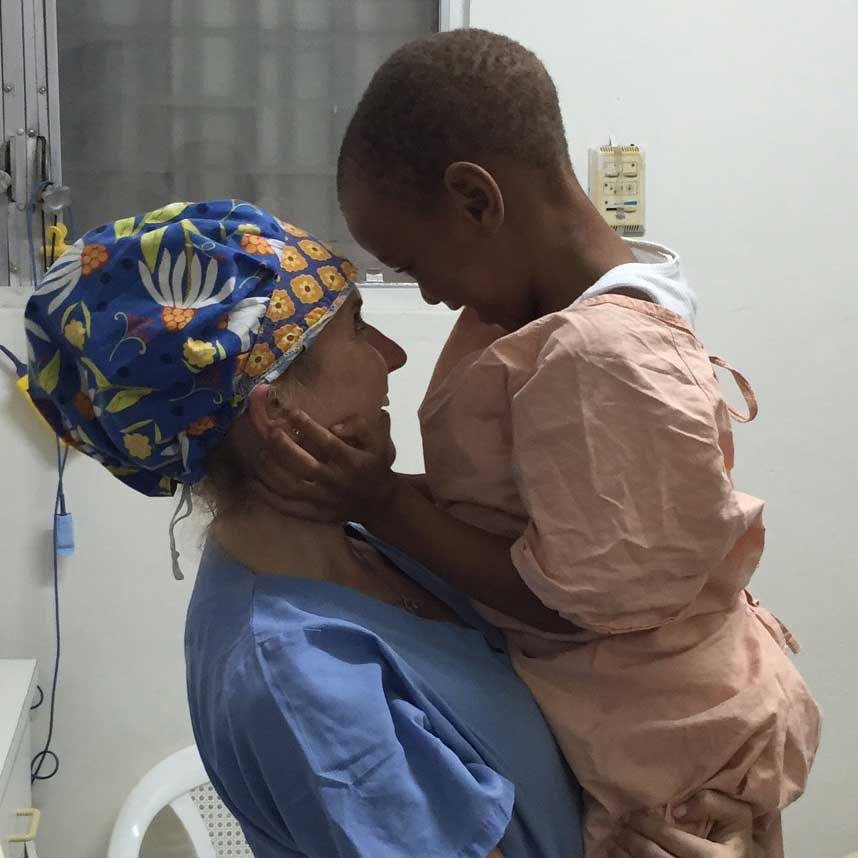 Pediatric ophthalmologist Courtney Kraus provides eye care to children, including eye exams and surgeries, during annual mission trips to underserved countries.
Over the past 11 years, pediatric ophthalmologist Courtney Kraus, M.D., the Knights Templar Eye Foundation Professor of Ophthalmology, has gone on 12 international missions to provide eye care to children in underserved countries, including Guatemala, Peru and — most recently — Belize, performing comprehensive eye examinations for more than 100 children and anywhere from 25–40 surgeries (pediatric cataract, strabismus and oculoplastic procedures).
“My experience traveling to Belize has been both incredibly rewarding and one that I look forward to every year,” says Kraus. “It is a country that does not have subspecialty pediatric eye care, and by traveling there annually, I am able to perform a necessary and valuable service. It is energizing to return to a place where I can see children I operated on six years prior return for a comprehensive checkup, and be doing great. I enjoy that this long-term relationship has allowed me to offer the same level of care and follow-up that I do here in the States.”