
Wilmer History: Spotlight on L. Harrell Pierce
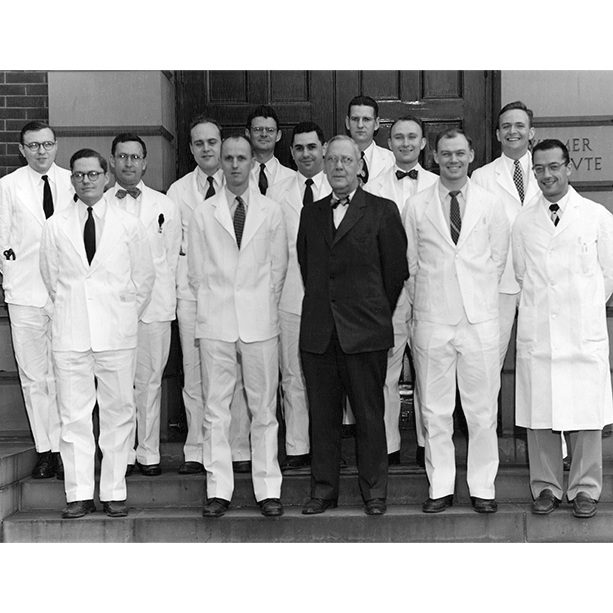
Wilmer residency class for 1951-1952. L. Harrell Pierce is in the third row, near the center.
The Wilmer Eye Institute has a world-renowned Retina Division, attracting patients from around the globe for its excellent patient care and superstar faculty members to join its ranks. The history of the Division dates back to 1952, when L. Harrell Pierce, M.D., began what was then called the Retina Clinic — one of the first subspecialty clinics at Johns Hopkins.
Pierce did his ophthalmology residency at Wilmer from 1948-1951, after which he left to do a fellowship with eminent ophthalmologist Charles L. Schepens, M.D., in Boston. Schepens is often referred to as the father of modern retinal surgery for his invention of specialized tools and innovative surgical techniques credited with increasing the success rate of retinal surgeries. Pierce became the first fellow to train with Schepens and after his time in Boston, he returned to Wilmer as chief resident before joining the faculty.
“Dr. Pierce was the first ophthalmic surgeon to train in the repair of retinal detachment with Schepens in Boston. On returning to Baltimore, through his private practice and surgeries performed at Wilmer, he cared for patients from many surrounding states,” says Harry Quigley, M.D., who trained as a resident with Pierce. Quigley then joined the faculty at Wilmer, where he has served as a glaucoma specialist for four decades and is now the A. Edward Maumenee Professor of Ophthalmology.
During Pierce’s career he performed over 6000 retinal detachment procedures. He was “the consummate retinal surgeon — precise, methodical and untiring. His reports were detailed and his examinations thorough. He was known as a stickler for detail,” wrote Robert B. Welch, M.D., in Pierce’s 2001 obituary for the Archives of Ophthalmology. Welch, who passed away in 2021, was Pierce’s longtime colleague and co-director of the Retina Clinic beginning in 1959.
“He was an advocate that every detail of surgery and care should be followed meticulously, leading to admirable salvation of vision for many patients,” says Quigley. “Every Wilmer resident for decades learned the examination and treatment of retinal disease by observing Dr. Pierce.”
When Pierce retired in 1984, Wilmer established the L. Harrell Pierce Award for excellence in teaching.