
Sleuthing to Identify a Very Rare Eye Disease
After undergoing routine eye surgery, Laura Styles developed mysterious symptoms that sent Wilmer clinician-scientists on the hunt for answers that would restore her vision.
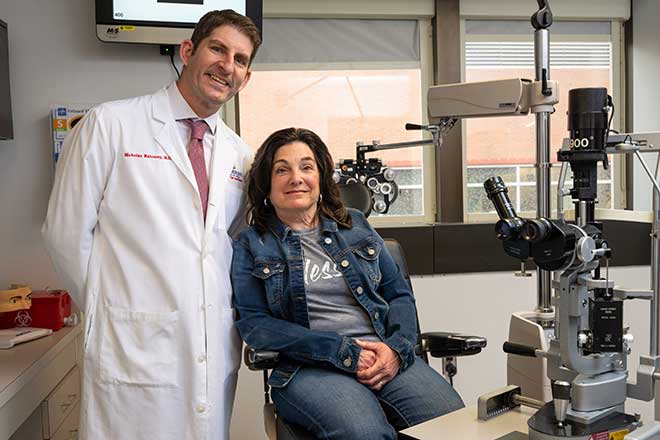
Nicholas Mahoney and Laura Styles
In 2020, near her home in Pennsylvania, Laura Styles had routine surgery for glaucoma. But two days later, Styles’ left eye swelled nearly shut, and she developed painful, itchy lesions on her eyelid. She went to an ocular surgeon, who scraped away the lesions, but they soon grew back. Styles, a home health care aide, also had reduced vision. This forced her to stop driving at night, but sometimes patients needed care then.
“There were also times when I’d be walking, and I’d just have to be very careful,” she says. “I missed being able to put makeup on and look my best. It was frustrating.”
Styles’ ocular surgeon referred her to the Wilmer Eye Institute, Johns Hopkins Medicine, where Nicholas Mahoney, M.D., the Earl D.R. Kidwell Jr., M.D., Professor of Ophthalmology and chief of the Division of Oculoplastics, and Charles Eberhart, M.D., Ph.D., director of neuropathology and ophthalmic pathology, spent more than a year gathering data. After several biopsies, a few nondefinitive leads and a review of the scientific literature, they landed on a very rare diagnosis — one that neither of them had seen in their careers.
The doctors’ detective work started in the fall of 2022, when Styles first saw Mahoney because of his experience with amyloidosis, a disease that occurs due to buildup of the amyloid protein. Styles’ previous ophthalmology team suspected she might have this condition. The clinical picture wasn’t a perfect fit, so Mahoney performed Styles’ first biopsy at Wilmer by removing a large segment of her upper eyelid, which he reconstructed afterward.
The specimen went to Eberhart, Wilmer’s Charlotte A. Wilson and Margaret K. Whitener Professor of Ophthalmology, who determined the results were inconsistent with amyloidosis. The sample also showed an increase in cell numbers consistent with another rare disease that he and Mahoney had treated before: immunoglobulin G4-related disease (IgG4-RD), which causes inflammation on the eyelids. But the increase wasn’t drastic enough for Eberhart to definitively make this diagnosis. Styles was treated with anti-inflammatory medications, primarily steroids in various forms, which eased her symptoms but had the side effect of worsening her glaucoma. The lesions always grew back.
In spring 2024, Mahoney decided to try an injection of a medication to spare Styles from the side effects of steroids while still controlling the inflammation. When Styles returned to Wilmer to check on a new mass that had appeared on her eyelid, it looked dense, thick and woodlike — a different appearance than the lesions had in the past. Mahoney performed another biopsy.
With this new specimen, Eberhart was able to rule out amyloidosis, and the increased cells from the previous biopsy that suggested IgG4-related disease weren’t present.
“At that point, we dug into the literature and started reading a lot about what sort of really rare diseases might look like this,” Eberhart says. “We turned up the possibility of ligneous conjunctivitis.” The ultra-rare genetic disease has affected only about 250 people worldwide to date and can flare up after surgery.
Mahoney, who is the scientific symposium director for the American Society of Ophthalmic Plastic and Reconstructive Surgery, recalled reading an abstract that had been submitted for review about using Ryplazim, which is derived from human plasma, to treat plasminogen deficiency, which is the cause of ligneous conjunctivitis. After additional blood tests to confirm Styles’ diagnosis, Mahoney became the first ophthalmologist in the world to prescribe Ryplazim, which is administered by injection, for ligneous conjunctivitis.
“After my first infusion, my eyes started to heal up within hours,” Styles says. “I felt better almost immediately.”
Styles’ left eye opened, the itching and pain stopped, and her vision returned to normal. The medication also improved her bleeding gums and hearing and sinus problems — all systemic symptoms that can be caused by plasminogen deficiency.
Today, Styles takes Ryplazim — either by administering it herself or with the help of her husband or nurses — every five days by injection. Mahoney has talked to her about decreasing the frequency or having an in-dwelling port placed to eliminate the need for frequent injections. But for now, Styles is taking the intense medication schedule in stride, and she is grateful to the team at Wilmer for uncovering her diagnosis.
“They were always prepared and helpful, and they made me comfortable and tried to get answers,” she says. “They really worked hard to put the puzzle together.”