
Listening to Light to Capture Images of the Eye
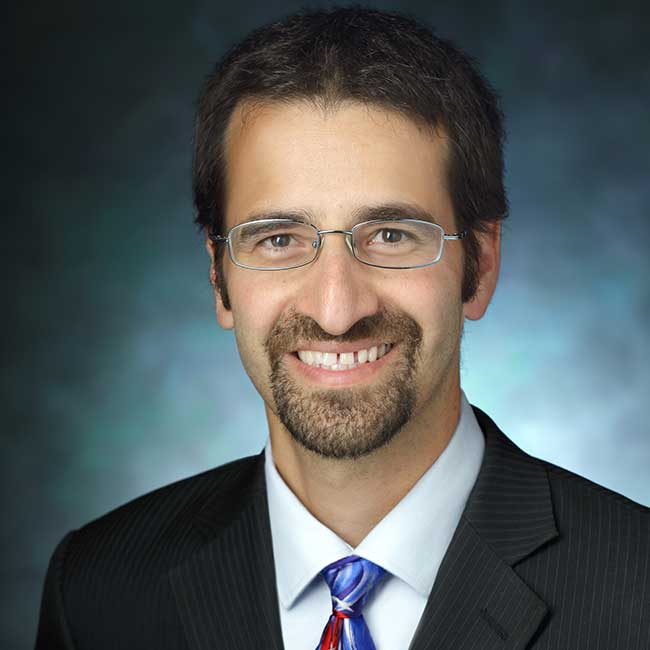
Yannis Paulus
Patients are the north star for Wilmer clinician-scientist Yannis Paulus, M.D. “The number one driver for all my research is to answer the question of what is causing blindness in patients?” says Paulus, the Jonas Friedenwald Professor of Ophthalmology.
His question led him to focus on age-related macular degeneration, which affects more than 200 million people worldwide. There are two types of macular degeneration: dry and wet. Patients start with dry and progress to wet as the disease worsens, but not all patients with dry AMD will develop wet AMD.
“The majority of patients with dry macular degeneration will never progress. But there's a subset of patients that will and that will lose a lot of vision and go blind because we don't catch it early,” says Paulus.
The challenge is how to closely monitor all those with dry AMD and how to know who will progress. “How do we distinguish the needle — those who will progress — from the haystack — the majority who will not?” says Paulus. And how do they find the needles early enough to intervene before vision loss.
Currently, the way to diagnose if macular degeneration has progressed is through eye examination and looking at images of the retina taken with optical coherence technology. “The OCT is effective once you have the new blood vessels and fluid of wet AMD, but we want to catch the disease before that.” What ophthalmologists need is an imaging modality that can show the blood vessels that are the hallmark of wet AMD earlier in their formation. This information will allow them to follow those patients more closely and to start treatment earlier.
A relatively new imaging technique that Paulus has pioneered in the eye has the promise to do just that: photoacoustic molecular imaging. Photoacoustics involves transforming light into sound waves, then capturing those sound waves visually.
The multi-step process begins by injecting into the body gold nanoparticles engineered to adhere to molecules involved in blood vessel formation that occurs in wet AMD. “We give the nanoparticles intravenously, and they will only bind in those patients where there actually are molecular changes which will lead to new blood vessels. Otherwise, they circulate in the body and are removed by the kidneys.”
“Next, we scan with a nanosecond pulse duration laser over the retina. When hit with a laser, the nanoparticles still in the body will make a sound. An ultrasound transducer we put on the eye’s surface ‘listens’ and records sound waves from each spot that is scanned,” says Paulus.
“It’s like lightning and thunder. The lightning happens when you shine the laser into the eye and then you actually look at the sound waves that come out of the tissue as a result,” says Paulus. These sound waves — the thunder — pinpoint where molecular changes involved in blood vessel formation are occurring in the retina. This blood vessel formation indicates the beginning of wet AMD.
Using photoacoustic molecular imaging could help ophthalmologists follow patients and their disease progression in much finer detail. “Now we group all patients with dry macular degeneration together but that could change,” says Paulus. With a more effective imaging modality, ophthalmologists will be able to find the needles in the haystack of 200 million people: those with dry AMD who are converting to wet AMD. Once found, these people will be able to start treatment earlier.
“This is very much the idea of personalized medicine,” says Paulus.