
Keeping Mitochondria Healthy
Investigating molecular pathways that promote cell survival and regeneration — with the goal of preventing AMD before it begins.
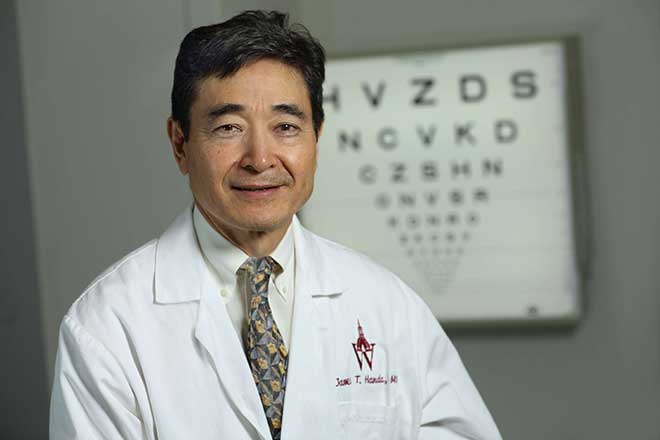
James Handa
Innovative, collaborative and well-resourced, researchers at Wilmer Eye Institute, Johns Hopkins Medicine, continue to lead the way in the bold quest to cure blinding eye disease.
James Handa, M.D., the Robert Bond Welch, M.D., Professor of Ophthalmology, explores how the normal aging of the eye transitions to age-related macular degeneration (AMD), which causes damage to the macula and is the leading cause of blindness among older adults. AMD affects some 300 million people worldwide.
“That’s almost as many people as those who live in the United States,” says Handa. And yet, “AMD is largely untreatable in its early stages.”
In particular, Handa has homed in on the role of cigarette smoking, which is the strongest environmental risk factor for AMD.
“We found that cigarette smoke accelerates aging at the cellular level, particularly in the retinal pigment epithelium (RPE), the key cell type involved in AMD, pushing healthy retinal cells toward disease much faster,” he says.
Using single-cell transcriptomic sequencing, Handa’s team identified healthy and diseased RPE cells in mice that were exposed to cigarette smoke. A key observation involved mitochondria, the powerhouses of cells. While young RPE cells initially respond to smoke exposure by increasing mitochondrial gene production to counteract the stress, aged cells are unable to compensate. They become damaged, and die.
A major breakthrough came when Handa was able to show that bioactive fragments of mitochondrial transfer RNA (tRNA) get released when these retinal cells are damaged. These fragments gather in extracellular vesicles — small biological sacks that can travel to neighboring cells and spread disease by damaging their mitochondria. Handa presented the findings at the 2024 meeting of the International Society for Eye Research.
One of Handa’s key goals is to determine whether mitochondrial damage among smokers is similar to that of nonsmokers with AMD, and, if not, how it differs. He says this could reveal new therapeutic targets and help differentiate environmental from age-related disease mechanisms.
Handa plans to study whether cells can recover if patients quit smoking. If cells can regain function, that could be an even stronger public health message about the benefits of quitting smoking. His lab is also exploring specific molecular pathways involved in cells that survive damage from smoking to identify potential interventions that could rejuvenate damaged retinal cells and keep them alive to prevent AMD progression.
Regarding whether these pathways can be restored, Handa is investigating specific molecular pathways that promote cell survival and regeneration. If he and his team can identify ways to bring back mitochondrial function, it could lead to a breakthrough treatment.
“If we can understand how to keep mitochondria healthy and find the pathways that prevent aging,” Handa says, “we may find a way to prevent AMD before it begins.”