
Johns Hopkins Skull Base Tumor Center Delivers Multidisciplinary, Individualized Care
Specialists from a variety of disciplines make up a world-class team at the Skull Base Tumor Center.
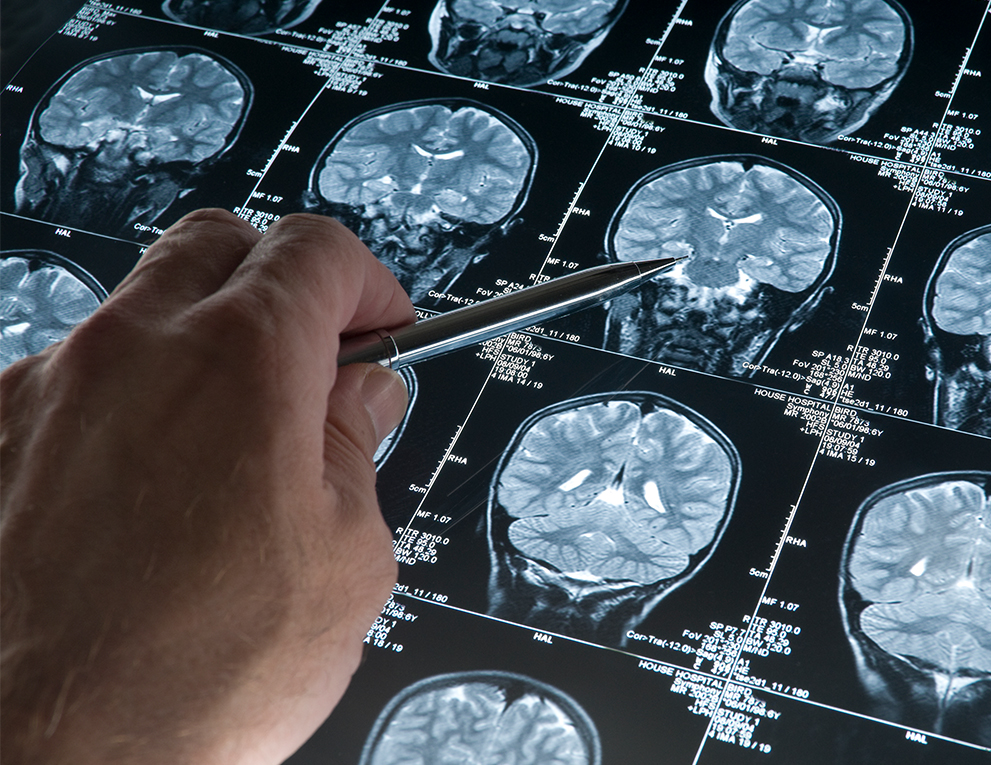
Skull base tumors can be especially challenging because they grow deep within the skull near nerves and blood vessels that run through the brain, head, neck and spinal cord.
At the Johns Hopkins Skull Base Tumor Center, specialists from across the institution work together to bring individualized care to patients with these tumors, which can require complex surgeries for removal of tumors and reconstruction of the skull base and parts of the face.
The large, multidisciplinary team at the Skull Base Tumor Center, which is part of the Johns Hopkins Comprehensive Brain Tumor Center, includes physicians from otolaryngology–head and neck surgery; radiation, surgical and medical oncology; neuroradiology; neurosurgery; radiology; facial plastic and reconstructive surgery; and ophthalmology. It is one of the highest-volume centers in the country for sinonasal and skull base tumors, which include meningiomas, olfactory neuroblastoma, squamous cell carcinoma, craniopharyngioma, acoustic neuroma (vestibular schwannoma) and many others.
The center treats both benign and malignant tumors, often using minimally invasive techniques.
“Taking care of sinonasal and skull base patients is a highly multidisciplinary team effort,” says Nyall London, a head and neck surgical oncologist, otolaryngologist and internationally recognized expert in sinonasal and skull base tumors. “There are many other places that do these surgeries and do them very well, but what differentiates us is how strong we are in all those different multispecialty aspects.”

One hybrid approach — using minimally invasive and endoscopic methods — involves making an incision through the eyelid to get to the anterior skull base, and inserting an endoscope through the nose to visualize the tumor during removal. The technique, pioneered by Johns Hopkins facial plastic and reconstructive surgeon Kofi Boahene, reduces the need for a large incision in the scalp.
During reconstruction, tissue flaps can be fed to the skull base through the nose, and surgeons can also use the nasoseptal flap to reconstruct skull base defects. These methods can reduce the need for large incisions in the skull or face. Other approaches involve making a small incision behind the ear and removing a portion of the occipital bone to access the skull base.
Some patients with malignant tumors have radiation as part of their treatment plan after surgery. This and other degradative processes can have downstream effects, including weakening of the bone between the brain and the nose. The team can fortify the bone through minimally invasive and endoscopic surgical approaches, London says.
Surgery can also alter the appearance of the face — sometimes eyes, portions of the nose or the entire nose and palate need to be removed to access and remove tumors.
“There’s a lot of impact on being able to eat and swallow,” London says. “Reconstructive surgeons at Johns Hopkins can repair these defects and really lessen some of the negative consequences of what we do to treat these diseases.”
In addition to its multidisciplinary care, the Skull Base Tumor Center also focuses on research and clinical trials that seek to further understand skull base tumors and discover potential new treatments.
To learn more and see a list of Skull Base Tumor Center team members, click here.
For Clinicians Clinical Connection
Clinicians, discover the latest in research and clinical innovation from Johns Hopkins experts. Access educational videos, articles, CME courses and other resources from our world-renowned institution.