
Faculty Start-Ups
Wilmer researchers and clinicians are working with The Johns Hopkins University and oversight committees to create companies to bring their treatments to market.
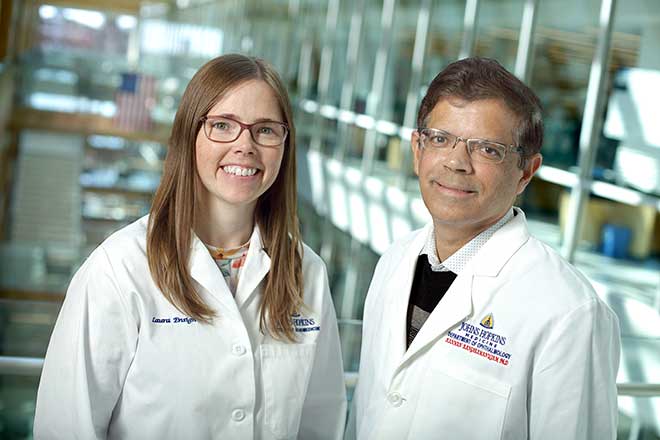
Laura Ensign and Kannan Rangaramanujam
Innovative, collaborative and well-resourced, Wilmer’s researchers continue to lead the way in the bold quest to cure blinding eye disease.
Kannan Rangaramanujam, Ph.D., co-director of the Center for Nanomedicine at Wilmer Eye Institute, Johns Hopkins Medicine, is brimming with excitement as he shares the recent results of a phase IIa clinical trial of an innovative, systemic, precision nanomedicine that he and his team pioneered through Ashvattha Therapeutics, a startup company he co-founded.
“It’s a rather stunning proof of concept,” says Rangaramanujam, the Arnall Patz Distinguished Professor of Ophthalmology, about the dendrimer-drug targeted treatment model. When delivered monthly through an injection in fatty tissue, the treatment showed a 67% reduction in the need for intravitreal injections (i.e., shots in the eye) for patients with wet age-related macular degeneration and diabetic macular edema. What’s more, the impact was systemic — both eyes, including the noninjected eye, benefitted.
By reducing the need for costly eye injections, such subcutaneous treatments, delivered at home, could vastly expand access to sight-saving therapy for people around the world, he says. Also critical: Treatment can begin during earlier stages of the disease, before damage to eyesight has occurred.
Rangaramanujam, who holds more than 150 patents and is launching three other new companies, is just one of dozens of faculty entrepreneurs at Wilmer. These faculty members are employed full time at Johns Hopkins as researchers and clinicians, but they work with the university and oversight committees to create companies to bring their treatments to market. They are supported by Johns Hopkins Technology Ventures (JHTV), launched in 2014, which offers research space in its two FastForward accelerators — one in East Baltimore, the other near the Homewood campus — as well as guidance on licensing and patent filing.
“Faculty members can use this incubator space to launch their startup companies away from their scientific research — in a different laboratory, where the company is doing the work needed to try to turn the discovery into a product that addresses an important, unmet medical need,” says Wilmer Director Peter J. McDonnell, M.D., the William Holland Wilmer Professor of Ophthalmology. To date, teams of Wilmer faculty entrepreneurs have created 14 such companies, with more being formed — by far more than in other ophthalmology departments, McDonnell says.
 Justin Hanes
Laura Ensign, Ph.D., the Marcella E. Woll Professor of Ophthalmology and vice chair for research at Wilmer, who co-launched Novus Bio and Novus Vision with Justin Hanes, Ph.D., the Lewis J. Ort Professor of Ophthalmology, says the licensing support provided through JHTV is critical.
“If you license the technology to an existing company, there’s no guarantee that it will be developed into a product that reaches patients,” she says. “We want these treatments that we’re working on in the lab to get to the clinic in the fastest way possible. Many times, that’s done if the people who believe in it and are the most passionate about it are the ones who are driving it.”
Hanes, director of the Center for Nanomedicine, has started eight companies and has over 100 inventions. He points out the importance of securing patents for faculty-led innovations.
“As faculty members, when we create something we think has value and could potentially be helpful to people and transformative to medicine, we want to make sure that it doesn’t get wasted,” he says. “If there’s no patent protection or if a patent is abandoned, then you can be sure that its impact would be greatly diminished or lost.”
Rangaramanujam, whose closest collaborator is his wife, Sujatha Kannan, M.D., vice chair for research for anesthesiology and critical care medicine, says together they have raised more than $200 million in investor and National Institutes of Health funding to bring their discoveries to market — thanks to Johns Hopkins’ support for faculty innovators.
“It enables people to focus on what is really important: impacting human health, while collaborating with superstars at Wilmer — and elsewhere at Hopkins — who are also focused on the larger cause,” he says.