
Designer Drugs
The combination of biomaterials engineering and AI-driven drug design offers promising solutions to some of the most pressing challenges in eye care.
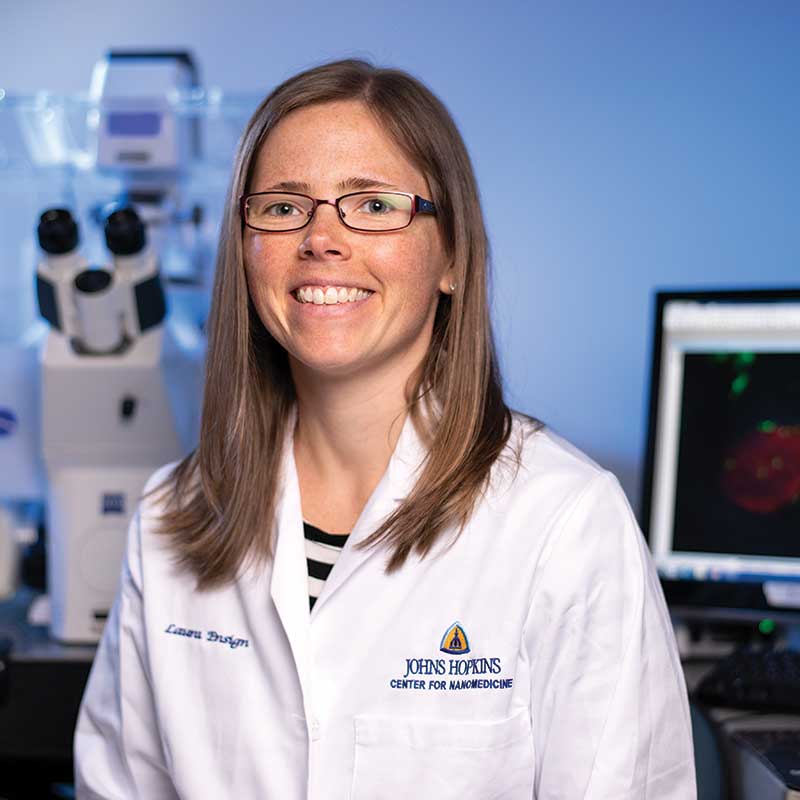
Laura Ensign
Innovative, collaborative and well-resourced, researchers at Wilmer Eye Institute, Johns Hopkins Medicine, continue to lead the way in the bold quest to cure blinding eye disease.
Laura Ensign, Ph.D., the Marcella E. Woll Professor of Ophthalmology, is a chemical and biomolecular engineer who specializes in biomaterials, particularly nanoscale drug delivery systems that help drugs make it to their intended targets, leading to greater efficacy and fewer side effects. These systems, often biodegradable and based on biomaterials, range from eye drops to implantable devices.
“We straddle the translational space between basic science — trying to understand how things work and why — and clinical research, making sure what we learn and develop can actually reach patients,” explains Ensign, who is vice chair for research at Wilmer. “We’re not just making better drugs; we’re engineering smarter ways to deliver them — ways that work with the body rather than against it.”
One of Ensign’s recent major projects is a startup currently conducting clinical trials on a type of eye drop that, once in the eye, forms a gel that coats the target area and lasts longer than a traditional liquid drop that might be required several times each day, such as those that treat glaucoma and other eye diseases. By reducing the frequency of application, patient adherence to drug regimens could be significantly improved, she says.
On a different but related angle, Ensign is using machine learning to engineer new peptides — a family of short amino acids that are the building blocks of longer proteins — for sustained drug delivery. These designer peptides are not drugs, but they attach to drug molecules to improve their efficacy. Ensign has demonstrated a peptide-enhanced delivery method in which peptides bind to melanin in the retina and are released over extended periods of time.
“With our peptide approach, we can sustain drug activity in the eye for weeks instead of hours without using implants or polymers,” Ensign says. “Machine learning doesn’t magically invent solutions, but when trained on the right data, it allows us to design peptides unlike any in nature, opening up potential new ways to treat disease.”
Beyond drug delivery, Ensign and her colleagues are now bringing their biomaterials expertise to the world of cell regeneration research. She hopes to build what she calls “scaffolds” of biomaterial, like the steel skeleton of a skyscraper, that support transplanted healthy cells that have been regrown in the lab from stem cells. This approach is a significant step toward restoring vision for patients who have already suffered vision loss.
“The next big step isn’t just preventing vision loss but reversing it — bringing back sight through regenerative strategies,” she says. “This combination of biomaterials engineering and AI-driven drug design offers some promising solutions to some of the most pressing challenges in eye care.”