
Confronting Paradoxes
New findings help explain why diabetic patients who start glucose control or have high glycemic variability may experience worsening of diabetic eye disease — and suggest a path to prevention.
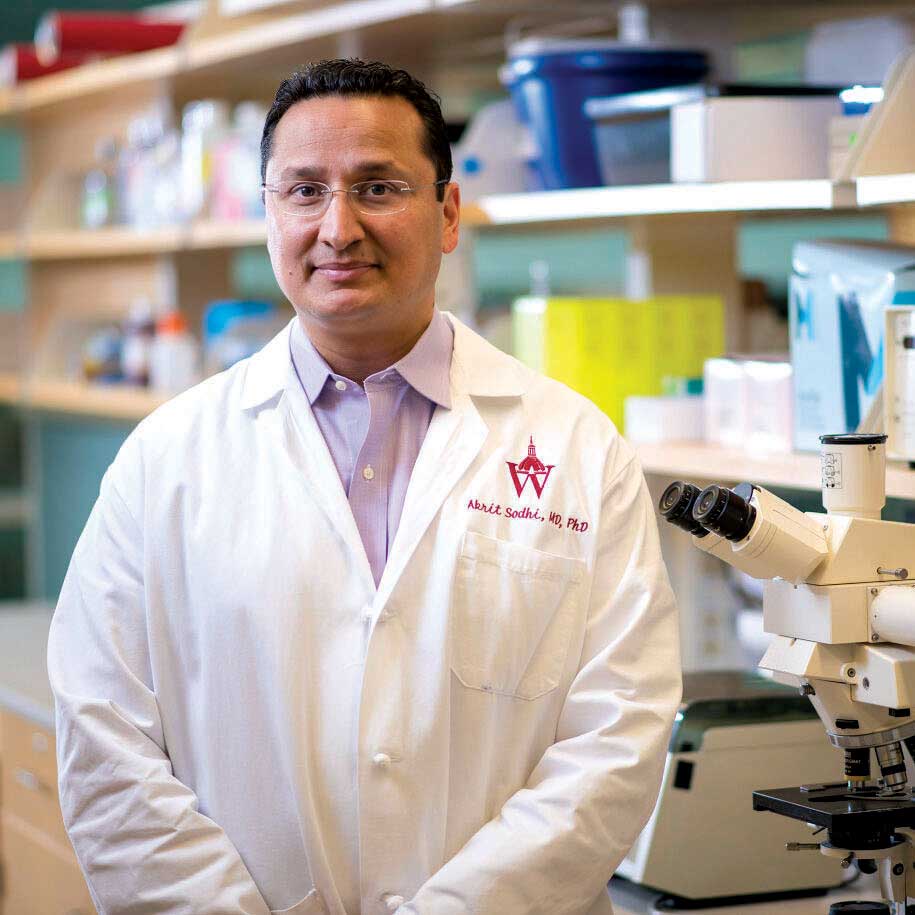
Akrit Sodhi
Innovative, collaborative and well-resourced, researchers at Wilmer Eye Institute, Johns Hopkins Medicine, continue to lead the way in the bold quest to cure blinding eye disease.
Diabetic retinopathy, which damages blood vessels in the retina, is a complex and elusive disease, says Wilmer ophthalmologist Akrit Sodhi, M.D., Ph.D., the Branna and Irving Sisenwein Professor of Ophthalmology. His research focuses on identifying novel biomarkers and potential treatments for diabetic retinopathy and other conditions, such as age-related macular degeneration (AMD).
An enduring conundrum that has perplexed researchers about diabetic retinopathy is why initial efforts to help patients with diabetes control blood sugar with insulin often cause accelerated injury to the blood vessels in the retina, resulting in leakage of fluid into the retina and worsening damage.
“One paradox of diabetic retinopathy is that aggressive glucose control can initially make things worse before they get better — our research helps explain why,” Sodhi says. His team has shown that a physiological response to low glucose can also “lead to a pathologic increase in proteins that encourage blood vessel growth and leakage that the average healthy person tolerates very well, but someone with diabetes does not,” he says.
In their studies, which have drawn much attention in the medical press, Sodhi and his team have found that hypoglycemic episodes (periods of low blood sugar) trigger increases in two proteins that promote blood vessel growth and leakage: vascular endothelial growth factor (VEGF) and angiopoietin-like 4 protein (ANGPTL4). He also says this phenomenon is tied to hypoxia-inducible factor 1-alpha (HIF-1α), a protein that helps the body respond to conditions of low blood oxygen.
Sodhi thinks, in essence, that the lower blood sugar produced by aggressive treatment with insulin results in transient episodes of hypoglycemia (low glucose). The retina responds to these episodes the same way it responds to a lack of oxygen, by increasing HIF-1α. This helps the retina adapt to the low glucose, but it also causes an increase in the growth and leakage from retinal blood vessels, which then cause retinal cell damage.
“This response helps explain why newly diagnosed diabetic patients just beginning insulin treatment initially experience worsening retinopathy,” Sodhi explains. “It turns on genes that regulate blood vessel growth and leakage, mimicking the response to low oxygen.”
Sodhi has taken things a step further by blocking HIF-1α to prevent leakage from retinal blood vessels, yielding a potential therapy. His group has also shown that this therapy is effective for treatment of later stages of diabetic retinopathy as well as the wet form of AMD, which is also the consequence of the abnormal growth of blood vessels. In tests of mouse models, HIF-1α inhibitors have proven to be at least as effective in stopping new vessels from forming as the anti-angiogenic approaches that block VEGF, which are currently the gold standard for treating patients with both diabetic retinopathy and wet AMD.
Another confounding question for Sodhi is why some patients respond better than others to current therapies targeting VEGF. Sodhi and his team have studied various proteins and discovered a distinct biomarker that predicts which patients with wet AMD will respond well to anti-VEGF treatment, and which will not.
“The Achilles’ heel of anti-VEGF therapy is that it promotes a paradoxical increase in HIF-1α, which we believe prevents some patients from responding well,” Sodhi says. “This insight could allow us to tailor therapies more effectively based on patient response.”
Sodhi and his mentor, Nobel Prize laureate Gregg Semenza, M.D., Ph.D., at the Johns Hopkins Institute for Cell Engineering (Semenza discovered HIF-1α) have co-founded a company to develop HIF-1α inhibitors as potential new drugs for treatment of eye disease and cancer.