
At The Vanguard
Innovative, collaborative and well-resourced, Wilmer researchers continue to lead the way in the bold quest to cure blinding eye disease.
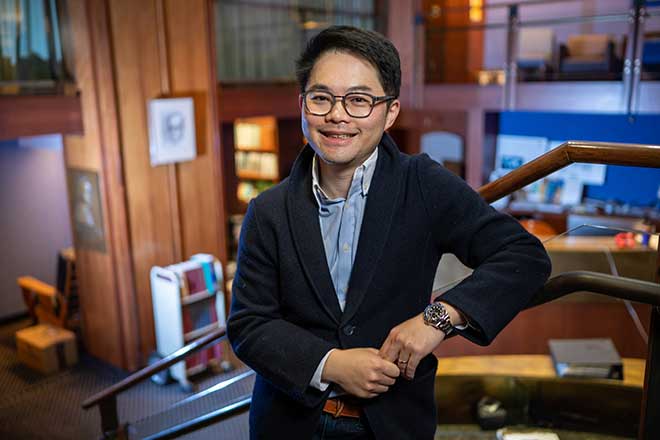
T.Y. Alvin Liu
For 100 years, the Wilmer Eye Institute, Johns Hopkins Medicine, has been at the vanguard of ophthalmology — thanks in large part to the institute’s commitment to research excellence.
“Wilmer sets itself apart with a uniquely expansive and collaborative approach to innovation in eye research,” says Peter J. McDonnell, M.D., Wilmer’s director and the William Holland Wilmer Professor of Ophthalmology. He notes that Wilmer’s greatest strengths are its interdisciplinary approach and an eagerness among researchers to collaborate — among themselves and beyond. Wilmer’s faculty members, who are leaders in their disciplines, can tap into expertise across the entire Johns Hopkins research ecosystem, from the Whiting School of Engineering to the Applied Physics Laboratory and across the broader medical and scientific community.
“In the future, research advances will become less and less the result of the individual work of some lone, brilliant scientist in his or her lab and more the result of teams of people working together,” says McDonnell.
Case in point: T.Y. Alvin Liu, M.D., was nominated by McDonnell to be the nexus of artificial intelligence (AI) efforts across Wilmer. Liu was recently named to lead the James P. Gills Jr., M.D., & Heather Gills Artificial Intelligence Innovation Center at Wilmer, which was launched through a $10 million endowment from the Gills family. The center will foster collaboration among clinicians and AI researchers and provide shared computing resources and outreach to tech industry leaders.
Liu is also using AI to autonomously screen patients for diabetic retinopathy, rolling out these services, which are approved by the Food and Drug Administration, across Johns Hopkins Medicine’s primary care clinics to improve screening rates and bring earlier diagnoses to underserved populations. In another research trajectory, Liu is using cutting-edge vision-language models to enable novel pathway discovery regarding age-related macular degeneration.
“By combining images, genomic data and deep learning models, we are entering a new era of AI-driven discovery in ophthalmology,” says Liu, the James P. Gills Jr., M.D., and Heather Gills Rising Professor of Artificial Intelligence in Ophthalmology.
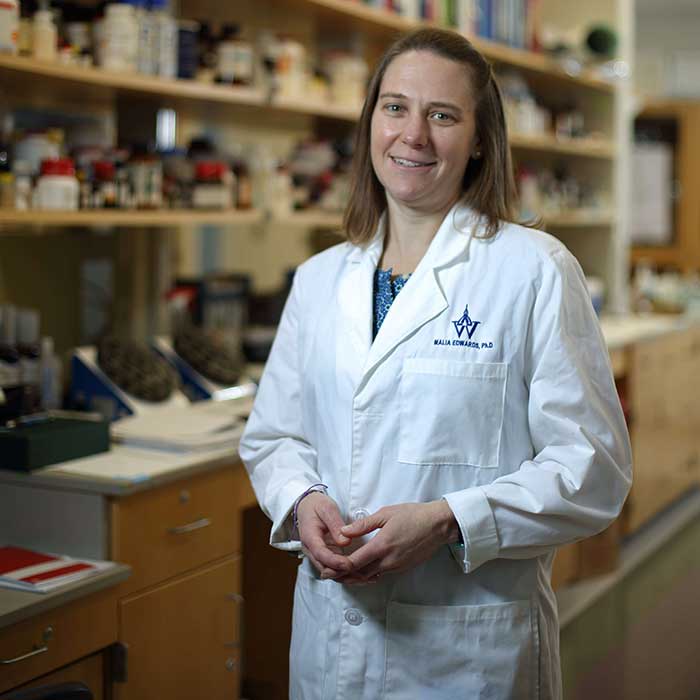 Malia Edwards
Fueling many new advances is Wilmer's Center to End Blindness. The center was established in spring 2021, when Sanford and Susan Greenberg called on Wilmer and its philanthropic community to raise $100 million to end blindness. This audacious goal could only be accomplished at Wilmer.
“Our goal is to eliminate eye diseases one by one,” says McDonnell. Much of the center’s budget is targeted to training and research, and McDonnell notes that new technology represents an area for particular optimism. Current projects include the use of implants in the brain to stimulate the visual cortex to allow patients to “see” again.
“While that work is still in the early stages, it’s already showing the tremendous promise of the center’s ability to end blindness no matter the cause,” McDonnell says.
Very often, real progress begins at the smallest of scales. Consider the work of Malia Edwards, Ph.D., who combines advanced medical imaging and molecular investigation to explore a lesser studied cell type — retinal glia cells, known as Müller cells — and their role in diseases such as age-related macular degeneration (AMD).
Müller cells were once overlooked and considered only support cells. “Retinal glial cells may not be the primary defects in [most] conditions, but they are critical players,” Edwards says. Her research on Müller cells includes detailed microscopic analyses of human donor eyes and comparison of medical imaging with molecular insights from the lab.
“We need [to see] all these cells talking together and working together to truly understand and treat retinal diseases,” Edwards says of her long-term goal for her work.
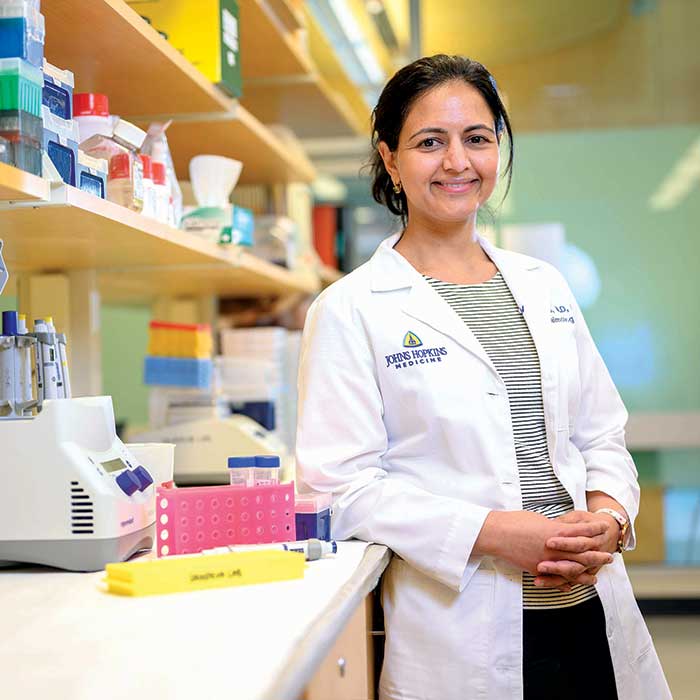 Mira Sachdeva
Just down the hall from Edwards’ lab, Mira Sachdeva, M.D., Ph.D., the Wilmer Rising Professor of Ophthalmology, studies the effects of diabetic retinopathy on neurons. Often, she says, by the time retinopathy is diagnosed, the neurons are already damaged. Understanding early changes is crucial to prevent vision loss. Sachdeva is looking for the causes and biomarkers of retinal neurodegeneration in patients with diabetes, focusing on how diabetes damages the retinal ganglion cells — the same cells that are lost due to glaucoma. Through work with her collaborators at the Institute for Cell Engineering at Johns Hopkins, she determined that synaptic regulatory proteins in the eye decline in patients with diabetes before visible retinal damage occurs. Sachdeva hopes to investigate these proteins as markers to track early disease progression and as possible targets for new treatments.
“We have a really good handle on treating the blood vessel problems, but we have zero way of protecting the retinal neurons,” Sachdeva explains. “That’s what ultimately leads to irreversible vision loss, not only in diabetes but many other eye conditions.”
As he surveys the vast array of research unfolding each day across Wilmer, McDonnell brims with hope. “Rather than trying to predict the next big breakthrough, our strategy is to explore all possibilities,” McDonnell says. “By fostering an environment where our researchers are free to explore their deepest intuitions and collaborate openly with experts from complementary fields, Wilmer will be at the cutting edge of eye care for the foreseeable future.”