
A Visionary Legacy
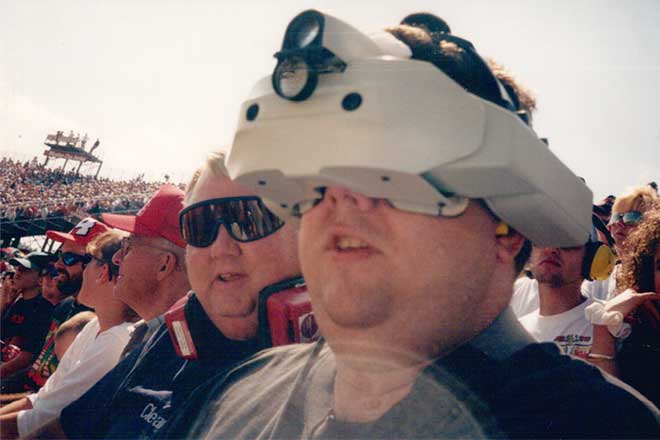
Tommy Korn, with the assistance of the Low Vision Enhancement System, was able to attend NASCAR races and watch the cars go by.
As the Wilmer Eye Institute, Johns Hopkins Medicine celebrates its centennial in 2025, it also reflects on a remarkable chapter in its history: one that brought together the worlds of medicine, aerospace and veteran care in a shared mission to restore independence to those living with severe vision loss.
Arnall Patz, M.D., Wilmer’s director in the 1980s, hoped to offer his patients a device that would compensate for their severe vision loss. At his request, Wilmer researchers collaborated with NASA and the U.S. Department of Veterans Affairs to create the Low Vision Enhancement System (LVES). Introduced commercially in 1994, LVES featured a battery-powered headset with a black-and-white video display and three built-in cameras. Two of the cameras gave a wide, 60-degree view through both eyes, helping the user get a sense of their surroundings. The third, center camera provided a zoomed-in, adjustable view straight ahead to make details easier to see.
For patients, it meant a chance to read, recognize faces and move through the world with greater confidence. The headset offered a view of the user’s surroundings equivalent to the image on a 5-foot television screen 4 feet away. The user was able to manipulate magnification and contrast within the device.
Those interested in using the device could come to Wilmer to test it out over a three-day training course — under the direction of Robert W. Massof, Ph.D., one of the developers of LVES — before deciding whether to make the $3,000 purchase. Hundreds of patients did so. Among them was Tommy Korn. Diagnosed with retinitis pigmentosa at age 13, he received the LVES in July 1995, 13 years later.
The system was originally designed for patients with age-related macular degeneration and other conditions that cause central vision loss — not for those with retinitis pigmentosa, a common inherited disease that leads to the gradual and permanent breakdown of the eye’s light-sensing cells. However, during an annual checkup at Wilmer, when Korn’s father asked if there were any devices that could help with his son’s low vision, LVES was suggested, as its constant light level and high contrast inside the headset might be able to provide Korn with a benefit that no other device could bring.
Korn tried a prototype of the device in a conference room and was able to see his mother, which he was unable to do without the device. He described it as a portable closed circuit television system, and more importantly, it was the only device that ended up working for him. “It was a revolutionary unit,” he says. “There was nothing like this.”
With the help of the LVES camera’s ability to work at very low light levels and the user’s ability to control contrast, Korn was able to see at night when he otherwise hadn’t been able to. When riding in a car, he could see signs and lines on the road. He took the device to NASCAR races and abroad on trips — including one to Germany, where he appeared on a segment of the television talk show Schreinemakers Live to demonstrate the device. Korn used his LVES for about two decades before his vision deteriorated to the point where the machine was no longer useful for him.
LVES was commercially available for about five years. Today, its capabilities can be found within head-worn electronic magnifiers that are a fraction of its size and weight. What looked like something out of a science fiction film — a head-worn video system with adjustable zoom, contrast and a panoramic view — became a symbol of what interdisciplinary innovation could achieve.
The Wilmer Centennial: The Low Vision Enhancement System
In 1994, a collaboration between the Wilmer Eye Institute, NASA and Honeywell led to the development of a revolutionary device that allowed people with very low vision to see. A precursor to today’s wearable optics, the Low Vision Enhancement System represented one of the first collaborations between government, private industry and academia.
