
Three New Rising Professorships Showcase Wilmer's Rising Talent
With support from Wilmer’s Rising Professorship Program, these young researchers are working to advance high tech imaging, AI in ophthalmology, and rehabilitation for patients with low vision.
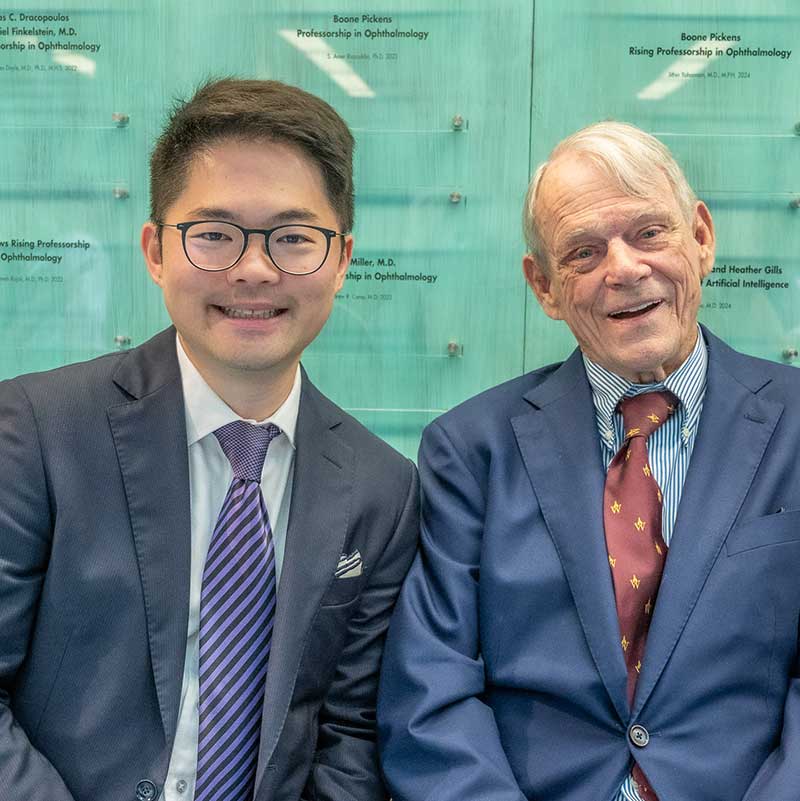
T.Y. Alvin Liu and James Gills
In September of 2024, the Wilmer Eye Institute, Johns Hopkins Medicine, celebrated T.Y. Alvin Liu, M.D., as the inaugural recipient of the James P. Gills Jr., M.D., and Heather Gills Rising Professorship of Artificial Intelligence in Ophthalmology. The rising professorship is one of three recognized last fall.
Funding for the AI in ophthalmology rising professorship is part of a larger gift that also established in 2024 the James P. Gills Jr., M.D., & Heather Gills Artificial Intelligence Innovation Center at Wilmer. James Gills completed a residency at Wilmer in 1965 and has since made gifts to the institution totaling more than $20 million. Liu, an associate professor who completed his residency and retina fellowship at Wilmer in 2018 and who has been a driving force in research and development of AI applications in ophthalmology, will be the center’s inaugural director.
AI-related projects at Wilmer encompass everything from precision medicine to surgical training to drug discovery, with many patients and faculty members benefiting from the unique, collaborative environment at Johns Hopkins.
“What sets Wilmer apart from other academic eye centers is the breadth of projects using artificial intelligence,” says Liu. “We also have a deep bench of investigators involved in the entire life cycle of AI projects, from fundamental model design to translating data into useful AI clinical decision tools, and from implementation of FDA-approved AI tools on a health system level to the ethical and societal considerations of AI technology.”
Since 2020, Johns Hopkins Medicine has deployed an autonomous AI screening device, approved by the Food and Drug Administration (FDA), for diabetic retinopathy in primary care physicians’ offices, with Wilmer playing a pivotal role in the implementation process. A research team at Wilmer led by Liu studied the effectiveness of these devices and concluded that they improve screening rates, access to care and health equity for underserved populations.
“Fortunately, we’re living in an era in which technology provides a catalyst to solve some of the toughest challenges to curing and preventing blinding eye diseases,” says Peter J. McDonnell, M.D., Wilmer director and the William Holland Wilmer Professor of Ophthalmology. “Thanks to the generosity of people like James and Heather Gills, we’re harnessing this technology to extend our reach and our impact.”
OVERCOMING SENSORY DEFICITS
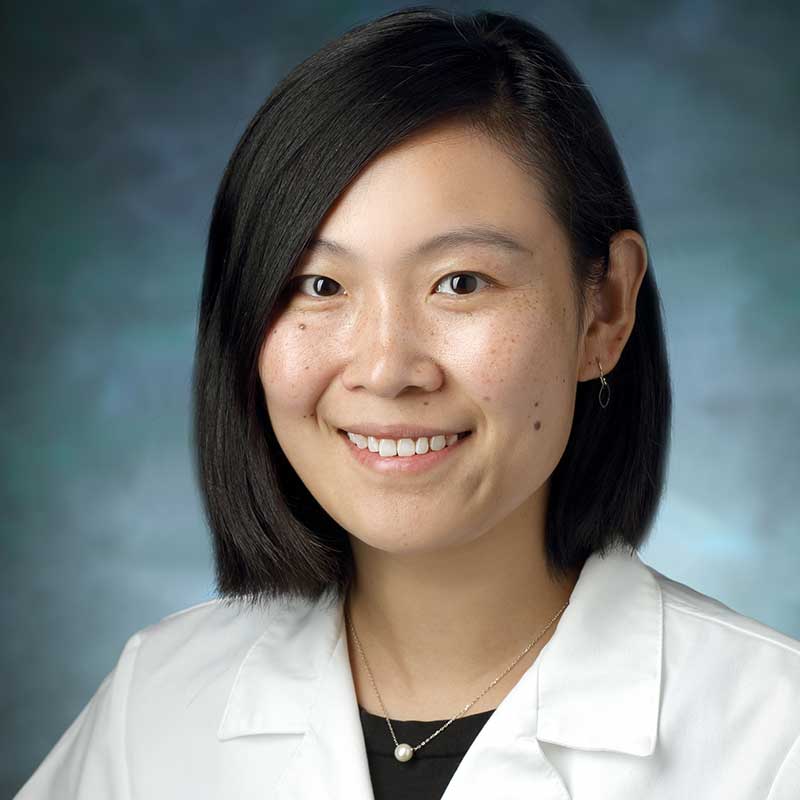 Yingzi Xiong
Yingzi Xiong, Ph.D., was named the inaugural Barbara E. Simerl Rising Professor of Low Vision last October.
“It’s thrilling and I’m deeply honored,” Xiong says of the appointment, which supports her work at the Lions Vision Research and Rehabilitation Center at the Wilmer Eye Institute, Johns Hopkins Medicine.
The funding will allow Xiong to build on the groundbreaking research at her XYZ Sensory Lab. The research is aimed at improving and systematizing rehabilitation for patients with low vision and other sensory deficits.
“There is a lot of exciting science we’re doing,” says Xiong. “There are incredible technical advances that can help people [with low vision] read again or navigate their environments, using everything from ‘smarter’ smartphones to artificial intelligence.”
To reach more people with low vision, Xiong recently launched a vision accessibility initiative. “The people we are studying are among the most reluctant to participate,” she says. “Perhaps they can’t drive, or they are intimidated by public transportation.” The initiative will provide transportation for patients and even make home visits by clinicians possible. “I want more [patients with] low vision to realize how important they are — that we can’t advance the research and rehabilitation for low vision without them.”
Xiong says funding for the professorship was an unexpected and exceptionally generous gift from a grateful patient. Barbara Simerl, who died June 26, 2022, at age 102, was devoted to her Wilmer doctor, Judith Goldstein, O.D., the Dr. Arnall Patz Endowed Professor for the Lions Low Vision Center, and to Goldstein’s work as director of the Lions Vision Research and Rehabilitation Center.
Goldstein and her team helped Simerl adapt to her declining vision and learn to use tools that kept Simerl active and engaged in her many hobbies and activities — from reading to knitting to hosting daily afternoon tea. In the process, Simerl and Goldstein became good friends.
Goldstein says she is grateful for Simerl’s faith in the low vision program, and for her gift that “will enable us to recruit young clinician-scientists and researchers dedicated to the field and to further the work of identifying and developing new treatment strategies to improve our patients’ lives.”
MAKING HIGH-TECH IMAGING WIDELY ACCESSIBLE
 Ji Yi
Ji YiA leader in the field of ophthalmic imaging, bioengineer Ji Yi, Ph.D., was named a Boone Pickens Rising Professor of Ophthalmology in November.
“I am honored and excited,” says Yi. He says the professorship’s substantial funding and institutional support will help him realize his dream of moving groundbreaking imaging technologies that he has pioneered out into the world.
Some of his most exciting work has been, as a postdoctoral fellow, developing a new engineering approach to make visible light optical coherence tomography — which produces 3D images of the retina in detail once thought impossible — available for practical use by clinicians. The process is noninvasive, so it is very patient-friendly. And it allows ophthalmologists to observe subtle changes in retinal cells, helping them detect and perhaps more effectively treat retinal diseases (such as age-related macular degeneration, diabetic retinopathy and inherited disorders like retinitis pigmentosa) in their early stages. Other imaging innovations in Yi’s repertoire are also helping researchers better understand and develop new strategies for preventing, treating and even reversing eye disease.
“If we can help even one patient, it means everything. Having said that, my dream is to make our work available to clinicians everywhere,” says Yi, who oversees a team of more than a dozen researchers in his lab and collaborates with colleagues including Amir Kashani, M.D., Ph.D., a retina specialist and surgeon at the Wilmer Eye Institute, Johns Hopkins Medicine. Kashani holds the Boone Pickens Professorship in Ophthalmology.
Last year, Yi — who joined Wilmer in September 2020 — was awarded $1.25 million by the Maryland E-Nnovation Initiative Fund, a state Department of Commerce program that encourages basic and applied scientific and technical research through grants to Maryland universities and colleges. The grants match privately raised funds, such as the $1.5 million Boone Pickens Rising Professorship endowment.
“Everything just came together,” Yi says.
Yi never met T. Boone Pickens, the storied oil magnate and philanthropist who died in 2019, but last year, he met Pickens’ daughter, Liz Cordia, a member of the Wilmer board of governors who is helping to continue her father’s legacy through the T. Boone Pickens Foundation. The foundation has made gifts to Wilmer totaling more than $28 million, including a $20 million gift announced in August 2023.
A grateful Wilmer patient, Pickens was able to retain his vision, despite macular degeneration, until his death at age 91, thanks to a care team that included Walter Stark, M.D., the pioneering Wilmer ophthalmologist who died last year at age 81. Stark was named the inaugural Boone Pickens Professor of Ophthalmology in 2005.
Stark and Pickens “became fast friends,” said Cordia in a 2024 article announcing the $20 million gift that helped create the rising professorship. “Walter Stark, like my dad, had deep Oklahoma roots,” she said.
Yi says he is incredibly moved by the generosity of Cordia and her family.
“I met her last year and she has such passion, such curiosity about new technologies and how they can impact clinical practice,” he says. “I am just so grateful for Liz and her family, and for their commitment to advancing research here at Wilmer.”
For Clinicians Clinical Connection
Clinicians, discover the latest in research and clinical innovation from Johns Hopkins experts. Access educational videos, articles, CME courses and other resources from our world-renowned institution.