
The Wilmer Residency: A ‘Jet-Fueled Liftoff’
Throughout its 100-year history, Wilmer has provided one of the nation’s top ophthalmology training programs, renowned for the quality of its faculty mentors.
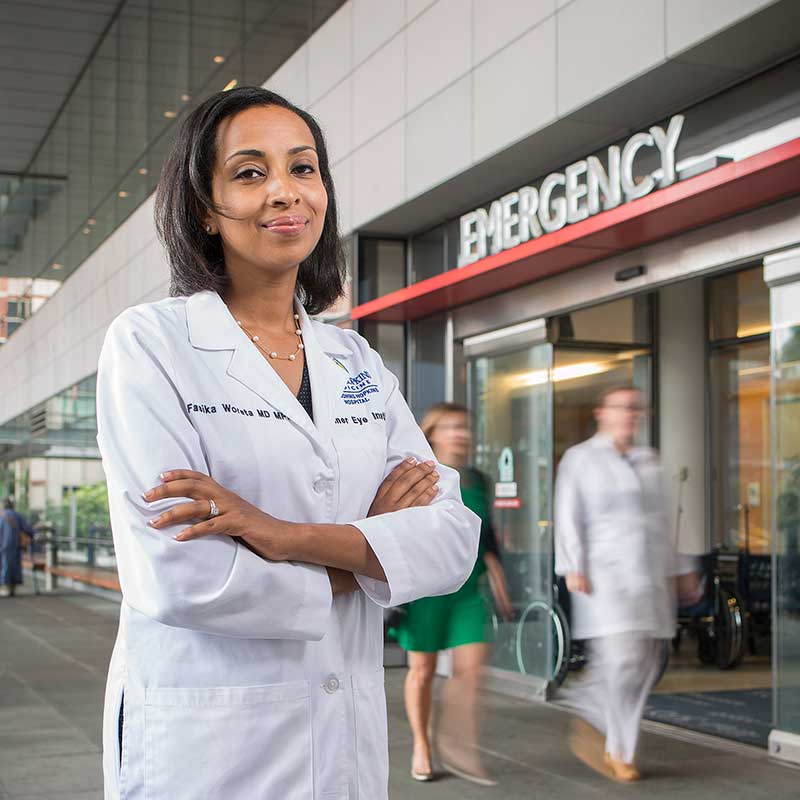
Fasika Woreta
Strolling through the “residents hall” of the Wilmer Eye Institute, Johns Hopkins Medicine, at The Johns Hopkins Hospital, visitors gaze upon photo after photo of Wilmer’s residency classes — a sea of young ophthalmologists in training, all on the cusp of influential careers.
“I remember as a resident at Wilmer, looking in awe at the ‘wall of fame’ and at the generations of Wilmer residents and assistant chiefs of service who came before me,” says Fasika Woreta, M.D., M.P.H., the Eugene de Juan, Sr., M.D., Professor of Ophthalmic Education and director of Wilmer’s ophthalmology residency program. “Many went on to become internationally recognized leaders in our field. Having trained at Wilmer myself, and training others in these hallowed halls, reinforces for me the history and continuity of this amazing place.”
Indeed, throughout its 100-year history, Wilmer has been recognized for providing one of the nation’s top ophthalmology training programs — a program renowned for the quality of its faculty mentors and for its relatively small size, which allows each trainee to receive unparalleled mentoring and guidance.
“My Wilmer residency was a phenomenal, jet-fueled liftoff for the trajectory of my clinical career, as well as my career in academic medicine,” says trailblazing retinal surgeon-scientist Julia Haller, M.D., Wilmer’s first female chief resident (class of 1985), who enjoyed a standout career at Johns Hopkins before joining Wills Eye Hospital in Philadelphia in 2007 as ophthalmologist-in-chief.
Among the comprehensive array of opportunities that comprise the Wilmer ophthalmology residency today:
- The Patient Access Center for the Eye (PACE), formerly the General Eye Service, is where Wilmer residents follow their own patients throughout the three years of their residency — honing exam skills, performing surgeries and pursuing advanced pathologies with gradual autonomy.
- Rotation through eight subspecialty clinics, many of which are the largest such programs in the United States.
- Wilmer’s location within The Johns Hopkins Hospital, home of the region’s only designated eye trauma center, means residents can see one of the highest volumes of eye trauma cases in the country. And they learn how to manage complex ocular injuries associated with facial burns at the Johns Hopkins Burn Center at Johns Hopkins Bayview Medical Center.
- World-class research facilities are located in the Robert H. and Clarice Smith Building, which offers five floors of collaborative research space and an ophthalmologic pathology lab. Each resident receives funding to conduct research, which can unfold at one of Wilmer’s dozen-plus research centers, including the Center for Nanomedicine, the Center for Stem Cells and Ocular Regenerative Medicine and the Dana Center for Preventive Ophthalmology, a leader in global blindness prevention efforts.
THE OR OF THE FUTURE
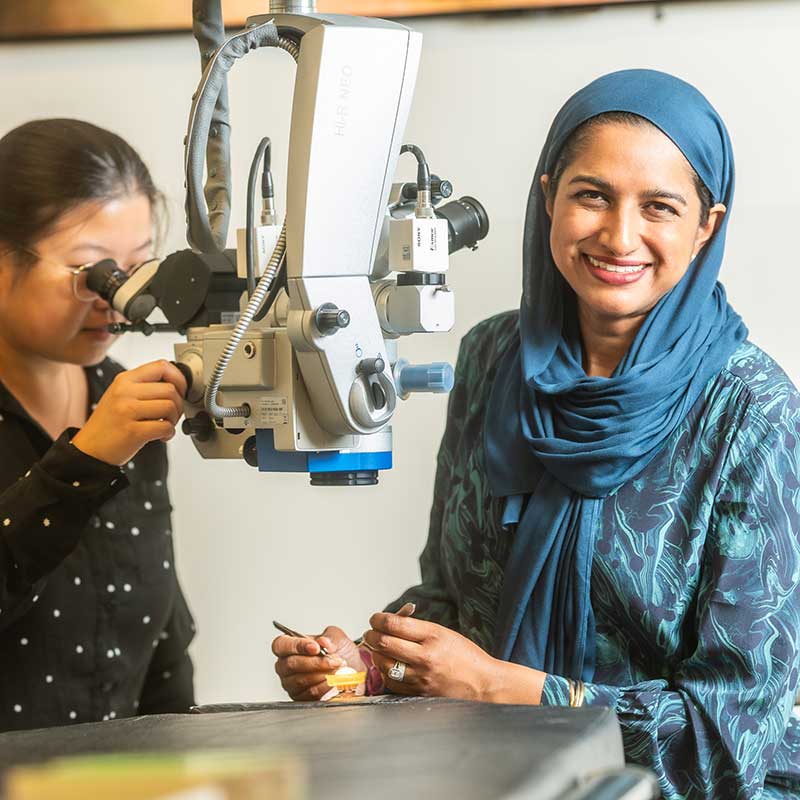 Shameema Sikder
During the first two years of their Wilmer training, residents hone their microsurgical skills at the high-tech Center of Excellence for Ophthalmic Surgical Education and Training (OphSET), which was created at Wilmer in 2015 under the direction of Shameema Sikder, M.D., the L. Douglas Lee and Barbara Levinson-Lee Professor of Ophthalmology.
“We wanted to tap into the latest advances in technology to improve the surgical training experience for residents and fellows, and for practicing surgeons who come here to train,” explains Sikder.
OphSET is home to a six-station state-of-the-art wet lab. “We call this our ‘operating room of the future,’” Sikder says. The wet lab features actual OR microscopes with high-definition, 3D projection and recording capacity. “We also have a revolutionary surgical simulator with tactile feedback,” Sikder notes.
Another key element of OphSET, says Sikder, is an innovation and demonstration lab where Wilmer surgeons, Johns Hopkins engineers and industry partners collaborate to rapidly advance surgical techniques and technology. Sikder is pioneering the use of artificial intelligence to improve how surgeons are trained. She and her team developed Circlage, a cloud-based platform that incorporates surgical videos and artificial intelligence to assess a surgeon’s performance. Their goal: to elevate surgical care globally.
Key to Wilmer’s success in training the next generation of surgical innovators, says Sikder, is the faculty’s commitment to sharing its wisdom through the time-honored educational model of see one, do one, teach one.
That faculty commitment to mentoring excellence permeates every aspect of the residency experience at Wilmer, says Divya Srikumaran, M.D., the Walter J. Stark, M.D., Professor of Ophthalmology (class of 2009). Srikumaran was vice chair of education from 2017-2024, when she became chief of the Division of Cornea, Cataract and External Diseases.
Once a Wilmer resident herself, Srikumaran says “there’s no greater opportunity to have an impact in ophthalmology, overall, than in training the future leaders of ophthalmology.”
OPTOMETRY RESIDENCY DEBUTS
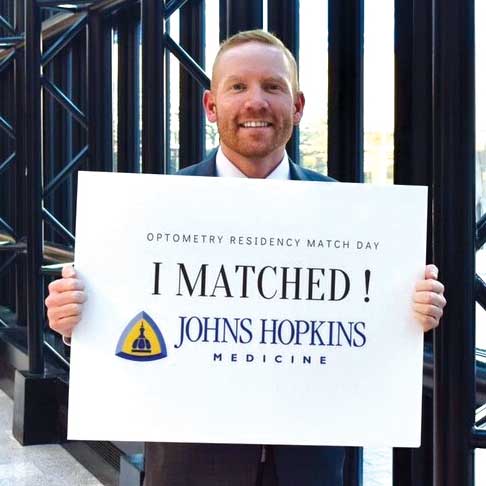 Bradley Salus
In July 2023, the Wilmer Eye Institute, Johns Hopkins Medicine, welcomed its first optometry resident, Bradley Salus, O.D., to a new program that prepares residents for careers in primary care optometry and provides an additional teaching opportunity for Wilmer’s optometry faculty.
During his one-year residency, Salus worked closely with Amanda Crum, O.D., Lee Guo, O.D., and Bryce St. Clair, O.D., M.P.H., seeing patients and receiving specialty training in contact lens evaluations for a broad array of medical indications.
Crum says an advantage of participating in a residency program rather than entering private practice after optometry school is that residents obtain high-volume exposure in their specialty during the one-year program. “If you went out into private practice, you might eventually be exposed to all of those same cases, but it could take you five or 10 years to get to that level of efficiency,” she says.
In addition to providing clinical care, optometry residents participate in Grand Rounds with their ophthalmology residency peers at Wilmer, and Grand Rounds and a journal club with optometrists. They also make presentations at the local, state and national levels.
“Our goal for this training program is that we will train the best and brightest optometry residents each year and hopefully keep many of them at Wilmer,” says Wilmer Director Peter J. McDonnell, M.D., the William Holland Wilmer Professor of Ophthalmology.
That was the outcome for Salus. “The residency cemented my interest in a career path in an academic medical center,” notes Salus, who completed the program in July 2024. The following month, Salus joined the Wilmer faculty in the comprehensive division, where he provides specialty contact lens care, glaucoma care and routine medical eye care at Wilmer’s Bethesda and Frederick satellite clinics.
PREPARING TOMORROW’S HEALTH CARE LEADERS
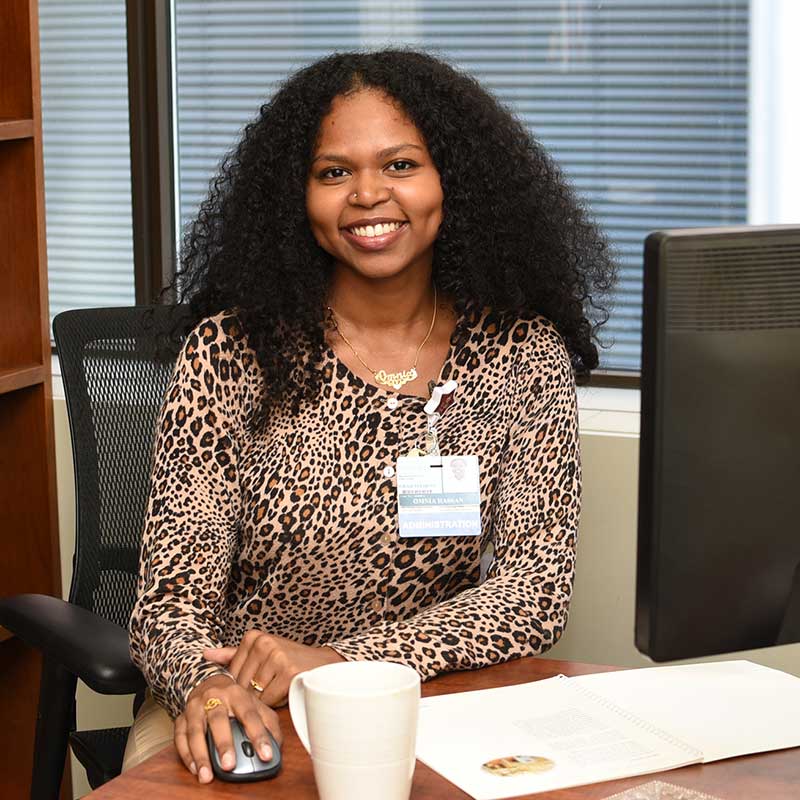 Omnia Hassan
Given the complexities of our nation’s health care system, it’s more important than ever to equip future health care executives with the skills they need to lead adeptly, says Wilmer administrator Cathy Kowalewski, M.B.A.
That’s why she is inspired to serve as a Wilmer mentor for the Master of Health Administration program offered by the Johns Hopkins Bloomberg School of Public Health. Participants first complete one year of full-time coursework at the Bloomberg School before moving on to an 11-month compensated administrative residency. The residency gives them hands-on experience and the expertise to lead in hospitals and health care systems, the health insurance industry and consulting firms.
Over the years, Kowalewski says, “we’ve found our administrative residents to be excellent partners in their work on complex projects and observational opportunities.”
Omnia Hassan, who is nearing completion of her M.H.A. residency experience at Wilmer, has worked closely with Kowalewski and co-mentor Rahul Shah, also an M.H.A. program graduate.
Hassan has participated in meetings on topics ranging from the physician compensation model to prospective faculty interviews and planning for Wilmer’s centennial celebration. Many of her tasks are project-based. For example, she has analyzed the efficiency and flow of Wilmer’s East Baltimore clinics with the goal of optimizing the patient experience.
“I’ve come to realize the nuances more and more as I work through this project and understand how each clinic is different,” Hassan says. “Hopefully we can come up with something that will work well for everyone.”