
Steady Giving for Sickle Cell Disease
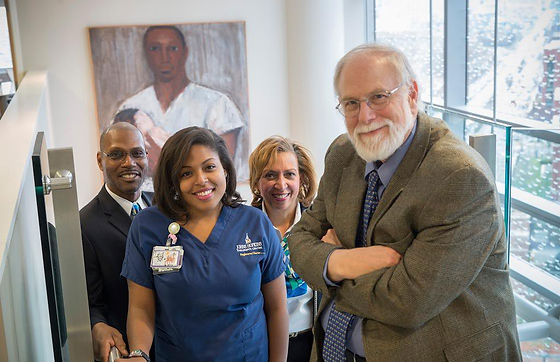
Leander Barnhill, Lea Armstead, Andrea Armstead and George Dover
In 1991, Leandra “Lea” Armstead was diagnosed as a newborn with sickle cell disease, a condition that can lead to complications such as stroke and sudden episodes of intense pain. For Lea, the sickle-shaped cells would often clump together in her lungs, which can cause acute chest syndrome. She had her first pain crisis in her leg at age 2, and she was hospitalized for about a week twice each year in Washington, D.C., close to her family’s Maryland home.
When Lea started college at Georgetown University in 2009, her pain crises became more frequent, says her mother, Andrea Armstead. So, Lea became a patient at Johns Hopkins Children’s Center. As part of her treatment, James Casella, chief of pediatric hematology, prescribed hydroxyurea, a drug that helps red blood cells stay round and flexible so they can move through the body (see more on p. 18).
“The medication dramatically reduced her pain crises and allowed her to graduate with honors from Georgetown’s nursing school,” Armstead says.
Lea went on to work as a nurse in the Johns Hopkins pediatric intensive care unit. She also earned a master’s degree from the Johns Hopkins University School of Nursing. Today, she is doing well as a new mom and a family nurse practitioner in neurology at Inova in Fairfax, Virginia.
Even though Lea didn’t begin treatment at Johns Hopkins until she was a young adult, her mother has been connected to the Children’s Center for decades. In 1992, Andrea and her husband, Leander Barnhill, founded the Armstead-Barnhill Foundation for Sickle Cell Anemia (curesicklecell.com), an entirely volunteer-run organization that raises most of its funds from individual donors. The foundation supports research and raises awareness about sickle cell disease. Armstead remembers flipping through her phone book’s yellow pages to search for their first grantees and found George Dover, a sickle cell specialist at the Children’s Center. Dover, who helped pioneer the use of hydroxyurea to treat sickle cell disease and later became the Children’s Center director, was the foundation’s first award recipient.
Since then, the foundation has given nearly $150,000 over 30-plus years to the pediatric hematology department at the Children’s Center. The contributions have supported clinical research on the neurovascular complications of sickle cell disease, a laboratory project focused on developing small nucleic acid molecules to inhibit sickle cell hemoglobin and prevent sickling (which led to a patent for these molecules), and a clinical trial to study whether hydroxyurea can prevent brain injuries, a complication of the disease.
“We used this money for seed projects to help us try something new or augment something that looked promising,” Casella says. “These have been very valuable funds.”
In 2023, the foundation’s support also led to creation of the pediatric hematology social work fund at the Children’s Center, which meets a critical need for some of the department’s 500 patients and their families, says social worker Beth Merz. The fund provides financial resources for families with social circumstances — including food insecurity, lack of transportation and homelessness — that might prevent them from accessing crucial care.
“Being on the verge of eviction or not having electricity or any food security is going to dramatically impact the health of the patient and the whole family,” Merz says. “But through this fund, we can help prevent that by paying a month’s rent or all or part of a BGE bill, or buying gas cards for patients who live hours away so they can afford to come here. These are huge things in terms of the stability of families.”
