
Staying the Course
Each day is a grinding challenge for young patients with sickle cell disease and their families. Johns Hopkins Children’s Center hematologists are there every step of the way — offering support and the latest treatments, many pioneered right here at Johns Hopkins.
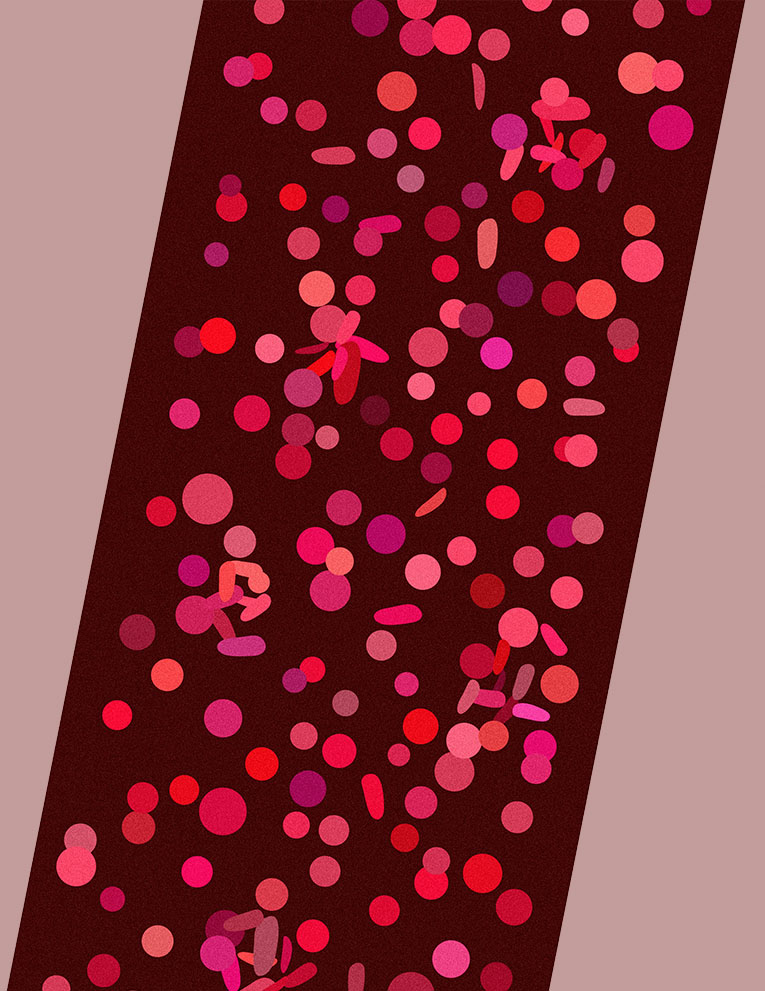
Illustration by Greg Mably
On a late winter afternoon, a brother and sister are at the sickle cell clinic at Johns Hopkins Children’s Center with their mother. Pediatric hematologist Emily Rao, has been caring for the siblings for years.
It’s the family’s first appointment since last summer, although both children were hospitalized the previous month for flu. As Rao chats and asks questions, she scratches out a to-do list for herself on a sheet of paper.
Fill out paperwork for prescriptions the older child needs to even out the iron load in her blood caused by transfusions. Submit an updated Family and Medical Leave Act form for a too-busy mom who needs time off for the many appointments her children require. Schedule some of those appointments: eye tests, to learn if the children are developing retinopathy, a frequent complication of sickle cell disease (SCD); conventional transcranial Doppler tests, to predict risk of stroke, another all too common outcome.
SCD, characterized by misshapen red blood cells that can clump together to block blood flow, “involves just about every organ system in the body,” says Rao. Though the severity varies by patient, the clumped cells typically cause debilitating pain crises in the short term, and organ damage over time.
The siblings at the sickle cell clinic are among 500 young patients who are finding help navigating those challenges from the six-doctor pediatric hematology team at Johns Hopkins Children’s Center, helmed by James Casella. A member of the Johns Hopkins faculty since 1983, Casella has led studies showing that blood transfusions and the chemotherapy drug hydroxyurea prevent strokes and silent cerebral infarctions — which are detected on a brain scan but show no symptoms — among young patients with SCD.
 Christopher Gamper
Casella joins a line of distinguished Johns Hopkins clinicians-researchers — stretching back to longtime Children’s Center Director George Dover — who have pioneered advances that dramatically improved life for children living with this agonizing inherited blood disorder. And now, pediatric hematologist Christopher Gamper is leading a push to make curative bone marrow transplants accessible to more young patients.
Still, the disease’s many cruelties pose decadeslong, day-to-day challenges for patients and their families, and Johns Hopkins clinicians do everything they can to guide them through a complex dance of medications, screenings and symptom management. They also help parents navigate insurance and prepare children for the day they will transition to adult care.
“Over time, we get to know the families,” Rao says. “We are there for the good days and the bad days.”

Like Being Hit by a Baseball Bat
Each year, an estimated 2,000 babies across the United States are diagnosed with sickle cell disease. The vast majority, about 90%, are Black or African American, and 3% – 9% are Hispanic or Latino.
For parents, the diagnosis — gleaned through a universal blood test — can be devastating.
Life expectancy is about 20 years shorter for people who have SCD than for people without it. And complications — including acute chest syndrome (during which sickle cells block blood vessels in the lungs) and stroke (when they block other blood vessels) — pose an ever-present source of anxiety.
“It can affect the kidneys, the heart, the bones — basically, wherever your blood goes,” says Dana Furstenau, a member of the hematology team at the Children’s Center. “That’s why sickle cell disease is so awful.”
One former Children’s Center patient, Lea Armstead, now 33, was diagnosed with SCD as a newborn, and didn’t find relief until she became a Johns Hopkins patient as a teen and started taking hydroxyurea.
Lea describes her pain crises like this: “It can be any part of your body, but most common are arms and legs. It feels like severe stabbing pain, like you’re being hit repeatedly by a baseball bat all over your body. It’s like childbirth, but honestly, it’s worse. It’s scary because you never know when it’s going to happen.”
Patients do best when they stay hydrated, minimize stress, eat well and get enough sleep.
“I always think of myself as being really high-maintenance,” says Armstead, who lives in Arlington, Virginia. “Can’t be too hot or too cold. Can’t be too stressed. Can’t get too mad. I have to get plenty of sleep. In theory, it’s all possible, but life is also life. It’s hard to get eight hours of sleep every night and go on walks and eat perfectly healthy. I have a 6-month-old and a full-time job as a nurse practitioner.”
Armstead began treatment at the Children’s Center during her college years, but pediatric patients typically start visiting the Johns Hopkins Comprehensive Sickle Cell Center at about 2 months of age, says Casella.
In a patient’s early years, the Johns Hopkins sickle cell team focuses on teaching parents how to ward off the worst symptoms. A typical regimen includes twice-daily doses of penicillin to prevent potentially fatal infections, and hydroxyurea to improve blood cell quality. Because run-of-the-mill fevers can morph into life-threatening infections, parents learn to seek hospital care if their child’s temperature spikes.
Some patients, particularly if they have already had strokes, go to the hospital once or twice each month for outpatient blood transfusions that remove some of their sickled blood and replace it with healthy donated blood. Patients also benefit from regular screenings to monitor stroke risk and damage to the retina and other organs. “It’s a lot to ask of families,” says Rao.
It feels like severe stabbing pain, like you're being hit repeatedly by a baseball bat all over your body. It's like childbirth, but honestly, it's worse. It's scary because you never know when it's going to happen."
Lea Armstead
‘The Go-to Place’
SCD was first described in 1910 by Chicago physician James Herrick, who noticed the misshapen red blood cells in a 20-year-old patient from Grenada. He gave the disease its name because the cells had a sickle shape.
Real progress in understanding and treating the disease began in the 1970s, when the National Institutes of Health’s National Heart, Lung and Blood Institute (NHLBI) launched the Cooperative Study of Sickle Cell Disease, a longitudinal look at SCD across 23 health centers.
One of the project’s early studies, in the mid-1980s, was stopped because it was so effective. It found that penicillin, given from ages 4 months to 5 years, could prevent potentially fatal infections in patients with SCD.
As the value of early interventions became clear, Dover, a pediatric hematologist who became interested in SCD shortly after joining the Johns Hopkins staff in 1972, successfully advocated for universal blood screenings in Maryland.
Across the state, when newborns were found to have SCD, Dover and his colleagues contacted the families, even those not connected with Johns Hopkins, to counsel them about how to care for their children. As a result, Johns Hopkins Children’s Center became “the go-to place for the sickest patients,” says Dover, who retired in 2016.
One reason screenings are so important, Dover notes, is that babies are born without symptoms, because fetal hemoglobin doesn’t sickle. It even inhibits sickling.
Working closely with his adult-side Johns Hopkins counterpart, Sam Charache, sometimes known as “Sickle Sam,” Dover found that two chemotherapy drugs could promote development of the nonsickling fetal hemoglobin.
In 1983, they collaborated on a paper in Proceedings of the National Academy of Sciences, which showed that the anticancer drug 5-azacytidine turned on fetal hemoglobin and therefore kept cells from sickling.
Twelve years later, Charache, director of The Johns Hopkins Hospital’s hematology lab from 1979 – 1995, and Dover were the lead authors of an article in The New England Journal of Medicine demonstrating that a less toxic chemotherapy drug, hydroxyurea, was just as effective as 5-azacytidine in decreasing the frequency of pain crises in patients with sickle cell disease.
But it took nearly two decades for the NHLBI to officially advance hydroxurea as the standard of care for pediatric patients. In 2014, the institute recommended offering hydroxyurea to patients starting at 9 months of age.
However, notes Furstenau, hydroxyurea use by children who have sickle cell disease remains low across the country, with current Johns Hopkins research showing that about 30% of the children by the age of 2 and 40% by age 3 are taking the medication. “At Hopkins, we’re probably above that number,” she says, “but we’re definitely not as high as we would like.”
Furstenau has undertaken research to figure out why.
One reason appears to be that parents simply don’t want to give their children a chemotherapy drug, even at low doses, she says. Though hair loss is rare, the medication can interfere with fertility. It can also lower white blood cell counts, requiring frequent monitoring, says Furstenau.
“We’re finding promising results in asking parents, ‘If hydroxyurea were effective in preventing brain complications in your child, would you take it?’ That might be the key to convincing people to start hydroxyurea early,” she says.
Stroke risk is an unfortunate reality for patients with SCD, notes Casella. “If you don’t do anything, one out of nine kids with sickle cell disease will have a stroke by age 21.”
Casella, who is chief of pediatric hematology, joined the Johns Hopkins hematology team as a postdoctoral fellow in 1979, and has led or participated in many studies aimed at reducing the risk of stroke in patients with SCD.
He was among the leaders of the BABY HUG study, the first randomized trial of hydroxyurea for infants with SCD.
He also co-led the Silent Cerebral Infarct Transfusion (SIT) Trial, published in The New England Journal of Medicine in 2017, which showed that blood transfusions can dramatically reduce the risk of silent cerebral infarction and stroke in children with SCD. The SIT study — Casella was senior author — found that giving transfusions to children ages 5 – 15 who had already suffered a silent cerebral infarct (a “silent stroke”) could avoid subsequent infarcts.
As is often the case with SCD, advances come with caveats. The transfusions, which basically dilute the sickled blood, are time-consuming, and they can contribute to iron overload in the blood, which requires medications called chelators (such as deferasirox) to reduce the iron load. But the daily regimen of pills and monitoring can be daunting.
In an exam room, a mother says her 5-year-old sometimes spits out his pills, and a 12-year-old girl promises to stick to her regimen, but she’s been saying that for years. Rao understands, and she offers solutions: for the younger child, a switch from pill to liquid, and for the older child, suspending hydroxyurea for the time being, even though it means putting on hold the plan to move away from transfusions.
Though painful trade-offs and day-to-day hassles are still the norm for patients with SCD, "there's room for optimism."
James Casella
Expanding the Pool
Some families are now considering bone marrow transplantation, which replaces the faulty blood-forming cells (stem cells) with healthy ones from a donor, allowing the body to produce normal red blood cells with healthy hemoglobin.
Gene therapy is another option at some centers. Although patients are not currently receiving gene therapy at Johns Hopkins, research efforts are underway in pediatric hematology to improve gene therapy for SCD.
Over the past 25 years, 38 pediatric patients with SCD at Johns Hopkins have received curative bone marrow transplants, most with remarkable results, says Gamper. Two of his patients, previously so ill that they spent hundreds of days in hospital beds, are now disease-free and in such good health that they are serving in the military, he says.
Until now, a major obstacle with bone marrow transplants, Gamper says, was finding donors with matching tissue types in order to reduce the risk of graft-versus-host disease. Historically, only 25% of siblings would be suitable immune-matched donors.
 Robert Brodsky
Gamper collaborated with Robert Brodsky, Johns Hopkins hematology director, to test a novel regimen that allows use of “half-matched” bone marrow donors — which could expand the pool of potential donors to include parents, half of siblings, aunts, uncles and cousins. The trial showed very high engraftment of the donor cells and very high cure rates (see sidebar).
Gamper notes that results will soon be available for pediatric patients, and he expects a similar degree of success, potentially allowing many more children and teens to benefit from the life-changing cure.
Though painful trade-offs and day-to-day hassles are still the norm for patients with SCD, “there’s room for optimism,” says Casella.
Back in the 1970s, when he started treating patients with SCD, little was known about the disease or how to treat it, he says.
“Now, we have a disease-modifying agent that really works, and two curative therapies,” he says. “Bone marrow transplants are established, and now we have gene therapy, which is embryonic. To me, that’s an encouraging landscape.”
A Game-Changing Bone Marrow Transplant
In February, investigators announced results of a study that promises to be a game changer for people living with sickle cell disease (SCD): a bone marrow transplant process that is safe and curative for adults, which offers a viable and less costly alternative to recently approved gene therapy products for SCD, the authors say.
Co-developed by researchers at the Johns Hopkins Kimmel Cancer Center, the process — reduced-intensity haploidentical bone marrow transplantation — allows for stem cells from “half-matched” donors, greatly expanding the potential pool of donors to include a parent, sibling, child, niece, nephew, aunt, uncle or cousin of the patient.
Before the transplant, patients are treated with low doses of chemotherapy and given total body irradiation. Following the transplant, they are given cyclophosphamide (to prevent graft-versus-host disease) and other drugs for up to one year.
Of 42 people with severe sickle cell disease who had the procedure during the trial — completed at Johns Hopkins and about 20 additional cancer centers nationwide and in London — 95% were alive two years after the transplant, and 88% are considered cured and are experiencing no disease-related events. The results were published in February in The New England Journal of Medicine Evidence.
The trial shows very high engraftment of the donor cells and very high cure rates, the authors say.
“Our results with allogeneic transplant are every bit as good as or better than what you see with gene therapy,” says Johns Hopkins oncologist Richard Jones, co-director of the hematologic malignancies program at the Kimmel Cancer Center. Most people with sickle cell disease are eligible for the transplant, which costs a fraction of the price of gene therapy, he says.
“Many people — and maybe most adults — aren’t eligible for gene therapy because of the requirement for high dose chemotherapy that people with end organ damage can’t receive,” Jones says. “The risk of long-term side effects likely also will be higher with gene therapy, both in terms of damage to organs and a risk of leukemia.”
A common misconception in the medical field is that transplantation for sickle cell disease requires a perfect matched donor and that it can result in severe graft-versus-host disease and high mortality, which this trial and other studies have shown aren’t true, says study co-author Robert Brodsky, director of the Division of Hematology at Johns Hopkins.
Transplantation is a far less costly option for medical centers and patients, Brodsky says. With a transplant, patients are in the hospital for about eight days, as opposed to six to eight weeks for gene therapy. Also, “the median number of transfusions for a gene therapy patient is 50, while the median number of transfusions after a haploidentical bone marrow transplant is six. It’s done almost entirely outpatient,” he says.
A review paper comparing allogeneic bone marrow transplant and gene therapy, which Jones and Brodsky co-authored, was published in February in Blood Advances. —Amy Mone