
Rising Professorships Jump-Start Research Careers
An innovative Wilmer program supports promising young faculty members to explore exciting new research.
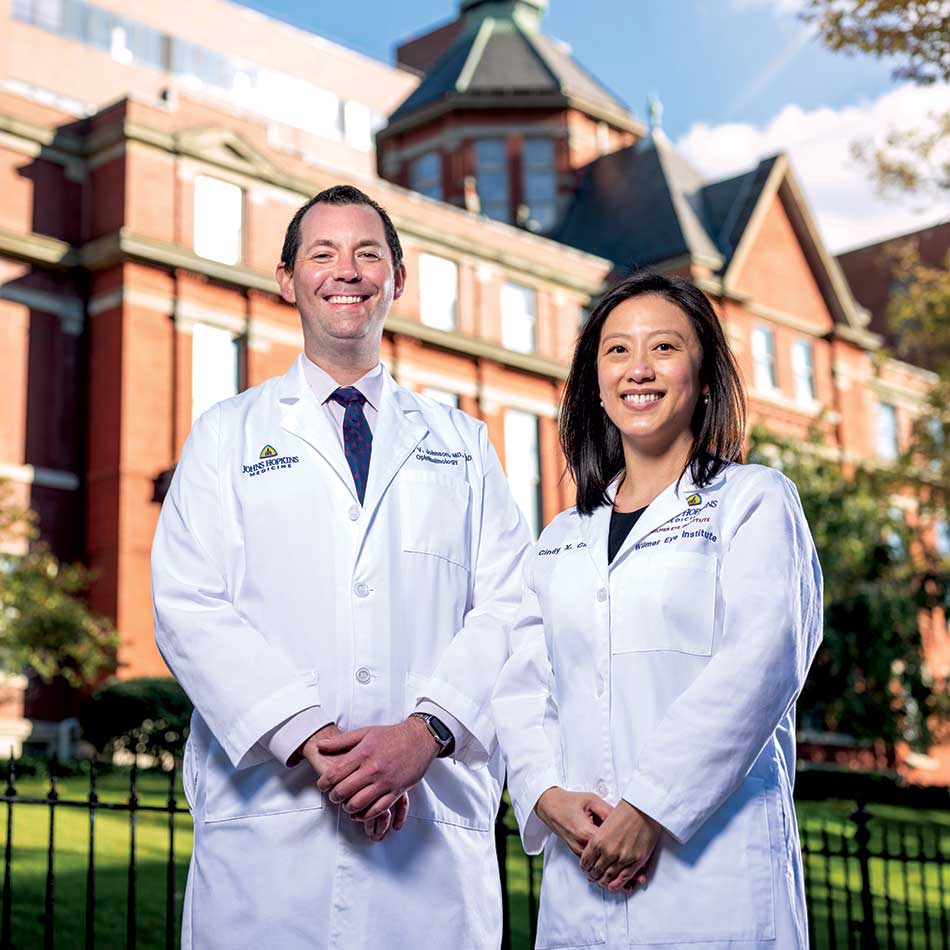
Thomas Johnson and Cindy Cai
During its century-long history, the Wilmer Institute, Johns Hopkins Medicine, has been known as the place where promising young people join the faculty, promptly make important contributions to advancing ophthalmology and emerge as the leaders of their field.
The leadership development strength is exemplified by the 136 Wilmer trainees who have gone on to become department chairs at institutions across the country and around the world. But while it was once commonplace for young investigators to start their careers with significant research grants (the most common is called an R01) from the National Eye Institute or other funding organizations, today, the average age to receive a first large federal research project grant is 44.
In 2020, Wilmer alumnus Jonathan Javitt, M.D., M.P.H., called his old friend, Wilmer Director Peter J. McDonnell, M.D., the William Holland Wilmer Professor of Ophthalmology, to discuss the need to support junior faculty pursuing novel research. They hatched Wilmer’s Rising Professorship Program, which provides young faculty members with up to seven years of funding they can use to pursue their new ideas, build their laboratories and garner the pilot data needed to establish themselves as physician-scientists while applying for larger grants such as R01s and developing their leadership skills.
The program has grown from four rising professors named in 2021 to 16 today, McDonnell says, with additional donors showing interest in providing support. “We’re seeing these rising professorships funded faster than the regular, traditional professorships, because clearly the idea resonates with a lot of people who want to see high-risk and exciting projects being pursued,” he says.
“This has never been done before,” Javitt explains, noting that historically, endowed chairs are given to people who are senior in their careers to recognize their past accomplishments. “We focused on putting support under incredibly promising young people who are going to be the next generation, if they just have the resources to do it.”
A committee of senior faculty members vets the junior colleagues and advises McDonnell regarding the most deserving candidates. One of the first faculty members to receive the honor was Thomas Johnson III, M.D., Ph.D., who holds the Shelley and Allan Holt Rising Professorship in Ophthalmology. He is working to restore vision for people impacted by optic nerve diseases such as glaucoma.
“It’s a really great program,” Johnson says. “When you’re a junior faculty member, you don’t have a lot of funding. It’s always a catch-22 because in order to apply for [larger] grants, you have to include preliminary data…and without grant funding, it’s hard to produce that pilot data.”
In people with diseases of the optic nerve (the nerve connecting the eye to the brain), retinal ganglion cells can die, resulting in permanent vision loss. Johnson’s lab aims to turn stem cells into replacement retinal ganglion cells, and transplant those back into the eye to re-form connections between the eye and the brain.
“If we can do this successfully, we’d be able to actually restore vision,” he says. His larger goal is to create a commercially available cellular product that could be offered to patients with optic nerve diseases.
The rising professorship, generously funded by the Holts, has helped significantly accelerate the pace of his work, Johnson says. His team, which grew from two to 15 people, expanded from testing the cells in retinal cultures in a petri dish to testing them in mice and rats, and now in a large animal model. “We’re starting to bridge the gap to clinical translation,” Johnson says.
Johnson has published papers about the work in journals including Stem Cell Reports, and he presented at large ophthalmology meetings and to groups in Austria, Pakistan, India and Chile. He has parlayed his lab results to obtain additional research funds, including a grant from the National Eye Institute, and he is part of a consortium of eye centers managing a $10 million grant from the Advanced Research Projects Agency for Health for a study on eye transplantation.
Allan Holt says he couldn’t be more pleased about the impact the Rising Professorship has had. “I thought it was a spectacular idea,” says Holt, a member of the Wilmer board of governors, and a senior partner and managing director of the Carlyle Group, a global investment firm. “The idea of allowing a young physician to set up their own lab and have the funding to do proper research was really just great.”
For Holt, the decision was partly personal. His father had diminished peripheral vision and difficulty walking as a result of nonarteritic anterior ischemic optic neuropathy (NAION), a disruption of blood flow to the optic nerve. The elder Holt received care from Wilmer neuro-ophthalmologist Neil Miller, M.D.
Javitt and his wife, a leading academic radiologist, donated funds to create the Jonathan and Marcia Javitt Rising Professorship, which is held by retinal specialist Cindy Cai, M.D. Cai is studying how social determinants of health, such as food insecurity and lack of transportation, impact care for people with diabetic retinopathy, a complication of diabetes that damages blood vessels in the retina and leads to vision loss.
“Diabetes is still the leading cause of vision loss among working-age adults in the U.S., which is crazy to think about because we have great treatments,” Cai says. “The reason patients are still losing vision is that they don’t come in for vision-saving therapies, or they do come in and then they don’t come back for a really long time. That’s the problem we’re trying to tackle.”
With funds from the professorship, Cai hired a data analyst to help her sort through more than 100,000 records from people with diabetic retinopathy who were seen at Wilmer, in addition to national U.S. census data on neighborhood statistics such as the percentage of people who live below the poverty line. One project, published in Ophthalmology Science, describes a method to identify when patients with diabetes have a lapse in their eye care. Cai plans to add that type of information into patient electronic health records, so clinicians will be alerted in real time when this happens. Then they can contact those patients and take any necessary steps to get them back into care to preserve their vision.
The professorship “lessens the pressure and the need to spend my time going after other sources of money … and just focus on the work,” says Cai, who has received a prestigious Research to Prevent Blindness Career Development Award and is now applying for an R01.
The rising professorships also have a key mentorship piece, says McDonnell, with recipients matched to senior faculty members who offer insight and guidance. Additionally, rising professors attend sessions focusing on business skills topics including effective leadership, task delegation, directing lab groups and conducting annual performance evaluations.
“Within Wilmer, my colleagues are extremely supportive of the rising professorships, and it makes me wish we’d come up with the idea a long time ago,” McDonnell says.
One generous donor read about the program in an annual report, was convinced of the wisdom of this approach and sent a check. When a grateful patient of glaucoma specialist Harry Quigley, M.D., the A. Edward Maumenee Professor of Ophthalmology, asked how he and his spouse could express their appreciation for his care, Quigley encouraged them to fund a rising professorship for a glaucoma specialist, and they have indicated they will do so. Other departments at Johns Hopkins have followed suit, establishing rising professorships in neurosurgery, pathology and basic sciences.
“My expectation for the future is that every stellar young recruit to Wilmer will benefit from this program,” says McDonnell. “Everyone will know that if they want to pursue a career in academic ophthalmology, our institute is the place to do it because they will hit the ground running instead of treading water for a decade or so before they obtain that first big grant. Things will happen faster at Wilmer.”