
Changing the Paradigm for Sickle Cell Disease
Financial support is crucial for extending the reach of new treatments.
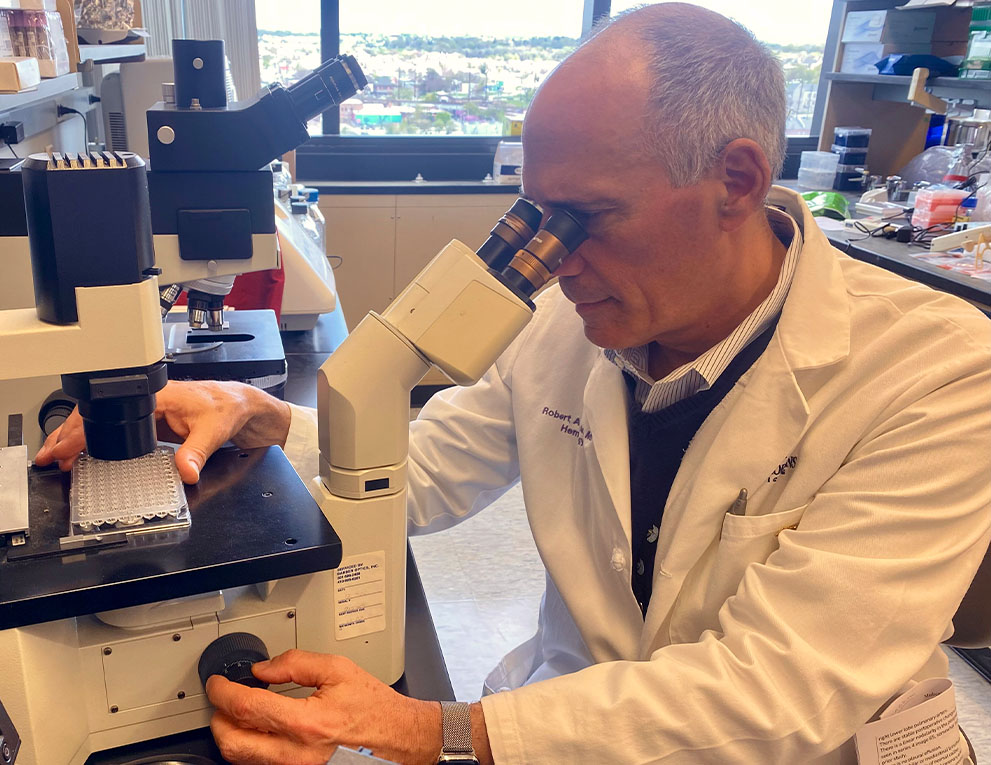
Johns Hopkins hematologist Robert Brodsky, shown above in the lab, has devoted much of his career to developing an effective cure for sickle cell disease (SCD) — a devastating genetic condition that causes organ damage and excruciating pain crises, and affects 120,000 people in the United States. Now Brodsky’s quest has taken a giant leap forward. In February, he and collaborators at Johns Hopkins and about 20 other medical centers reported that a new bone marrow transplant process is curative for 90% of adult patients with SCD.
The procedure, reduced-intensity haploidentical bone marrow transplantation, works with a partial genetic match, or “half-matched” stem cell donor, such as a parent, sibling or cousin. “Virtually everyone has a half-matched donor,” says Brodsky, director of the Division of Hematology at the Johns Hopkins University School of Medicine and the Johns Hopkins Family Professor of Medicine and Oncology.
The cure is here. “What’s next,” says Brodsky, “is changing the paradigm for sickle cell in the United States.”
At the Johns Hopkins Sickle Cell Center for Adults, this means expanding work already underway to treat and cure patients with SCD and partnering with health systems to scale access beyond Baltimore. Many patients need help getting to appointments and covering out-of-pocket expenses. (Half of U.S. patients are on Medicaid.) Years of managing intense pain with high doses of medication can lead to narcotic dependence and withdrawal. Post-traumatic stress and depression are common, as are complications like organ damage. All of this requires specialist care, and demand far outstrips capacity.
Lauren and I want to unlock Dr. Brodsky's miracle from resource constraints so that more SCD patients can be cured in Maryland and throughout the U.S.
Howard Woolley
Brodsky’s priority is his patients. He also acknowledges that curing more people will have a positive ripple effect on hospital resources. One-third of the blood supplied at Johns Hopkins goes to patients with SCD. Cured individuals no longer need ED visits for pain episodes or regular blood transfusions. “This is going to make blood more available for cardiac surgeries, traumas, leukemias and other transplants,” Brodsky says. “That’s huge.”
Marjorie Rodgers Cheshire, a Johns Hopkins Medicine and Hospital trustee, recently made a $200,000 gift to support SCD treatment and research at Johns Hopkins. She is inspired, she says, by the “transformative work on behalf of people who have suffered mightily” and moved by the power of the cure to change lives. One of Brodsky’s patients was just accepted to medical school. “I did not understand how incredibly life-giving the cure is,” Cheshire says.
Howard Woolley’s late wife, Gail, died from complications of SCD in 2015. A successful journalist who traveled the world, her wish was to eradicate the disease. Woolley, a trustee of Johns Hopkins Medicine and University, recalls multiple hospital trips a year to manage Gail’s intense pain crises. “The nurses and receptionists knew us by name,” Woolley says. During her lifetime, the only cure was a bone marrow transplant requiring a full genetic match. After seeing Brodsky cure patients with the half-matched transplant, Woolley and his current wife, Lauren, donated $100,000. “Lauren and I want to unlock Dr. Brodsky’s miracle from resource constraints so that more SCD patients can be cured in Maryland and throughout the U.S.,” says Woolley.
Both donors hope their gifts will be a catalyst for gifts of all sizes. “The intention behind a gift is really powerful,” Cheshire says. “Even if it’s small, it’s alleviating someone’s suffering.”
To support sickle cell disease research and treatment at Johns Hopkins, visit: bit.ly/JHSickleCell
PEARL
A Prudent Investment
The cost of a half-matched bone marrow transplant is roughly $300,000 and is covered by most insurance and in-state Medicaid. Robert Brodsky notes that’s a fraction of the lifetime costs associated with treating SCD. Transplant is also significantly less than gene therapy, which requires high-intensity chemotherapy and can run from $2 million–$3 million.