
'An Unprecedented Panorama'
The Medical Scientist Training Program, which celebrates its 50th anniversary at Johns Hopkins this year, has made an indelible mark on hundreds of M.D./Ph.D. graduates — and seeded discoveries that have transformed medicine.
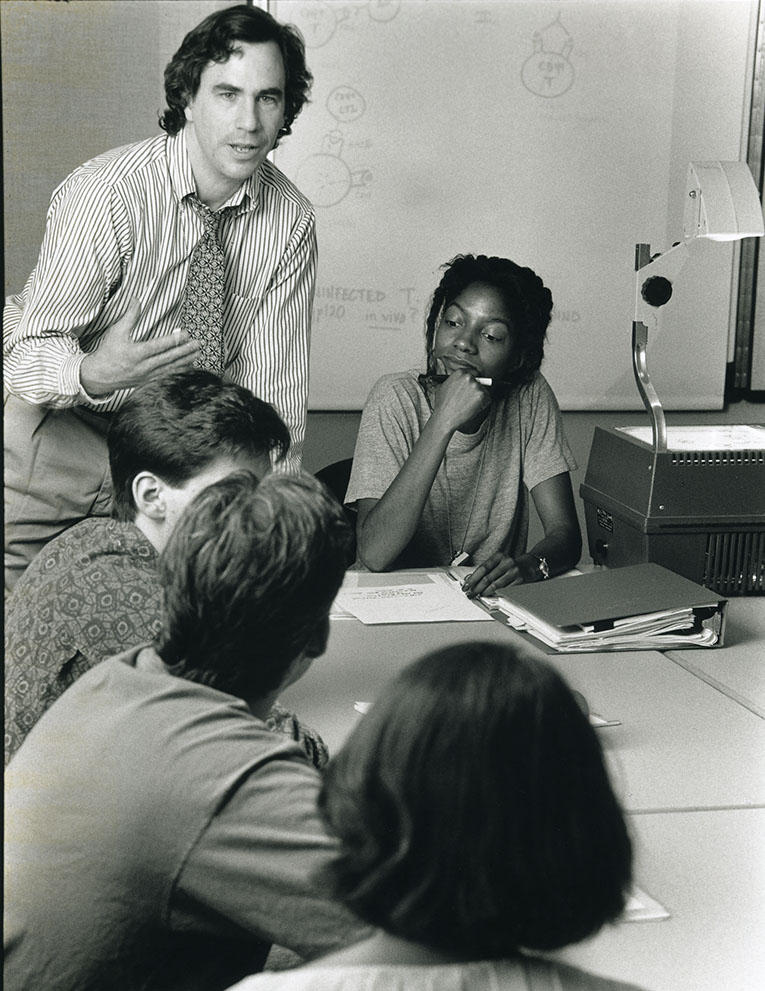
Robert Siliciano, pictured above with students in 1995, was one of the first to enter the Medical Scientist Training Program, in 1975.
In the mid-1990s, long before the arrival of CRISPR gene editing, Todd Waldman spent two years developing a protocol to make it possible for the first time to knock out genes in human cells.
Waldman was working in the lab of pioneering cancer geneticist Bert Vogelstein as an M.D. /Ph.D. student in the Medical Scientist Training Program (MSTP) at Johns Hopkins. He remembers sitting in front of an old phosphor imager, worried that if this fourth modification of the protocol failed he might need to switch projects to something less risky — and less important.
Then came one of those breakthroughs that he still remembers vividly 30 years later.
“The image that popped up demonstrated that, finally, after so much time and effort, it was working in a way we thought could really transform things. I ran to grab Bert, saying, ‘You have to come see this!’ It was one of those very rare moments of real discovery, which makes all the emotional ups and downs worthwhile.” The procedure Waldman developed demonstrated the utility of knocking out genes in human cells and laid the groundwork for the CRISPR revolution 20 years later.
Now the head of the M.D./Ph.D. program at Georgetown University School of Medicine, Waldman is one of 482 physician-scientists who have completed the highly competitive MSTP program at Johns Hopkins, which celebrates its 50th anniversary this year. Most of those graduates have remained in academic medicine and made substantial contributions to biomedical science.
Waldman (MSTP 1991–98) runs a lab at Georgetown that studies a tumor suppressor gene known as STAG2, which was discovered by one of his M.D./Ph.D. trainees. The research has the potential to provide novel treatment strategies for a wide range of cancers including bladder cancer, Ewing sarcoma, leukemias and brain cancers. Other MSTP grads are making their mark in virtually every corner of medicine, from pathology to neurology to infectious diseases.

Paul Talalay
Toggling Back and Forth
The evolution of M.D./Ph.D. training traces back to the influential Flexner Report in 1910, which underscored the need for medical education to incorporate scientific advances with clinical training. But as the century progressed, training pathways for medicine and science became increasingly specialized, sophisticated and separate. Recognizing the critical need to develop physician-scientists who could translate laboratory discoveries into effective treatments for patients, the National Institutes of Health (NIH) launched the MSTP in 1964, under the auspices of the National Institute of General Medical Sciences.
The prestigious program would provide full funding for participants to complete both their M.D. and Ph.D. degrees, typically within seven to eight years.
The first schools to receive funding in 1964 were Albert Einstein College of Medicine, New York University and Northwestern University. The Johns Hopkins program started in 1975 under the leadership of the late pharmacologist Paul Talalay, who also directed the Laboratory for Molecular Sciences.
Its value wasn’t immediately embraced by some working under the Dome. In a 2008 interview, Talalay noted that the program initially required convincing Johns Hopkins clinicians of the value of dual training. “My colleagues told me not to send over scientists to care for sick people,” he said. But once the program got rolling, said Talalay, “MSTP changed medical education. No other program or combination of training provides an individual with an unprecedented panorama of normal molecular processes to the state of disease.”
What Talalay and other Johns Hopkins leaders recognized was that M.D./Ph.D. graduates are ideally positioned to translate research findings from the lab to clinical practice. Their clinical experience allows them to design research questions that directly address patient needs and challenges, leading to more relevant studies. And they often go on to become leaders in academic medicine, conducting research programs, mentoring other scientists, and advocating for translational research initiatives.
From the start, the MSTP program has attracted highly talented and motivated applicants, drawn by the potential to engage in advanced research with top researchers and the promise of graduating debt-free with two degrees.
Doris Stoffers (1984–1991) was an undergraduate at Johns Hopkins University in the early 1980s when she learned about the MSTP program and decided it was tailor-made for her. After working on hormone processing with scientist Betty Eipper in the then recently formed Department of Neuroscience led by Solomon Snyder, she pivoted from her initial interest in neuroscience and the brain to a passion she discovered during her rotation with Paul Ladenson, professor of endocrinology and metabolism.
Today a professor of medicine at the University of Pennsylvania Perelman School of Medicine, Stoffers leads a lab investigating the development, maintenance and regeneration of the pancreatic islet beta cells that produce insulin.
“I ended up in endocrinology, when I never thought I would, as a consequence of the exposures I had in the program,” she says. “The opportunity to toggle back and forth between the clinical world and the research world is very powerful. Because of my training as a physician-scientist, I realized that working on diabetes could have a great impact.”
The secret sauce of the MSTP program is this culture of interactivity and collegiality."
Drew Pardoll
Opening a World of Possibilities
The MSTP program is now offered by more than 50 U.S. medical schools. Typically, students spend their first two years in M.D. classes, then complete three to four years of Ph.D. research before returning to finish medical school. While they fall out of step with their med school classmates, many say they form tight and lasting bonds with their fellow MSTP students, mentors and lab collaborators.
“At the same time that we’re really learning how to do science, we’re surrounded by other people who can help us to think in different ways and consider different possibilities,” says David Dowdy (MSTP 2002–2008), today an infectious diseases epidemiologist at Johns Hopkins.
“Those sorts of training opportunities can transform someone from a fellow who can be a hardworking scientist who publishes lots of papers into someone who can discover things that other people might not be able to,” says Dowdy, who has helped demonstrate how reducing tuberculosis transmissions in geographic “hotspots” can also reduce transmission on a broader scale.
Sometimes those bonds are strengthened outside the clinic and lab.
Bob Siliciano (MSTP 1975–1983) discovered the latent reservoir of HIV in humans, a finding that launched efforts to cure HIV based on accurate understanding of HIV biology. He shares stories of amiable student-cooked dinners, admitting that his own spaghetti dish needed improvement.
Yale University School of Medicine genetics professor Daniel DiMaio (MSTP 1975–1981), who runs a laboratory studying tumor-causing viruses, remembers overnight rustic retreats, late-night conversations, campfires and learning how not to capsize a canoe.
Many graduates remain proud to be part of an intergenerational chain that continues to harvest dreams of improving medicine. Some, like Waldman, feel so strongly about the importance of MSTP that they have gone on to lead similar programs at other institutions.
Drew Pardoll (MSTP 1976–1982) has changed the standard of cancer care by finding ways to empower the patient’s immune system to kill their cancer. He proudly notes that one of his MSTP students, Alex Huang (MSTP 1999–2008), now heads the program at Case Western Reserve University, where he is a professor of pediatrics.
“The secret sauce of the MSTP program is this culture of interactivity and collegiality,” Pardoll says. “There’s a lot of shooting ideas around. And then there’s a lot of hard work to take the ideas that really stand out as promising and turn them into treatments and prevention that can really move the dial.”

MSTP Today
Andrea Cox, professor of medicine and oncology, has directed the Medical Scientist Training Program at Johns Hopkins since 2013.
Every year, the program admits a dozen students — about 10% of the medical school class — who are supported by private and university funds as well as by government grants.
“The NIH funding model has transitioned from one of supporting programs with near complete support to supplementing programs with a maximum of 25% support,” she says. “The [Johns Hopkins] program has always required support from the school but was remarkably successful at earning NIH funding.”
Since 1983, when the first cohort graduated, Cox says 98% of graduates have gone on to residency programs and 83% of graduates have pursued careers in research.
“We allow students to select a Ph.D. mentor in every Ph.D. program and several programs in the Bloomberg School for Public Health,” Cox says. “It affords enormous opportunity to study the most significant issues in a wide variety of fields.
“The program remains a priority for the institution, because the graduates have done such extraordinary things,” she says. “What’s striking to me is how the students are both so passionate about scientific discovery and providing the best care for patients.
“Our graduates have repeatedly made transformative discoveries that have changed the standard of medical care across the globe.”