
After 48 Years at Johns Hopkins and 35 in the Dean’s Office, Kathy Long Eases into Retirement
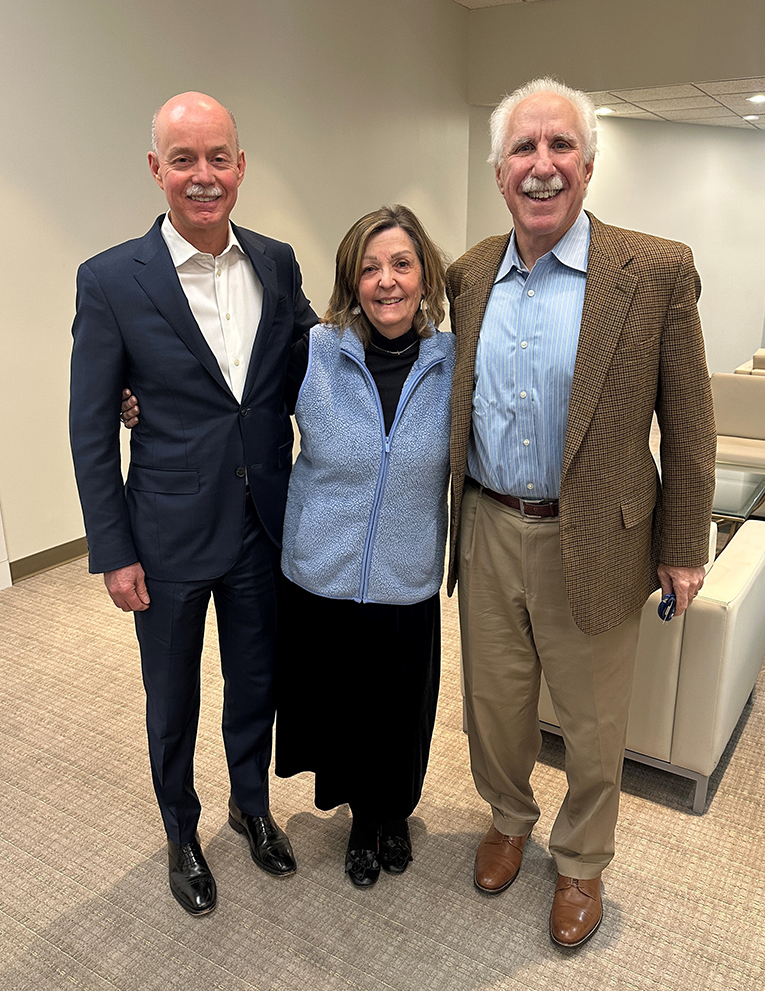
Kathy Long with deans Theodore DeWeese (left) and Paul Rothman.
It was 1977, and Kathy Long was driving to her first day of work at The Johns Hopkins Hospital. Before she even parked the car, she decided she’d look for another job soon.
“I remember thinking, ‘I can’t do this every day,’” she recalls. “I didn’t like the commute. I didn’t like driving through the city.”
It was one of the few times that Long, usually so careful with her facts, was wrong.
When she leaves the dean’s office suite in the Miller Research Building on July 3, Long will cap 48 remarkable years of commuting from Baltimore County and now Harford County to work at Johns Hopkins, including 35 years as executive specialist to four consecutive deans: Michael Johns, Edward Miller, Paul Rothman and Theodore DeWeese.
“I have been so lucky, 48 years in the same place,” she says during a conversation filled with reminiscences and punctuated by the occasional tear. “Each dean kept me. They could have come in and cleaned house.”
The job, which requires a knack for helping high-powered people manage high-stakes situations, is not easy, and has only grown more complex over time, as the institution itself has gotten larger.
Long, who has been in the dean’s office longer than anyone, boasts unmatched institutional knowledge and an even temper. “You can’t get flustered,” she says. “Nothing bothers me. Or if it does upset me, I don’t show it.”
Each dean has had his own style, and Long is proud to note that she’s gotten along famously with each, becoming lifelong friends with them and their families. She is adamant that she doesn’t have a favorite.
“I respect all of them in their own ways for everything they’ve done and what they’ve accomplished,” she says.
The admiration is mutual.
“Your dedication and service to Hopkins Medicine have been nothing short of extraordinary,” says Johns, in one of many appreciative notes gathered by colleagues to celebrate Long’s career. “Over the years, you have been an integral part of the dean’s office, offering invaluable support and ensuring that everything ran smoothly. Your professionalism, kindness and unwavering commitment have made a lasting impact on all of us.”
Says Rothman: “You have touched many people with your knowledge and your warmth, and for this, I and the entirety of the Johns Hopkins entity owe you our deepest gratitude.”
Long, 68, plans to work from home a few hours a week, and promises she’ll be available to answer questions for everyone in the office, including Helen Harrison, currently executive specialist for Department of Medicine Director Nadia Hansel, who will be taking over the job. “I assured Helen, everyone’s looking forward to working with you and everyone will help you,” she says.
Long is looking forward to spending time with her grown daughters and their spouses, to exercising more, and to simply relaxing. “By the time I drive home on Friday nights, I’m so tired,” she says. “As one of my friends said to me, there is life after Johns Hopkins.”
‘I Didn’t Get My Fun Summer’
In June 1977, Kathy King (this was before she married Bill Long) had graduated from Parkville High School and completed a medical secretary program at Essex Community College. She was living in her childhood home and planning a fun summer of waitressing at a Ponderosa Steakhouse and hanging out with friends before getting a serious job.
Her parents had other ideas, though, and insisted that she mail her resume to local hospitals. “Johns Hopkins called right away,” she says, and in short order, she had accepted a job as assistant to George Nager, chair of the otolaryngology department. “They hired me on the spot, and I started the next week. I didn’t get my fun summer.”
Long liked the work, and described Nager, who was born in Zurich, as a “Swiss gentleman, very proper and very sweet.”
She stayed with him until he retired in 1984, and Michael M.E. Johns was recruited from the University of Virginia School of Medicine to become professor and chair of the Department of Otolaryngology–Head and Neck Surgery.
Johns built the department into one of the country’s largest and most prestigious. So it was no surprise to Long when, in 1990, he became the next dean of the Johns Hopkins University School of Medicine with the retirement of Richard Ross, who had been dean since 1975.

Edward Miller’s retirement in 2012. Left to right: Christine White, Cindy Delinski, Kathy Long, Karen Parkent, Lynne Miller, Edward Miller, Maggie Newman, Diane Labuda, Susan Gallagher, Elaine Freeman.
Moving Across the Street to the Dean’s Office
When Johns got the job, he asked Long to move to the dean’s office with him. “I adored him, so I said ‘of course,’” Long recalls. In April 1990, they carried their photos and other office supplies almost literally across the street, from the Carnegie wing of the hospital to the school of medicine administration building (now the Edward D. Miller Research Building).
Long, who had married in 1985, learned shortly after the move that she was pregnant. Katie was born in January 1991. Long took her six-week maternity leave, then returned to work while her mother took care of Katie.
Long’s other daughter, Kelsey, was born in January 1996, three weeks early and during a historic blizzard that dumped nearly 4 feet of snow on the Baltimore region. Long had planned to deliver at The Johns Hopkins Hospital, but instead was rushed to St. Joseph Medical Center after a fireman arrived on a snowplow to take her to the ambulance, which couldn’t get through the snow to her front door.
When Long returned to work after her maternity leave, her colleagues threw her a baby shower and told her that Johns was planning to take a job at Emory University. His successor would be Edward Miller, who had joined Johns Hopkins in 1994 as professor and director of the Department of Anesthesiology and Critical Care Medicine. Long was surprised and pleased when he asked her to stay.
A year later, when Johns Hopkins Medicine was formed and Miller became its first dean/CEO, Long remained, shouldering the added responsibilities of the combined school of medicine and health system.
“It was a challenging time because we had to create the Johns Hopkins Medicine Board of Trustees, and bring on somebody to take care of the board,” she says.
Miller, the 13th dean of the school of medicine as well as vice president of The Johns Hopkins University and the first CEO of Johns Hopkins Medicine, was a wonderful boss, “a great, caring man,” she says, even while coping with the unenviable workload and ego clashes that come with leading a large and changing organization. “I saw him go through a lot,” she says.
Long was the keeper of the dean’s calendar, and the first person who visitors saw when they walked in. Sometimes people would just show up, upset and demanding to see the dean. Long would surreptitiously type an email to Miller, with the subject line, “don’t come out,” so he’d know to stay in his office.
Miller’s tenure, through 2012, was a time of tremendous growth for Johns Hopkins. The health system added four community hospitals: Howard County General Hospital (now Johns Hopkins Howard County Medical Center), Sibley Memorial Hospital in Washington, D.C.; Suburban Hospital, in Bethesda, Maryland; and All Children’s Hospital (now Johns Hopkins All Children’s Hospital) in St. Petersburg, Florida.
The Johns Hopkins Hospital was also expanding, with construction underway to build the Sheikh Zayed Cardiovascular and Critical Care Tower and The Charlotte R. Bloomberg Children’s Center.
“They were exciting times,” Long says.
For Long, they were also marked by tragedy. In 2002, her husband, Bill, was in a horrific accident, falling 40 feet while on the job at a construction site. Long remembers how supportive Miller was, even showing up at the hospital on that first awful day.
Bill survived and lived another 15 years, paralyzed and depressed. The Longs had to move out of their home, into one that was specially built for him to navigate.
The COVID-19 Years
When Paul Rothman came to Johns Hopkins in the top spot in 2012, he also opted to keep Long instead of hiring someone new. As with other deans, Long developed a bond with Rothman and his family. His support helped her through the darkest of days, when Bill Long died of a heart attack in 2017 at age 63.
The COVID-19 pandemic was a defining feature of Rothman’s tenure. On March 11, 2020, The Johns Hopkins University transitioned to remote learning, and many employees across Johns Hopkins Medicine were asked to pack up their offices and begin working from home.
“I remember Dr. Rothman calling everyone out of their offices and saying, ‘You all need to go home. I don’t know for how long, but take whatever you need to do your work.’”
The only people in the office every day were Rothman, Long and Kristy Dickson, chief of staff for Rothman. We wore masks, and kept our distance and slathered on the hand sanitizer. “It was very weird in the beginning, then we got used to it,” Long says.
She says she never felt scared for her own safety as she supported efforts to keep faculty, staff and patients safe amid rapidly changing information and shortages of important supplies.
“I had a good feeling, being part of it, being here,” she says. “I felt like I was doing my part. Everything was urgent.” She scheduled Capacity Command Center meetings, managed a team that was working remotely, and generally “just tried to do everything I could for the dean.”
When Rothman retired on June 30, 2022, Theodore DeWeese, vice dean for clinical affairs and president of the Johns Hopkins Clinical Practice Association, became interim dean and then permanent 18 months later.
Long had known DeWeese for years, and seemed to adjust easily to the change from the measured tone of Rothman to the higher-energy, more outgoing style of DeWeese. “When he became interim, he asked if I would work for him,” she says. “When I said yes, he hugged me. And we just starting working together.”
DeWeese says Long is “someone that I completely trust to always support and gently guide me, and to have an unwavering commitment to the work we do for this great institution.”
In his farewell note, he adds: “There are many heroes that have strode the halls of Johns Hopkins and we can recount their names. Kathy, please know you are one of the silent heroes of Johns Hopkins Medicine that has done important things to support this institution. You have lived up to what is to be a true Hopkins person.”
Walking through the halls of the Miller Research Building after our interview, we bumped into DeWeese, who lamented how much he would miss her before striding off to his next meeting.
The dean’s office is a busy place, and it will still be busy after Long leaves.
But it won’t be the same.
“I’m the last one of the original office to retire.”
Kathy Long, in late 2024, marking the days until her retirement.