
Partners in Lupus Research
Johns Hopkins rheumatologists work together to unravel the mysteries of the disease.
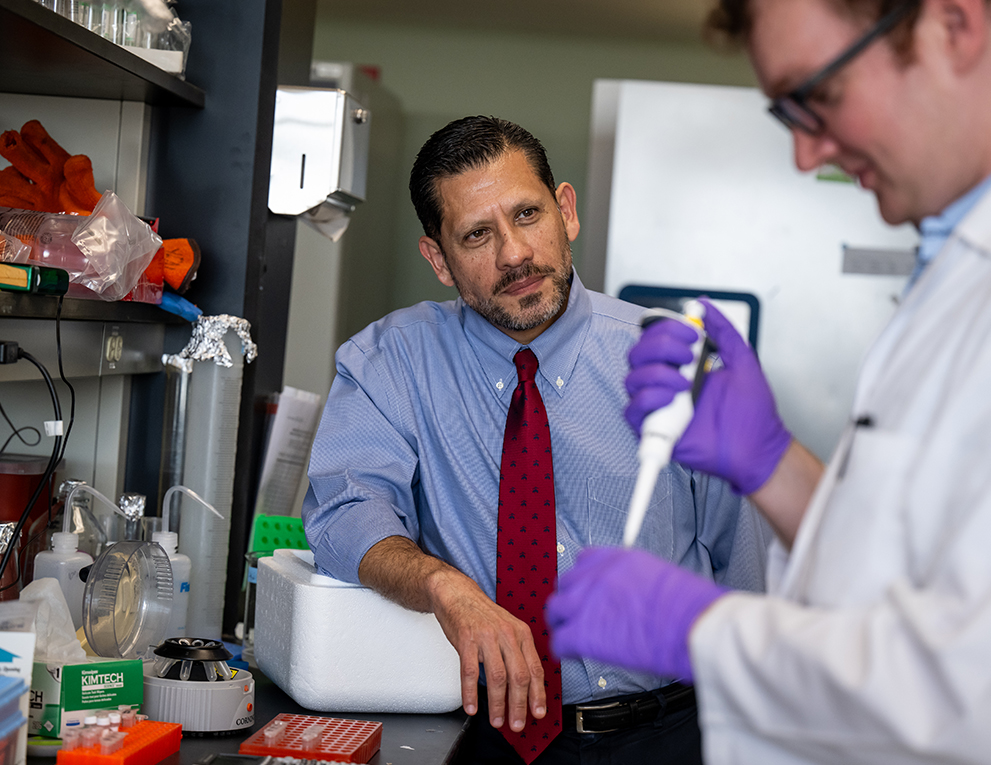
Felipe Andrade
More than 1.5 million people in the United States are living with lupus, a chronic autoimmune disorder that affects mostly women and causes the body’s immune system to attack healthy tissues and organs.
Beyond that stark statistic lies a condition that devastates lives, and a clinical research field abounding with unknowns: Why do some patients with skin rashes respond well to available lupus treatments while others with similar symptoms go on to develop additional symptoms like arthritis … and still others progress to kidney failure? What puts some patients with lupus at higher risk of having a heart attack or stroke? Just how does lupus progress in each individual patient — and what does that mean for how treatments could be tailored earlier on to stave off future damage?
These are among the vital questions driving the research of Division of Rheumatology faculty members Felipe Andrade, M.D., Ph.D., and Eduardo Gómez-Bañuelos, M.D., Ph.D. The two researchers are moving ever closer to finding answers, thanks to recent advances they’ve made in their lab at the Johns Hopkins University School of Medicine.
“Lupus comprises distinct subgroups that may have similar clinical manifestations but are driven by different cellular mechanisms,” explains Gómez-Bañuelos, assistant professor of medicine.
“That is why it is so important for us to focus on better understanding, at the molecular level, what the different drivers of the disease are,” adds Andrade, an associate professor of medicine. “We need to distinguish between patients who may look clinically identical to understand why one patient will go on to have a different outcome than another.”
In their research efforts to identify and define these new patient subsets, and to better understand various pathways of the disease, they rely heavily on a treasure trove of consented patient data, including blood and tissue samples, developed by Michelle Petri, M.D., M.P.H., professor of medicine in the Division of Rheumatology. Since 1987, she has led the Johns Hopkins Lupus Cohort, a longitudinal study that has followed more than 3,000 patients with lupus.
“This incredible characterization of patients, going back decades, and the availability of research-grade data and samples has been a huge advantage to our work today,” says Andrade.
Investigating Lupus Together
While Gómez-Bañuelos has been fascinated by lupus since his days as a medical student in Guadalajara, Mexico, Andrade, who trained in Mexico as a rheumatologist, devoted the first 15 years of his research career at Johns Hopkins primarily to investigating rheumatoid arthritis.
“But I’m not a single-disease scientist, and lupus was always in my sights as a disease that I wanted to study,” Andrade says. “Then, about seven years ago, Eduardo joined our group as a fellow; I saw in him a path to start exploring lupus more fully. He was a driver for me to make the jump. Now, we work very closely together.”
During Gómez-Bañuelos’ rheumatology fellowship in Mexico, he treated patients with lupus before he moved full time to medical research at Johns Hopkins. “That experience with patients helps me understand better what all those clinical variables mean, and the weight they should have for patients,” says Gómez-Bañuelos, whose wife, Marta Escarrà-Senmarti, Ph.D., is also a researcher in the Andrade lab.
Gómez-Bañuelos splits his time between the “wet lab” (bench research) and the “dry lab,” analyzing data on the computer. “Both methods are complementary and one informs the other,” he says. “Going back and forth is very exciting.”
Through their detective work in the lab, the two researchers are shedding light on the pathogenesis of lupus and its intersection with the unique course of disease in each patient, which could guide clinicians in providing better tailored therapies.
“We’ve found an entirely new biomarker that can help us identify which patients with APS have a high risk of developing a heart attack or stroke, or experiencing a deep vein thrombosis.”
Eduardo Gómez-Bañuelos
Interacting Interferons
One of their recent projects opens an exciting new window into the role that interferons play in various forms of lupus. Interferons are a family of cytokines, which are key proteins in the body’s immune response to invaders. In recent years, lupus specialists have prescribed medications targeting interferon type I (IFN-I) in an effort to stem symptoms.
“Many patients with lupus have increased levels of IFN-I, so the paradigm has been to provide drugs that block the IFN-I pathway to control disease,” says Gómez-Bañuelos. “The problem is that only about one-half of patients with high IFN-I have some degree of response to anti-IFN-I treatments. Our question was: Why?”
Some, but not all, of the downstream effects of the interferons are shared — making it challenging to know exactly which interferon is causing clinical problems in patients with lupus. In their study, published in the May 2024 issue of Cell Reports Medicine, the two researchers therefore cast a wider net, looking at the role played by additional types of interferon: specifically, IFN-II and IFN-III. They used a unique assay to precisely measure the independent activity of each IFN type in patients’ blood samples and tapped into the extensive clinical, laboratory and whole blood transcriptional data available in the Johns Hopkins Lupus Cohort.
Previous research by scientists had found that IFN-II and IFN-III levels were elevated in patients with lupus, “but there was no analysis of how these different types of interferons were interacting,” says Andrade. “Our approach was to analyze all three types at once, in every patient.”
Zeroing in on the interactions proved key. The scientists found, for example, that patients with IFN-I involvement alone mainly had skin disease, clarifying why this subset of patients responds very well to IFN-I blocking agents. Conversely, patients with kidney disease, one of the most severe manifestations of lupus, showed activation of IFN-I, IFN-II and IFN-III. “So, blocking IFN-I may not be enough for these patients,” says Gómez-Bañuelos.
By offering new insights into interacting effects between IFN families, as well as IFN-independent mechanisms, Andrade and Gómez-Bañuelos are moving the field closer to providing more effective, targeted therapies for lupus.
“We anticipate that these findings will be important in identifying those patients who will respond better to IFN-I blocking agents, as well as useful for designing clinical trials that target the right therapeutic mechanisms to the appropriate patient subgroup,” says Gómez-Bañuelos.
A Biomarker for Thrombosis
Andrade and Gómez-Bañuelos also have a strong focus on understanding how the autoantibodies made by lupus patients serve as markers of the type of disease that the patient gets, and understanding the mechanisms underlying those clinical associations. In a promising area of study, the duo has discovered a novel autoantibody that identifies patients with lupus who are at higher risk of thrombosis leading to heart attack or stroke — specifically in the group of lupus patients who have antiphospholipid antibodies, some of whom develop blood clots.2,3
“The antibody biomarkers for this syndrome [antiphospholipid antibodies, or aPL] have been known for years and they have a strong diagnostic value,” says Andrade. “However, not all patients who have aPL antibodies go on to experience clots. And not all patients who develop thrombosis will have aPL antibodies. Here again, we wondered: Why?”
In their work in the lab and analyzing data at the computer, the researchers zeroed in on a protein that resides in the cell’s mitochondria. They ultimately identified TFAM (transcription factor A mitochondria) as a target of antibodies in about 30% of patients with lupus. Moreover, they discovered that these antibodies were associated with thrombosis and antiphospholipid syndrome (APS) independently of aPL antibodies.
“So, we’ve found an entirely new biomarker that can help identify which patients with APS have a high risk of developing a heart attack or stroke, or experiencing a deep vein thrombosis,” says Gómez-Bañuelos.
Moreover, says Andrade, “when both anti-TFAM antibodies and lupus anticoagulant — a marker of APS — are present, the chances of thrombosis increase up to 10 times.”
In addition to better defining lupus patients at higher risk of thrombosis, says Gómez-Bañuelos, “we have opened the door to showing that mitochondrial damage is associated with thrombosis events in lupus. Understanding how this might be further exploited in studying SLE [systemic lupus erythematosus] and its prevention and therapy is a high priority.”
Exploring the Origin of Antibodies Targeting DNA in Lupus
In their work on autoantibodies in lupus, the duo made another surprising finding. “We discovered a new autoantibody that is directed against DNase1L3, an enzyme whose function is to destroy DNA,” says Gómez-Bañuelos.
DNase1L3, which is secreted by specific immune cells, helps break down DNA released from dying cells, preventing it from causing an autoimmune reaction. If DNase1L3 does not work correctly or is blocked by antibodies, this leftover DNA can cause harmful autoimmune responses, such as producing anti-DNA antibodies, resulting in lupus symptoms.
In a recent paper in Nature Communications, they show some patients have antibodies that target DNA and DNase1L3 at the same time.4 “We were never expecting this!” says Andrade. “We know that anti-DNA antibodies are a hallmark of lupus. But not every anti-DNA antibody is equally dangerous. Some may be harmless, while others target the kidneys or the brain, causing lupus nephritis or neuropsychiatric lupus, respectively. The reason why anti-DNA antibodies are so diverse is not fully understood.”
Andrade notes that patients who harbor this subset of double reactive antibodies to DNA and DNase1L3 have a higher risk of developing more severe disease than those with antibodies that only target DNA. “It is like having two pathogenic antibodies in one,” he says. Through further investigation, the scientists found that during lupus development, antibodies that initially target DNase1L3 mutate and gain reactivity to DNA, explaining the origin of double reactive anti-DNase1L3/DNA antibodies.
Insights like these into the progression of the autoimmune response, the scientists say, could help clinicians recognize which patients are at higher risk of developing a severe inflammatory response, so that steps could be taken earlier in the disease to prevent such progression before damage to organs and other body systems occurs.
“We think specific antibody subsets can be informative about which pathogenic pathways are more active in different groups of patients,” says Gómez-Bañuelos.
He and Andrade are encouraged by discoveries like these — and excited to continue investigating the sea of unanswered questions that remain in their quest to develop personalized treatments for patients with lupus and other autoimmune disorders.
“As we make new discoveries, instead of finding immediate solutions, sometimes we add to the complexity,” says Andrade. “But that’s OK! We know that any new information we can generate, if not applied today, can be used to improve the lives of future generations of patients.”
For Clinicians Clinical Connection
Clinicians, discover the latest in research and clinical innovation from Johns Hopkins experts. Access educational videos, articles, CME courses and other resources from our world-renowned institution.