
Newest Rising Professorship Celebrates Teaching
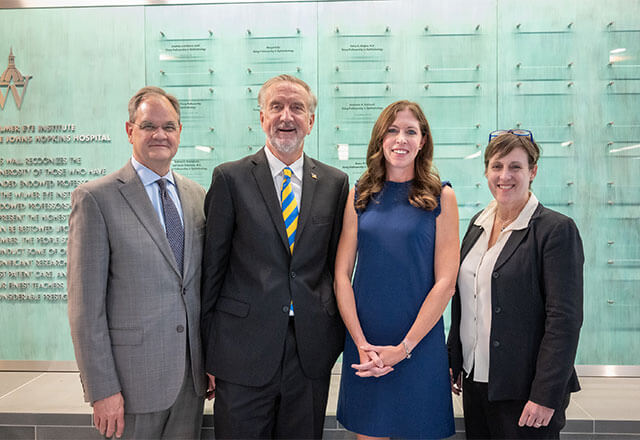
Landon King, Peter J. McDonnell, Bryn Burkholder, Jennifer Thorne
Last June, Bryn Burkholder, M.D., an associate professor of ophthalmology and uveitis specialist at the Wilmer Eye Institute, stood behind a podium in front of her peers at a ceremony honoring her as the inaugural recipient of the Antoinette R. Schifanelli Rising Professorship in Ophthalmology, an endowed professorship created to recognize excellence in clinical teaching.
Since 2012, Burkholder has provided crucial support to dozens of residents and fellows, from invaluable mentorship during complex cases to engaging review sessions involving competitive Jeopardy!-style games. At the ceremony, Burkholder, who completed her residency and fellowship at Wilmer between 2008 and 2012, told the audience that she stayed at Wilmer after her training because of the residents. “One of the best parts of teaching is seeing the residents evolve over their time here and getting to be a small part of their development,” she said.
Launched in 2020, the rising professorships program at Wilmer recognizes the promise and achievements of early career faculty members and equips them with seven years of funding to accelerate their careers and their impact on patients. The Antoinette R. Schifanelli Rising Professorship was made possible because of Antoinette “Toni” Schifanelli, a 36-year staff member in the engineering department of a prominent telephone company who died in 2015 and left a generous bequest to Wilmer.
With support from this endowment, Burkholder has been able to free up more time each week to focus on teaching and on her research on uveitis, a form of eye inflammation.
Since joining the faculty 14 years ago, Burkholder has dedicated many hours to helping residents build skills and grow as clinicians. As divisional educational champion for Wilmer’s Division of Ocular Immunology, she provides beneficial resources for residents, including planning four uveitis educational sessions per year. She also mentors a rotating second-year ophthalmology resident, supervises a third-year ophthalmology resident during cataract surgeries and works with uveitis fellows during their yearlong appointments.
“Dr. Burkholder would always be more than willing to help the residents see patients, explain the findings and basically be a teacher in every sense of the word,” says Jacob Light, M.D., now a retina specialist in Washington state, who was a 2023–24 assistant chief of service at Wilmer, a role in which former Wilmer residents who have completed their fellowships dedicate a year to teaching residents.
“She was a great mentor because she would clearly explain concepts while also pushing the residents to make sure they were developing independence,” adds Jasdeep Sabharwal, M.D.,Ph.D., an assistant professor of ophthalmology at Wilmer who also was a 2023–24 assistant chief of service.
With this rising professorship, Burkholder aims to expand her research examining a common form of uveitis associated with the HLA-B27 allele, a common genetic variant linked to uveitis and other types of autoimmune disease. Working with a team of medical students, residents and fellows, her goal is to improve characterizations of this genetic disease and identify possible triggers for flares in order to treat patients more effectively.
Recognizing the importance of supporting great clinician teachers, Wilmer Director Peter J. McDonnell, M.D., the William Holland Wilmer Professor of Ophthalmology, shared his gratitude for the gift that made the rising professorship possible, noting, “This generous gift from Ms. Schifanelli supports one of Wilmer’s outstanding teachers. Just as Dr. Wilmer was a remarkably skilled doctor who had the ability to teach his trainees all he knew, so today does Dr. Burkholder, and so will future recipients of this professorship.”