
Get to Know Jacob Kanter
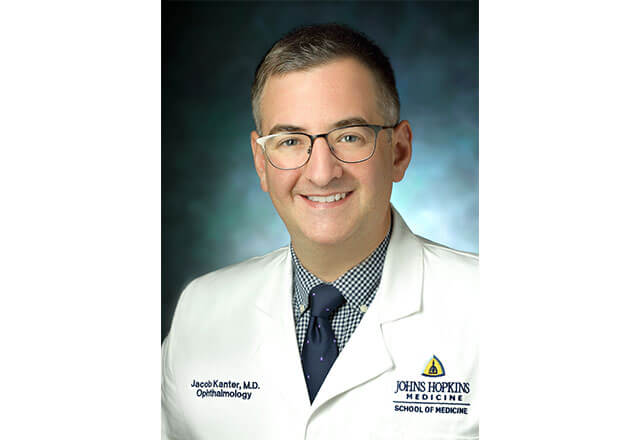
Jacob Kanter, M.D., joined the Wilmer Eye Institute, Johns Hopkins Medicine faculty as an assistant professor of ophthalmology in August 2024 after completing his fellowship at the institute earlier this year. A glaucoma specialist, Kanter sees patients at Wilmer’s East Baltimore and Green Spring Station clinics.
What attracted you to the field of ophthalmology?
It really stemmed from the first time I saw the eye under the microscope. I was just struck by the amount of detail and complexity that is contained in this tiny organ.
A few years later, on the first day of my ophthalmology rotation in med school, I saw three patients back-to-back who had their vision restored or preserved for different reasons. It’s truly remarkable how many therapies have developed within the field of ophthalmology in just the last few decades, from a simple pressure eye drop to non-invasive laser treatments to cataract and glaucoma surgeries. And that's really what I wanted to do from the time I realized I wanted to be a doctor, to help people in a tangible way. To be a part of that process on a daily basis is truly a privilege.
How did you become interested in your specialty?
I got into glaucoma clinically because you have to think very critically and carefully about whether glaucoma is truly even present, and whether it’s controlled or not. There’s also an investigation that has to take place as to why the pressure is elevated. I really liked that investigatory aspect of it, along with the utilization of different tools and technologies to make that decision.
I also fell in love with glaucoma surgery during residency, both the traditional filtering surgeries like tube shunts and trabeculectomies, as well as the newer MIGS surgeries in which we’re working in the iridocorneal angle. There's also been an amazing explosion of innovation in the surgical space in just the last few years—implantable devices, new drops, and various ways to lower pressure.
So when I realized that I love both the clinical and surgical aspects of glaucoma, and I saw the many ways in which I’m able to help patients, it felt like a no-brainer.
What drew you to Wilmer?
There are many glaucoma faculty members here that have had, I would say, an indelible mark on the field. An opportunity to learn from them and train with them as a fellow was very hard to pass up. I came to Wilmer specifically to learn more about trabeculectomy, a procedure that creates drainage to lower eye pressure, and Wilmer is one of the few places in the country where not only is it done, but it’s taught really well.
I joined the faculty because early on in my fellowship I fell in love with the culture that exists among our faculty members and all the other members of our patient care teams. We’re really driven by an inquisitiveness which will drive the field forward, and we’re providing high quality patient care. To be able to do that on a daily basis, while being a part of the mission to prevent blindness and restore vision, working as part of a team that is constantly innovating to push the boundaries of science and medicine, is a dream come true.
What are you working on right now and how will it contribute to the advancement of ophthalmology?
One thing I’m interested in is how to better understand patients’ experience at the time of glaucoma surgery. I’m studying how we communicate with patients as surgeons and how to convey what patients can expect from their surgery. This includes trying to better delineate the range of experiences during and after surgery, so we can utilize better data when discussing surgical options and their respective recovery periods with our patients.
I’m also working on projects surrounding checking eye pressures at home, to better understand how eye pressure changes throughout the day. There’s a lot of good preliminary data showing that if you're checking the pressure in the office just once every few months, you might be missing some fluctuations that can occur week to week, or outside of normal business hours. This can be very relevant for patients who might be having progression of their glaucoma, even though the pressure looks well controlled in the office. So, it's about learning when to utilize that tool of home tonometry, how to best utilize it, and how to better understand the therapies and surgeries we’re doing and how they’re working.
Where do you see opportunities for advancement or innovation in your specialty?
There’s a lot of innovation in the field and a lot of it is happening here at Wilmer. One of the most exciting things is we have people working on implementing artificial intelligence to better utilize visual fields and optical coherence tomography. We also have people working on regenerating or restoring the health of the optic nerve, which is honestly the Holy Grail in glaucoma: we're talking about lowering the pressure at every patient visit, but we're not actually treating the optic nerve which is the part of the body that's damaged in glaucoma. Those are exciting spaces.
There are also other therapies coming out, such as new minimally invasive glaucoma surgeries on the horizon utilizing the suprachoroidal space — the area between the choroid and the sclera. Additionally, there are new types of drug-eluting implants on the horizon. There's a lot of surgical and medical innovation happening, and it's really exciting to be here at Wilmer.