
At the Forefront of Refractive Surgery
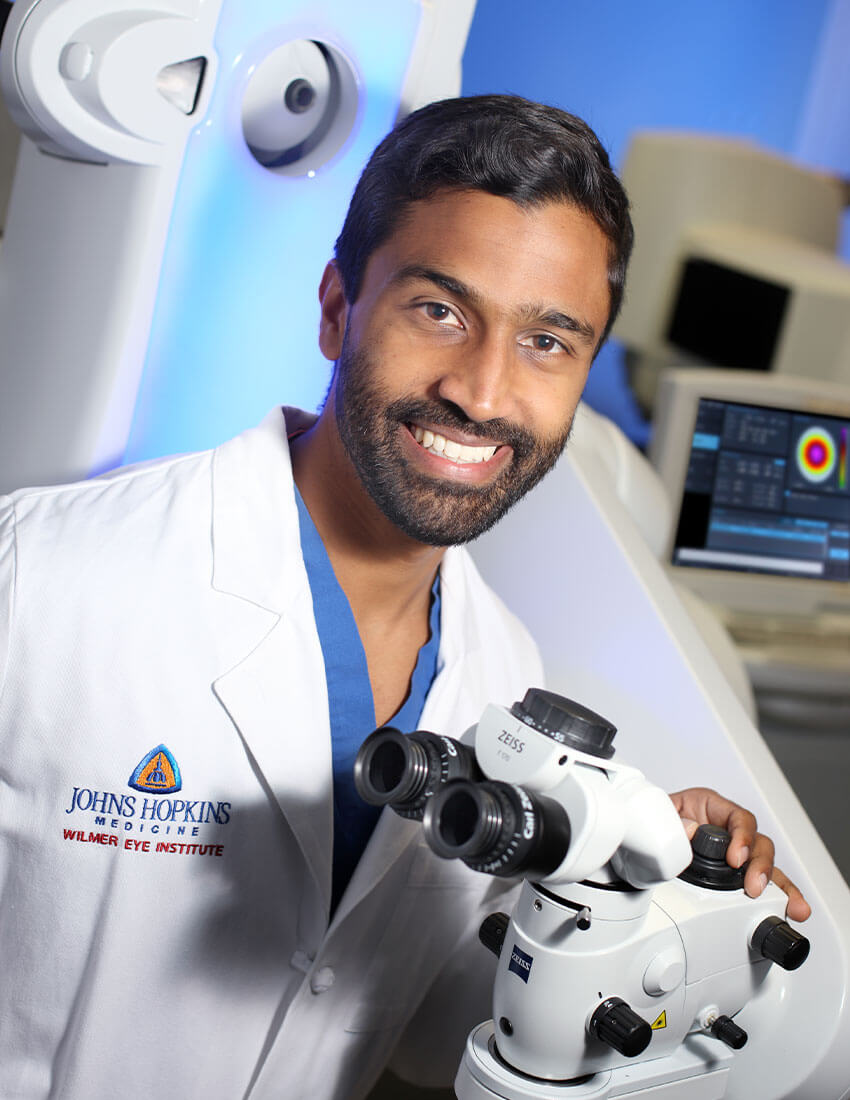
Isa Mohammed
The refractive surgery program at Wilmer Eye Institute, Johns Hopkins Medicine has long been in high demand among patients. Wilmer is renowned for having developed some of the earliest lasers for vision care, and has performed laser vision correction procedures since the early 1990s.
Today, the institute continues to be at the forefront of refractive surgery. As the world’s population experiences a dramatic increase in the prevalence of myopia, many who find glasses or contact lenses inadequate or unsatisfactory have turned to Wilmer for refractive surgery to correct their vision.
Leading the refractive surgery program at Wilmer is Isa Mohammed, M.D., following the June 2024 retirement of Kraig Bower, M.D. In this role, Mohammed is working to ensure that the institute continues to deliver top-of-the-line care while it trains the next generation of refractive surgeons.
Mohammed, an assistant professor of ophthalmology, pursued a career as a refractive surgeon because, he says, it was a subset within ophthalmology through which he could improve someone’s vision and affect their quality of life in a dramatic way. After undergoing his residency at the University of Maryland Medical Center, he completed subspecialty training in cornea and refractive surgery at the renowned Cole Eye Institute at the Cleveland Clinic.
Now leading the way at Wilmer — and keeping in mind Wilmer’s tripartite mission of patient care, teaching and research — Mohammed is excited for the opportunity to help shape the field. “The impact that you can have with your patients at Wilmer is huge, especially with the resources available,” he says. “Training three fellows each year, who then spread across the nation, amplifies this impact. By doing so, you’re contributing to ensuring that the standard of care is upheld nationwide, which is really meaningful.”
A personal experience as the recipient of refractive surgery played an influential role in Mohammed’s career. Prior to the surgery, Mohammed needed glasses to read even the big E on the Snellen chart, which measures visual acuity. The procedure, which he underwent while in medical school, enhanced his vision from 20/2400 to 20/15, which is considered better than the standard 20/20 vision. “Going from needing glasses or contacts every single moment of being awake to being completely free and seeing better than I’ve ever seen before, I knew that was something I would love to give back to other people,” he says. “It’s incredibly rewarding.”
Divya Srikumaran, M.D., the Walter J. Stark Chair of Ophthalmology at Wilmer and director of the institute’s cornea division, says Mohammed has hit the ground running charting the course of the program. She has been impressed with how he has engaged with and included faculty members who have interest in performing refractive surgery, as well as with clinicians who may be referring patients to them.
Peter J. McDonnell, M.D., the William Holland Wilmer Professor of Ophthalmology and director at Wilmer, says Mohammed was chosen after a careful national search. “His Wilmer colleagues have all been impressed by his energy and his focus on this important area,” he says.
With new leadership in the refractive program comes a six-figure investment from Wilmer to upgrade its refractive surgery infrastructure — including the laser suite at Wilmer’s Green Spring Station clinic — which will increase the program’s capabilities.
“Our expectation is that Wilmer should be at the forefront in all areas within ophthalmology, including refractive surgery,” McDonnell says. “As new technology becomes available that our experts believe can help ensure that our patients achieve the best possible outcomes, it is appropriate for Wilmer to offer that technology.”
The state-of-the-art equipment will allow for more precise procedures and shorter recovery times. It also provides Wilmer with additional capabilities, including topography-guided photorefractive keratectomy, a treatment for keratoconus that customizes laser correction for corneal irregularities to improve vision, and keratorefractive lenticule extraction (KLEx), a new, minimally invasive laser vision correction procedure for myopia and astigmatism. KLEx, also known as small incision lenticule extraction or SMILE, offers faster recovery and a quicker return to normal activities compared to previous procedures like LASIK.
“I think being at Wilmer, where you’re at the leading edge, we need to have the best equipment and the highest capability to be able to take care of patients,” Mohammed says. “And at Wilmer, we have that ability.”
While most of the new equipment will be at Wilmer’s Green Spring Station clinic, some equipment used for testing will be at Wilmer’s East Baltimore cornea clinic, allowing more cornea faculty members to identify patient candidates for refractive procedures.
The equipment also serves as an investment in Wilmer’s education program, as the institute’s residents and the cornea division’s three fellows all use the equipment in their training. Mohammed says it’s important to train the next generation of burgeoning ophthalmologists on the latest and greatest technology.
“We need to make sure that we’re training people on technology and techniques that allow them to treat patients to the best of their ability,” Mohammed says. “It’s incumbent on us as physicians to deliver the highest standard of care to all of our patients, and the upgrade allows us to do that.”