
A High School Student Focuses on Wilmer
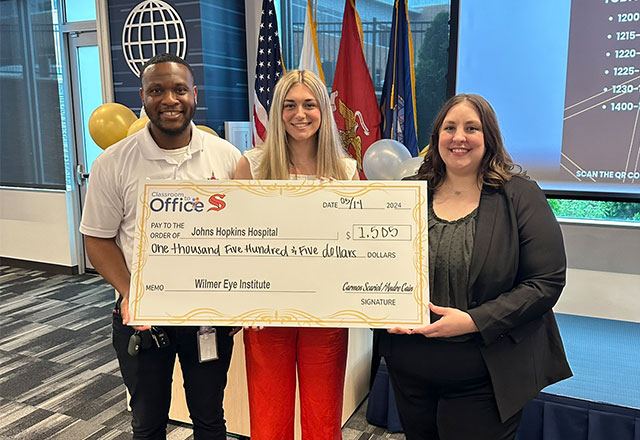
Carmen Scariot presents her check to the Wilmer Eye Institute
As soon as she received the assignment, Carmen Scariot knew exactly what she would do: raise money for the Wilmer Eye Institute, Johns Hopkins Medicine. Scariot, a student at Sherando High School in Northern Virginia, was taking an economics and finance course, which required students to engage in a capstone project that impacts the community.
Though a high school student in Northern Virginia, Scariot was connected to Wilmer through her mother, Justine Linahan, a patient of Michelle Hessen, O.D.
“My mom has Stevens-Johnson syndrome, and she’s been working with the Wilmer Eye Institute for a long time to better her vision,” says Scariot. “I wanted to have the money go to them to help with more research for not only her, but for other patients with similar issues.”
A rare disorder of the skin and mucous membranes, Stevens-Johnson syndrome is usually caused by a response to a medication, which was the case for Scariot’s mother, who reacted to a medication she received as a child after a serious bicycle accident.
“In Stevens-Johnson syndrome, there is a main event when a person has a major medical reaction, usually to a medication, followed by slow healing, which typically results in scarring of the skin and mucous membranes,” says Hessen. “Sometimes people have a lot of scarring on the surface of their eyes, which mimics a severe dry eye case in terms of their symptoms.” Such symptoms include blurred vision, light sensitivity and pain. “People are often unable to perform activities of daily living without special scleral lenses to help support the surface of their eyes,” Hessen adds.
Scariot knows well the consequences of Stevens-Johnson syndrome for patients. “My mom’s condition has been one of the most impactful things on my life, due to her not being able to drive and a lot of people having to help her out,” Scariot says. “One of the first things that came to mind [when brainstorming a project] was finding a way to help my mom. I decided the best way to do that was to have the money we raise donated to the Wilmer Eye Institute.”
Once Scariot determined her project focus and desired goal, she had to develop her strategy. First, she contacted Wilmer to set up a way for people to donate to her fundraiser and direct their gift to Hessen. After that, she built a website, Saving The Eye, on which she shares information about the initiative and its goal to “support ongoing research to find new treatments and cures … and [make] a difference in the lives of those affected by eye diseases.” Finally, she posted on social media and asked others to share the message.
Scariot, not a regular user of social media, was nervous about asking others to share information about Saving the Eye, but once she did, she was “very happy to know that other people were willing to donate to something that meant a lot to me, and that the money was going to help people.”
When Hessen heard about Scariot’s fundraiser, “I was genuinely humbled by her kindness and that she, as a high school student, was so thoughtful in terms of trying to raise awareness of Stevens-Johnson syndrome, which is quite rare,” she says. “I appreciated the time and effort that she utilized to raise money to donate to my continued research around helping these patients with Stevens-Johnson syndrome and ocular surface diseases associated with various etiologies.”
As Hessen explains, “For patients with this condition, I use PROSE (Prosthetic Replacement of the Ocular Surface Ecosystem) treatment. It’s an FDA-approved, highly customizable lens that helps hold sterile saline against the eye. The hard lens protects the eye from the external environment, as well as from the eyelids from constantly rubbing over the surface of the eye,” says Hessen. “It helps to promote healing, improve patient symptoms and restore vision.” Hessen is engaged in research on improving treatments such as this for patients with severe ocular surface diseases and other systemic causes of severe dry eye. Scariot’s donation will help support this work.
Hessen points out, though, that Scariot’s project did more than raise funds. “The website alone is helpful. And it got shared time after time on social media, which is very useful for spreading the word about a rare condition.”
In spring 2024, Scariot achieved two goals. After presenting her work, she received a perfect score on her project. That same day, she also presented a check to the Wilmer Eye Institute, demonstrating that she did indeed create a project that impacted the community.