
Using Scleral Lenses to Restore Vision
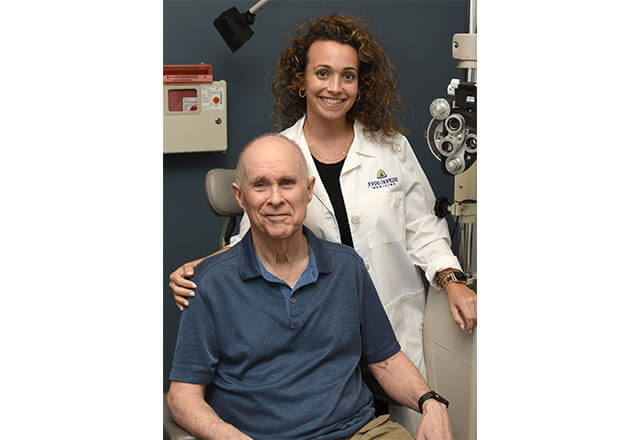
Laura Di Meglio, O.D. with Thomas Lewis
A longtime resident of Texas who moved to Maryland last year, Thomas Lewis came to Wilmer Eye Institute, Johns Hopkins Medicine with a history of vision challenges. In 2012, he began to have blurry vision and he was seeing floaters. By the time he arrived at Wilmer, he had lost his vision completely in one eye and had extremely poor vision in the other.
“It wasn’t any fun to watch television. I couldn’t go to a movie. I couldn’t walk out on the street and safely know when there was a walk sign or a stop sign,” he says.
In Texas, Lewis had been diagnosed with birdshot chorioretinopathy, a rare eye condition that causes inflammation, which can damage the retina and choroid — a thin layer of tissue filled with blood vessels — and cause vision loss or blindness.
For 11 years, Lewis went to various ophthalmologists, often taking one step forward and two steps back in terms of improving his vision. He had tiny devices implanted in both eyes that delivered continuous steroid treatment to control the inflammation and improve his blurry vision. But the treatment led him to develop glaucoma in both eyes. He had several surgeries for the glaucoma, losing his vision completely in his left eye after one of them. A gel stent was eventually installed in Lewis’ right eye to lower the pressure, but by 2022, the pressure got too low, causing his vision in this eye to decline.
This is when Lewis came to Wilmer. First, he had the gel stent removed, but this didn’t increase his eye pressure. On the recommendation of his daughter and son-in-law, he made an appointment with Laura Di Meglio, O.D., for a refraction, or eye exam. Di Meglio explained that due to the low pressure, the cornea — the outer clear part of the eye that is typically inflated and smooth — had deflated and wrinkled. As a result, light was getting trapped in the ridges of his cornea and scattering in a disorganized fashion instead of clearly passing through to the retina, which was creating his vision challenges.
At one appointment, Lewis mentioned that his vision was best in the morning. He could read after he woke up, which he could not do for most of the day. This gave Di Meglio an idea about a possible treatment.
“When we’re sleeping, our corneas tend to swell because of a lack of oxygen when the eyelid is closed. This thickens the corneal tissue, giving it more of a typical inflated look,” Di Meglio says. This, she continues, most likely created a smooth surface on Lewis’ cornea that allowed the light to successfully pass through to his retina in the mornings. “I thought if we could give him a hard, smooth surface to look through, he would get better vision that stayed consistent all day long.”
A scleral lens is a hard lens made of gas-permeable material that sits on the sclera, or white part of the eye, and vaults over the cornea, creating a smooth surface. With each use, the wells of these lenses are filled with a preservative-free saline solution. Then, after they are placed on the eye, “The fluid fills in the cracks between the scleral lens and the cornea, and the lens imitates the perfectly round surface of a normal cornea, masking all of those irregularities,” Di Meglio says.
Lewis’ eyesight had classified him as legally blind for some time, but a scleral lens immediately took his vision in his right eye to 20/40, which is legally permissible for driving. The lens allowed light to clearly pass through Lewis’ cornea, leading him to have strong vision again with his right eye.
“He was so happy,” Di Meglio says. “His wife, Sue, almost cried, and they both gave me a hug. And they said, ‘You’re like an angel that’s been sent to us.’”
Since that day in Di Meglio’s office, Lewis says, “I can watch television again. We watch a lot of mysteries on BritBox and PBS. We’ve even been to plays. It’s just wonderful.”
Today, to address his various ophthalmology needs, Lewis continues to see a team at Wilmer, including Jennifer Thorne, M.D., Ph.D., a world-renowned expert in birdshot chorioretinopathy. Di Meglio also connected Lewis with Timothy Friel, a specialist in ocular reconstruction at Wilmer, who created a prosthetic for Lewis’ left eye. “It’s just cosmetics, but it makes me feel better,” Lewis says. “Now nobody can tell the difference between my two eyes. I love it.”
Lewis credits Di Meglio with dramatically improving his quality of life. “I consider it life-changing that I met Dr. Di Meglio,” he says. “I’ll see her for the rest of my life.”