
Seeing is Believing for Wilmer Biomedical Engineer
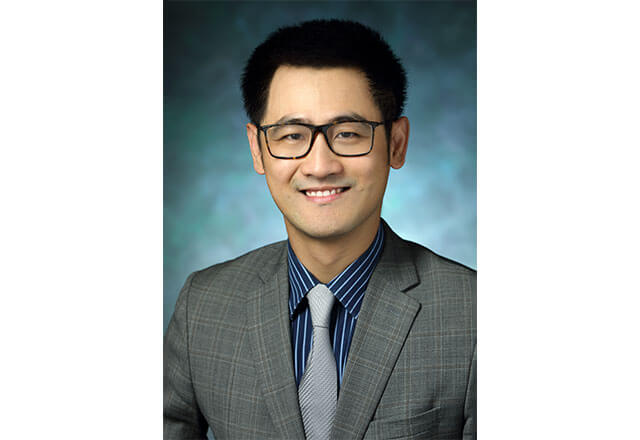
Ji Yi, associate professor of ophthalmology at Wilmer Eye Institute
Ji Yi, Ph.D., a biomedical engineer at the Wilmer Eye Institute, Johns Hopkins Medicine, likes to make things work. Engineering as a field appeals to him because engineers turn theory into reality. “There are so many uncertainties in life, but in engineering, things that were predicted to happen actually happen,” says Yi. As an example, he points to Einstein’s prediction of the existence of black holes in 1915. It was only a theory, though, until 2019, when the Event Horizon Telescope finally captured the image of one and made it real for the world — an accomplishment that took hundreds of people to implement, including many engineers. “When you put things together and they actually work as predicted — it’s very satisfying,” says Yi.
He knows this firsthand. Yi’s specialty is imaging. As a postdoc, he created a device called visible light optical coherence tomography using a new laser technology. “The device uses a laser technology that was not available until about 10 years ago,” says Yi. “And then, once that light source became available, we came up with a new engineering approach to implement the physics into a real device that is applicable in clinics.”
Optical coherence tomography, or OCT, is revolutionizing ophthalmology by imaging the eye, including the retina, in 3D. Visible light OCT has several advantages over conventional OCT, one of which is being able to image the cells of the retina in exquisite detail. To explain visible light OCT, Yi cites his work imaging photoreceptors in the retina.
A photoreceptor is a long cell with a top half and bottom half, the latter of which converts light into the electrical signal the brain interprets. In the bottom half, structures will appear in light or dark bands. In a conventional OCT image, the multiple bands blur together, and not much can be interpreted from them. But with Yi’s device, the bands appear as three, four or five distinct bands that correspond to important physiological functions in vision.
Being able to visualize photoreceptors in greater detail means being able to see when their structures begin to change — even before a patient has vision loss. Changes in these bands indicate that the photoreceptors are being altered in a fundamental way, which could indicate photoreceptor death, a precursor for vision loss in multiple eye diseases, including age-related macular degeneration, retinitis pigmentosa and other inherited retinal dystrophies. Catching changes early also means having the option to intervene with treatments earlier.
Yi’s imaging devices aid not just clinicians, however. Basic science researchers use them as well to visualize and quantify fundamental biological processes. An exciting endeavor multiple Wilmer researchers are involved in is attempting to regenerate the optic nerve. Different research teams are using various model systems — including organoids, or retinas created in a lab dish, and animal models — to study the complicated processes involved in regeneration. A key piece of the puzzle is measuring if, and when, cells are communicating with each other.
“We know that the retina is part of our brain, and the brain communicates by electric signals that travel in a millisecond, or 1,000th of a second,” says Yi. The standard way to measure the electrophysiology of the tissue — as in whether electric signals are traveling through it — is invasive. One must physically connect a device to the tissue, which can affect the processes it is trying to measure. In addition, this device, called a patch clamp, can measure only small areas of the tissue at a time.
“We wanted to be able to optically capture those communications,” says Yi. Optical measurement, which is what Yi’s device uses, is a noninvasive way that also can catch a wider range of the electric signals.
The number of projects on Yi’s docket continues to grow, which he welcomes. “The problem we have with clinical challenges is they simply cannot be solved by a single perspective. The situation calls for an interdisciplinary group of people who have different expertise working together to solve one complex problem. From the clinical perspective or basic sciences perspective, they know very well the biology side, but they may not necessarily have mastered all the fancy, cool, new engineering out there. So, this interdisciplinary work is critical to push the frontier of biomedicine forward,” says Yi.
Wilmer, and Johns Hopkins in general, is ideal for this type of interdisciplinary collaboration. “This is something that we should definitely cherish. I appreciate it more the longer I am here,” says Yi.