Research and Clinical Trials
We are interested in how immune responses occur in the cervix. The focus of our translational research is on developing immune therapies for disease caused by human papillomavirus (HPV). HPV infection causes more cancers than any other virus in the world.
Cervical cancer is the most common cancer caused by HPV, and although we have known how to screen for it for over half a century, it remains the second most common cause of cancer death in women. Although the preventive vaccines are a public health milestone, they prevent HPV infections, but are not designed to make immune responses to treat HPV.
We are testing different strategies to make immune responses that could treat HPV disease.
Clinical Trials
Artesunate intravaginal inserts or ointment for the treatment of high grade dysplasia in patients with persistent recurrence of HPV disease of the lower ano-genital tract
OVERVIEW
This is a compassionate use protocol for patients with persistent recurrence of HPV-associated disease of the lower ano-genital tract, and/or who have high grade squamous intraepithelial lesions (HSIL) at multiple body sites after standard-of-care surgical treatments can be enrolled in this expanded-access protocol.
This expanded access protocol includes two categories of patients: (1) patients who have already undergone multiple surgical procedures, and still have recurrence of their high grade dysplasia; and (2) patients who have extensive high grade dysplasia (HSIL) at more than one anatomic site, including vaginal, vulvar, cervical, or peri-anal.
Clinical Trials
Therapeutic HPV vaccines
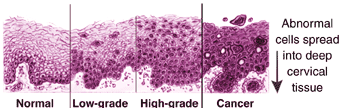
The focus of our translational research is on developing immune therapies for disease caused by human papillomavirus (HPV), to target a person’s own immune response to the pre-cancerous cells. We are interested in identifying and treating pre-cancerous lesions of the cervix, vagina, vulva, and per-anal area.
Development of off-the-shelf, personalized HPV vaccines
In collaboration with the Jim Heath group at the Institute for Systems Biology in Seattle, we are studying immune responses generated by treatment with a therapeutic HPV16 vaccine in persons who had HPV16-associated precancerous lesions, before they underwent standard surgery to remove them. NCT . This proof-of-concept clinical trial showed that HPV-specific immune responses could be generated by therapeutic vaccination, and robust immune changes responses were seen in the target tissue, the cervix. Lesions underwent regression in 7/11 (71%) of patients who received the highest dose. (Maldonado et al, Intramuscular therapeutic vaccination targeting HPV16 induces T cell responses that localize in mucosal lesions PMID24477000)
While most of the lesions regressed, some did not, and so provide an opportunity to determine what an effective HPV immune response looks like, and what happened in lesions that had not regressed. In subject-matched blood samples taken before and just after vaccination, as well as at the time of surgery if necessary, and postoperatively, the Heath group is identifying vaccine-generated HPV-specific T-cells in vaccinated patients. We are assessing subject-matched specimens in the context of the immune microenvironment in the cervical tissue. These insights will guide development of therapeutic HPV vaccines in the future. They will also form the basis of generating off-the-shelf, personalized immune therapies for HPV cancers. This work is underway and is not available to the public. A report of the platform for discovery of clinically relevant T cell receptors is currently under review.
Artesunate
We are testing the use of artesunate, a plant-derived compound used globally to treat malaria, as a topical treatment for high-grade precancerous HPV lesions. Treatment of cervical precancers with artesunate suppositories resulted in regression in 19/28 (67.9%) of patients. This trial was a potential breakthrough, as it tested the feasibility of giving medications to patients to administer to themselves, at home. Larger trials are ongoing. (Trimble CL et al, A first-in-human proof-of-concept trial of intravaginal artesunate to treat cervical intraepithelial neoplasia 2/3 (CIN2/3), PMID32005582)
We are also using artesunate ointment to treat precancers of the vulva and the perianal area, and have a Compassionate Use protocol to treat persons who have recurrent high-grade lesions. In our first trial testing artesunate ointment on vulvar pre-cancers, we observed regression in half of the lesions. This is clinically significant because high-grade vulvar HPV disease recurs in approximately half of patients who undergo surgery. (Michener CM et al, Safety and efficacy of topical artesunate for the treatment of vulvar intraepithelial neoplasia 2/3. https://doi.org/10.1016/j.ygyno.2023.10.003). Clinical trials testing topical artesunate at other sites are ongoing.
CONTACT
Maria Shay: 410-502-0512 or [email protected]