
Christopher A Maroun, MD
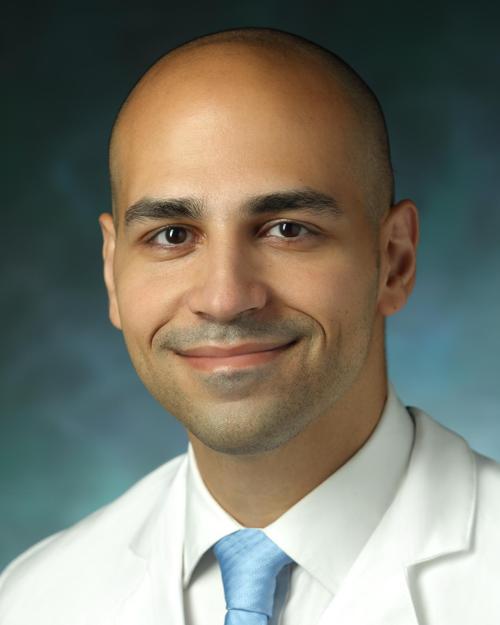
Expertise: Otolaryngology, Head and Neck Surgery, Head and Neck Surgical Oncology
Department of Otolaryngology
Levi Watkins, Jr., M.D., Outpatient Center
601 N. Caroline St., 6th floor
Baltimore, MD 21287
Program Director: Nyall London, M.D., Ph.D.
Phone: (301)-896-6077, option 3
One yearlong position is available each year, with an option of an additional research year, which must be partially/wholly funded. Other parallel fellowships: Pediatrics, Otology/Neuro-otology, Facial Plastic and Reconstructive Surgery, Rhinology, Laryngology, Head and Neck Endocrine.
The objective of this fellowship is to promote and develop leaders in the field of academic head and neck surgical oncology and reconstruction. Emphasis is on broad clinical training, including all aspects of head and neck surgical oncology and reconstruction. Advanced fellows will have the opportunity to focus on skull base surgery. Fellows will have a faculty appointment at the Instructor level that includes a mentored experience focused on a transition to independence. In particular, fellows develop skills in clinical teaching within the context of our residency program.
During the clinical year, fellows will participate in clinical and surgical care of patients within the faculty practices in an apprenticeship model, but will also have an individual, mentored clinical surgical practice. Fellows completing the program will have finely honed skills in surgical diagnosis and treatment of tumors of the head and neck and reconstruction (if desired). Training will cover the entire gamut of head and neck surgery including endocrine, robotic, skull base, minimally invasive and reconstructive approaches. Interested fellows can also get training in free flap and pedicled reconstruction as well as open and endoscopic (if desired) skull base surgery.
Fellows may choose to do an additional year of research. We offer a rich environment of translational research bridging surgical oncology and molecular biology pertaining to head and neck cancer, and population health sciences. The research training may serve as the basis to seek grant funding to facilitate the initiation of an academic career and is particularly attractive to those candidates seeking a career as a clinician-scientist. Fellows may set up an individualized research training experience with interdisciplinary colleagues in the institution, outside of the department of otolaryngology head and neck surgery, in consultation with the fellowship director. A variety of opportunities are available throughout Johns Hopkins University and the National Institutes of Health.
A bi-weekly case conference to highlight relevant literature including the multidisciplinary faculty and trainees is, led by the fellow and chief resident. Landmark and current literature are reviewed for head and neck oncology in the context of case presentations. For microvascular reconstruction, there is a journal club dubbed “Re-con-ference” that meets twice a month. Led by the reconstructive faculty, the club discusses key topics from distraction osteogenesis to site-specific defect reconstruction. We hold an annual open and endoscopic skull base cadaveric dissection course and monthly skull base didactic for Johns Hopkins trainees.
The fellowship offers an opportunity to personalize training. The basis of the training is a rotating apprenticeship model with the faculty and a prioritization for Transoral Robotic Surgery (TORS), reconstruction and skull base cases pending the interest of the fellow and after ensuring competence in the oncologic portion of the practice and ablative cases.
The Head and Neck Oncology and Reconstruction Fellowships at Johns Hopkins began in 1986. It received approval of the American Head and Neck Society in 1993.
Board eligibility in Otolaryngology- Head and Neck Surgery, General Surgery or Plastic Surgery.
All interested applicants are to apply through the American Head and Neck Society website. The administrative barriers to accepting a fellowship candidate who has not completed a residency in the United States are considerable and we currently are only accepting applicants through the American Head and Neck Society.
The Johns Hopkins Medical Institutions are world renowned for leadership in clinical medicine, public health and basic biomedical research. Johns Hopkins is a busy regional, national and international medical center encompassing the full range of clinical medicine with training programs for medical students, residents, and fellows in all major fields.
The following is a list of all cases available to the head and neck fellow for the fellowship period. During the year, the fellow performed approximately 400 cases, of which 300 were major procedures. Approximately 20% of all cases are performed by the fellow as primary attending with mentorship support provided by a faculty mentor. Available cases include:
We offer a comprehensive, interdisciplinary head and neck oncology and reconstruction team, complemented by robust research and education programs. The fellow will develop increasing comfort in managing complex head and neck oncology patients within a multidisciplinary framework. Dedicated clinical faculty provide mentorship to help develop skills and knowledge needed for an academic career. The academic milieu includes one of the finest otolaryngology residency programs in the country, with excellence in every aspect of the field. The tumor immunology, engineering and public health programs at Johns Hopkins are pre-eminent, and a rare tumors joint program with the National Institutes of Health creates a unique environment. Trainees have been highly successful in launching clinical translational academic careers. We have a strong multidisciplinary skull base surgery team and maintain a designation as a North American Skull Base Surgery (NASBS) Multidisciplinary Team of Distinction.
A=Ablative, M=Microvascular, R=Research, SB= Skull Base
Medical Oncology
Neuroradiology
Neurosurgery
Pathology
Radiation Oncology
Speech Language Pathology
Expertise: Otolaryngology, Head and Neck Surgery, Head and Neck Surgical Oncology