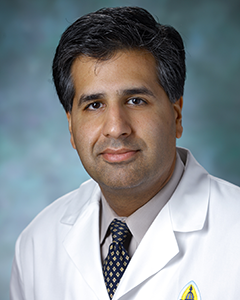
On behalf of the faculty, fellows, and staff of the Johns Hopkins Division of General Internal Medicine, I'm delighted to welcome you to our website.
Since I first came to Hopkins as a GIM Fellow in 1989, the Division has grown substantially. Hopkins GIM is now home to over 80 full-time faculty members and has an annual budget of over $25 million. Our mission is nothing less than international leadership in teaching, research, and practice in general internal medicine.
Our educators hold leadership positions in medical student education, residency training, and continuing medical education at Hopkins and have won national awards for excellence. Our researchers have built internationally recognized research programs in a wide range of fields: medical ethics; health services and outcomes research; comparative effectiveness; evidence-based medicine; and the epidemiology and prevention of major chronic diseases including heart disease, high blood pressure, obesity, diabetes, HIV, depression and mental illness, and chronic kidney disease. All of this co-exists with the practice of general internal medicine at the highest level of excellence whether in the office, the clinic or the historic wards of The Johns Hopkins Hospital. You can read about our history on our web page entitled Hopkins GIM: 30 Years of Medicine Without Limits.
We are particularly proud of our GIM Fellowship which has trained leaders in academic medicine for over 25 years and has been a major source of new faculty recruits to our own Division. Led by Dr. Jeanne Clark and Dr. Geetanjali Chander, and before them by Dr. Eric Bass, the program has trained over 100 fellows. Alumni serve in the US and abroad as Division Directors, Residency Program Directors, Research Professors, and Deans. In future years, we envision that the Fellowship will be a source of new faculty in Hospital Medicine, Behavioral Medicine, Women's Health, and Cancer Care and Prevention.
The 2010-11 academic year was an eventful one for the Division on a variety of fronts.
Despite a weak economy and a university-wide hold on hiring, the GIM Division continued to grow. Two former GIM Fellows joined the faculty in the Hospitalist Program. Dr. Romsai (Tony) Boonyasai moved mid-year from a clinically oriented post at Hopkins Bayview to a research-oriented post at Johns Hopkins Hospital where he will focus on quality improvement and transitions of care. After finishing our GIM Fellowship in June 2011 with an emphasis on Hospital Medicine, Dr. Henry Michtalik joined the faculty as an Assistant Professor. With funding from a KL2 Grant from the Johns Hopkins Institute for Clinical Research, he will focus on patient safety. The Hospitalist Program also recruited Dr. Sosena Kebede, a clinician-scholar with an MPH in health policy. Finally, Dr. Dwight Wooster joined the Tumulty Group as a senior clinician-educator, after 30 years of experience in private practice. He will see patients, teach, and precept in the Johns Hopkins Outpatient Center.
GIM faculty advanced the educational mission of the Division. Dr. Jodi Segal, Director of the GIM Program on Pharmacoepidemiology, established a new course on pharmacoepidemiologic methods at the School of Public Health and expanded the Program’s seminar series. The newly establish Med-Peds Urban Health Residency successfully matched its second class of trainees. Led by Dr. Rosalyn Stewart and Dr. Lenny Feldman, the Program has won national attention and has prompted the Department of Medicine to open an Urban Health track within the Osler training program.
Several GIM faculty received recognition within the University. Dr. Gail Berkenblit was named Associate Program Director for Ambulatory Education in the Osler Training Program. Dr. Ebony Boulware won the David M. Levine Award for Excellence in Mentoring from the Department of Medicine, an honor typically reserved for full Professors. Dr. Lisa Cooper, who directs the NHLBI-funded Center to Eliminate Cardiovascular Health Disparities, was named an inaugural Gilman Scholar by JHU President Ron Daniels. The Center, which is currently focused on improving blood pressure care for urban African Americans, launched a seminar series and a grant program this year.
Dr. Larry Appel was named Director of the Welch Center—a unique, interdisciplinary, geographically unified center with over 30 faculty and 50 trainees and over $18 million in annual funding from NIH. An internationally regarded researcher in CVD prevention and nutrition, Dr. Appel gave the 2010 Conner Lecture at the American Heart Association Scientific Sessions in Chicago and authored the AHA’s Presidential Advisory about salt consumption and CVD in the United States.
Other GIM faculty also won national honors. Dr. Jeremy Sugarman, the Meyerhoff Professor of Bioethics, was named to join the Institute of Medicine where he will serve
alongside Dr. Lisa Cooper. Dr. Padmini Ranasinghe was elected to the Governing Council of the AMA’s International Medical Graduates Section. Dr. Gail Daumit was named a ‘National Hero’ by the National Alliance for Mental Illness in recognition of her work on weight reduction and CVD prevention in people with serious mental illness.
Dr. Felicia Hill-Briggs was invited to speak at the 40th Annual Legislative Conference of the Congressional Black Caucus in Washington, DC. She spoke on the benefits of diabetes research and the importance of translation of evidence-based programs for diabetes prevention and management within the African-American community. And yours truly won awards from the American Diabetes Association and from the Association of Chiefs and Leaders in GIM and was elected to membership in the Association of American Physicians.
Our faculty also attracted media attention. The NY Times ran stories based on recent work by Dr. Wendy Bennett on evidence-based care of diabetes and by part-time GIM faculty member Dr. Anand Parekh on care of adults with multiple chronic diseases. Dr. H.C (Jessica) Yeh’s work on trends in type 2 diabetes among Asian Americans was covered by Reuters, Fox News, the Times of London, and National Public Radio. The Wall Street Journal interviewed Dr. Larry Appel for his expert opinion on salt consumption. Dr. Diane Becker’s study of cardiovascular risk genes in African Americans was featured by Reuters, the New York Post, and multiple health news outlets. And Dr. Sonal Singh's study of the cardiovascular adverse effects of a smoking cessation drug was covered by the NY Times, the Wall Street Journal, and National Public Radio.
Ask Hopkins faculty what makes the place special, however, and you won't hear about size, or growth, or grants, or programs. You'll hear about our history--a history of a small band of young scholars who moved to a provincial city to gamble on a fledgling school that was radically oriented toward training and who saw it change the face of American medicine in their lifetimes. You'll also hear about the collegial culture they created--a culture that persists to this day in form of unusually strong relationships across traditional boundaries of Divisions, Departments, and Schools. I like to think of Hopkins GIM as a special heir to those twin birthrights: at the cross-roads of scientific inquiry and at the center of the School's mission to train the leaders and healers of tomorrow in the tradition of Welch and Osler.
Frederick L. Brancati, M.D., M.H.S.
Professor of Medicine and Epidemiology
Director, Division of General Internal Medicine