Strabismus
What is strabismus?
Strabismus — also known as hypertropia and crossed eyes — is misalignment of the eyes, causing one eye to deviate inward (esotropia) toward the nose, or outward (exotropia), while the other eye remains focused. Misalignment can occur once in a while in newborns, especially if they are tired, but they should outgrow it by three months of age. In children, uncorrected strabismus can lead to amblyopia, a condition in which the brain starts to ignore signals sent by the weaker, misaligned eye that leads to vision problems.
In some children, strabismus is one of several manifestations of other medical conditions, including traumatic brain injury, retinopathy of prematurity, retinoblastoma, cerebral palsy and others.
Symptoms
- Crossed eyes
- Uncoordinated eye movements
- Double vision
- Vision in only one eye, with loss of depth perception
Diagnosis
If your doctor determines that your child has strabismus, the following tests will help determine the degree of the problem and possible causes:
- Visual acuity
- Retinal exam
- Neurological examination
Treatment
It is important to start treatment as early as possible to prevent vision problems and vision loss.
- Strengthening the eye muscles to realign the eyes by use of glasses and eye muscle exercises
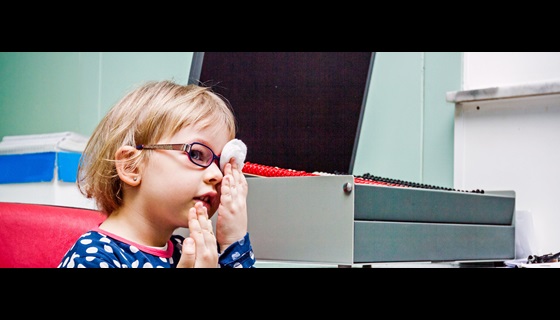
- In cases of amblyopia, covering the strong eye with a patch to stimulate the weaker eye
- Surgery to realign the muscles
The patch is not a popular treatment with children, who find it annoying and distressful. Johns Hopkins Children’s Center ophthalmologists have been using less traumatic treatments, such as drops or special glasses, simply to temporarily blur vision in the good eye, thus stimulating the weaker eye.
If surgery is necessary, Hopkins Children’s Center eye surgeons can use a technique called adjustable sutures. In this procedure, the surgeon precisely aligns the eyes several hours after surgery. Some types of strabismus now can be treated with a new drug instead of surgery. The drug temporarily weakens muscles, and when injected into the stronger set of muscles, it eases the pull, allowing the weaker muscle to gain strength. The drug gradually wears off over a few months, and muscle balance and eye alignment are often restored.
When to Call for Help
Seek advice from a specialist if your child is older than three months and his or her eyes are misaligned, even if it only happens from time to time, or if you notice that the child often looks with one eye closed or turns his or her head to one side when looking at things.