How the Ear Works

Understanding the parts of the ear — and the role of each in processing sounds — can help you better understand hearing loss.
The Outer Ear
The auricle (pinna) is the visible portion of the outer ear. It collects sound waves and channels them into the ear canal (external auditory meatus), where the sound is amplified.
The sound waves then travel toward a flexible, oval membrane at the end of the ear canal called the eardrum, or tympanic membrane. Sound waves cause the eardrum to vibrate.
The Middle Ear
The vibrations from the eardrum set the ossicles into motion. The ossicles are actually tiny bones — the smallest in the human body. The three bones are named after their shapes: the malleus (hammer), incus (anvil) and stapes (stirrup). The ossicles further amplify the sound.
The tiny stapes bone attaches to the oval window that connects the middle ear to the inner ear. The Eustachian tube, which opens into the middle ear, is responsible for equalizing the pressure between the air outside the ear and that within the middle ear.
The Inner Ear
The sound waves enter the inner ear and then into the cochlea, a snail-shaped organ. The cochlea is filled with a fluid that moves in response to the vibrations from the oval window. As the fluid moves, 25,000 nerve endings are set into motion. These nerve endings transform the vibrations into electrical impulses that then travel along the eighth cranial nerve (auditory nerve) to the brain.
The brain then interprets these signals, and this is how we hear.
The inner ear also contains the vestibular organ that is responsible for balance.
Research Shows A Closer Look at the Cochlea
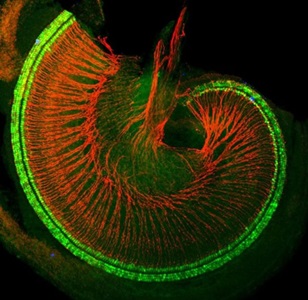
A small portion of a rodent’s cochlea is captured in this image. In green are four rows of hair cells that respond to sound vibrations, and in red are auditory nerve fibers that convey sound information from the hair cells to the brain. Researchers at Johns Hopkins are studying the molecular mechanisms that guide the formation of hair cells. Studies such as these might be a step towards less invasive treatments for deafness in which molecular cues can be used to biologically regenerate hair cells in the cochlea.