


An image of the Charlotte R. Bloomberg Children's Center and Sheikh Zayed Tower


Scheduling with surgical precision

A fresh suite of operating rooms ends a cycle of delays and cancellations in the OR.

By Shannon Swiger (Hopkins Dome, Nov. 2011)

On a typical, recent day in Surgery, a team of doctors and nurses in scrubs and gloves worked steadily to prepare for a heart transplant procedure. They put the patient to sleep and began surgery in anticipation that the new heart would soon arrive. But when bad weather stalled the transport of the donated organ, the surgical team had to bring the operation to a temporary halt.

As the transplant team's wait lengthened, patients who were scheduled for surgery later in the day were sent home one by one—a young mother requiring a heart valve replacement, an elderly man in need of a pacemaker. While scenarios like this are not uncommon at many hospitals, that will soon change at The Johns Hopkins Hospital, explains anesthesiologist Jackie Martin, the hospital's medical director of perioperative services. The upcoming transition to the new 33-room, state-of-the art OR acted as a catalyst, leading staff to revise the blueprint for how patients are scheduled for surgery.

After months of work, a cross-disciplinary team of administrators, anesthesiologists, nurses and surgeons has developed a plan to minimize suspended surgeries so patients can receive care in a timelier manner. "We want to focus the timing of an operation on when the patient needs to be in the operating room," says Julie Freischlag, head of the Department of Surgery and Hopkins Hospital's surgeon in chief. Costly to the institution, delays are frustrating not only for patients but also for staff who face long workdays, overtime and general unpredictability in their schedules, Martin says. "Many of our employees never know when their day is going to end. We want to provide them with more reliable schedules and a better overall work-life balance."

Hopkins has enlisted the help of the Institute for Healthcare Optimization, or IHO, a research and teaching nonprofit that uses operation management tools to improve patient flow and quality of care at hospitals. "Separating the process by which different types of patients are scheduled and placed in terms of physical space and resources is the key to smoother and safer surgical schedules," says Michael Long, IHO senior clinical fellow and former anesthesiologist. He describes categories of cases that often compete for the same OR resources: life-threatening emergencies, such as trauma from a motor vehicle accident; prescheduled elective surgeries, such as a joint replacement or hysterectomy; and hospitalized patients who need surgery within a few days.

Finding staff for unplanned cases and for surgeries that have been pushed back or rescheduled can be difficult. "A case may come in on a day when a surgeon isn't scheduled to be in the OR. The surgeon will say that they can do the case at 4 p.m., but the room and staff may be available at 10 a.m.," Martin explains.

There's also been what can seem like a disincentive for efficiency: Often the reward for finishing early or on time is an additional case, says Terry Emerson, a nurse manager in the operating rooms. Many times these added surgeries don't match up with the surgical team's specialty. "I think it's going to be a significant nursing satisfier that you come in and you know what cases you're going to be doing throughout the day," Emerson says.

IHO spent three months recording data on surgical caseload, scheduling, patient type, length of surgery and more. After analyzing that information, the consultants identified a new model that could best use space, equipment and available staff to improve patient access and flow in the OR. Hopkins is planning to use it during a three-and-a-half month pilot beginning in January in Weinberg and the operating room.

The plan calls for dedicating operating rooms and staff for both scheduled and unexpected surgeries, as well as for putting an emergency surgeon and team on call. Advanced technology in the new clinical buildings' operating suite also should improve overall workflow and safety, including medical booms used to better position audio, video and medical equipment, and intraoperative MRI, which allows surgeons to use imaging to evaluate the success of a procedure during surgery.

If the pilot succeeds at increasing patient access, better managing facilities and improving staff scheduling, then the pediatric and cardiac operating rooms will also undergo similar changes, Martin says.


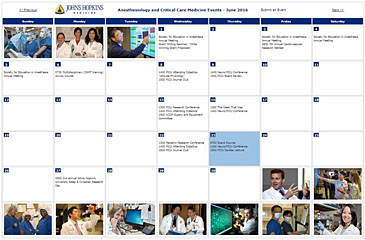
Grand Rounds
Calendar and Webcasts

Grand Rounds take place Thursdays at 7 AM in Hurd Hall. Windows Media Player is required to view webcasts.

June 20th: Patient-Based Learning Discussion – Tracey Stierer, M.D.

June 27th: End-of-Block Divisional Meetings

July 11th: State of the Department

ACCM Research-sponsored Grand Rounds: Anesthesia and developmental neurotoxicity: Are we closer to understanding the truth? – Vesna Jevtovic-Todorovic, M.D.
Watch webcast >>

Department of Anesthesiology and Critical Care Medicine Biennial Meeting
More info >>
Watch webcast >>

Donald W. Benson Lecture on Pain Medicine: The Clinician-Scientist, Pain Medicine, and Entrepreneurship: A Case Study – James N. Campbell, M.D.
More info >>
Watch webcast >>

7th Robert A. Abraham, M.D. Endowed Lectureship: Maintenance of Epidural Labor Analgesia, From Bolus to Infusion to Bolus – Cynthia Wong, M.D.
Watch webcast >>

Grand Rounds Archives
View archived webcasts >>


Out of State and International Patients

Make a Gift


© The Johns Hopkins University, The Johns Hopkins Hospital, and Johns Hopkins Health System, All rights reserved.

Legal Disclaimer