Simulator Training at CISTEL:
Center for Immersive Simulation and Telemedicine

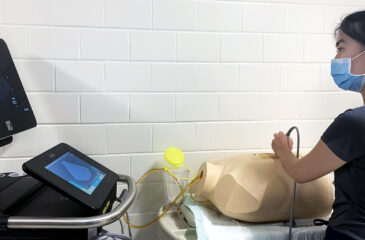
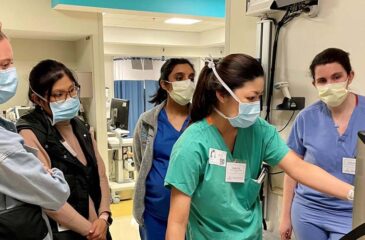
Dr. Eric V. Jackson watches intently as the first-year anesthesiology resident hovers over the figure of "Sim Man", the simulation patient, while Dr. Benjamin Lee closely monitors from the laptop. During the first week of training, Dr. Jackson gently coaches the resident on airway skills for the operating room. At various times, he is joined by other faculty including colleagues Mark Rossberg, Chauncey Jones and Robert Brown. The room is tightly packed with real equipment, including the anesthesia delivery system, and it closely resembles a live operating room where real patients are undergoing surgery. As the academic year continues, Dr. Lee and Dr. Jackson and other faculty will repeat this scene with every resident. In the first month of the academic year, over 170 simulation events were completed.

Resident Rosanne Sheinberg practices
Airway Management
during Week 1
One of the goals of the Center for Immersive Simulation and Telemedicine known as CISTEL is to create a completely realistic residency training environment for the Operating Room. Directed by faculty members Eric Jackson and Benjamin Lee, the next generation of Hopkins anesthesiologists assembles during the July orientation month to carefully prepare for their real-life roles using advanced simulation techniques. As pioneers in Anesthesiology and Critical Care Medicine's use of the Center, Jackson and Lee are regularly joined by a cadre of other faculty who introduce new skills and knowledge to each arriving class of eager residents.

Dr. Ronald Pauldine and Dr. Sharad Desai
CISTEL is already receiving high marks from clinicians whose careers began decades before the development of simulation technology. While it is too early to measure all of the ways that such simulation training will impact the residency program, the ACCM faculty already reports informally that this rigorous new training is making a marked difference in helping to prepare the incoming class of residents for their roles in the operating room.
Perhaps the biggest change is that it provides a safe and comfortable environment for the rigorous clinical orientation of housestaff to a complex and ever changing set of new technology. Besides making residents more prepared to use complex technology, the Center is widely considered an exciting leap in patient safety that is proving increasingly important for a complex academic medical center perioperative environment where multi-disciplinary teams routinely work on the cutting edge.

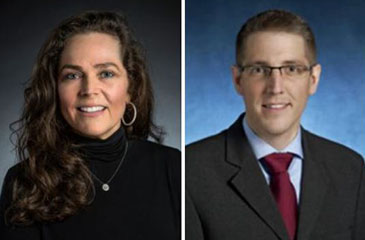
Dr. Eric Jackson and Dr. Benjamin Lee
This year marks what Malcolm Gladwell refers to as the "tipping point" for simulation-based education for anesthesiology residents in our department. A formal simulation curriculum has been developed, tested and well received by the residents. By report, the residents enjoyed the airway skills sessions utilizing partial task trainers. Broad departmental participation has been established. As of this year, the majority of anesthesia residents in our program have experienced simulation.
|

Andrew Goins (right) performs rapid sequence induction while
Emmett Whittaker (left) and Elizabeth Martinez (right) observe.

Jeremy Huff, Karen Lindeman and Eugenie Heitmiller
Other Simulation Links
Three prestigious medical institutions including the Johns Hopkins School of Medicine in Baltimore, Md.have agreed to serve as test sites for Pulse!! The Virtual Clinical Learning Lab being developed by Texas A&M University-Corpus Christi. Dr. Eric V. Jackson Jr., director of the Center for Immersive Simulation and Telemedicine at Johns Hopkins, said the project dovetails with the center's goals. "The Johns Hopkins Simulation Center and the Center for Immersive Simulation and Telemedicine are dedicated to advancing the fields of medical education and patient safety and believe that the Pulse!! project represents an exciting innovation that can truly contribute to both," Jackson said.

Elizabeth Martinez, MD and Faculty Member Eugenie Heitmiller
participate in surgical role play

Philip Roman, MD, and Faculty Members Dr. Mark Rossberg
and Dr. Chauncey Jones
2007
CISTEL Faculty |
|
Lauren Berkow |
|
Adolfo Blanco |
|
Robert Brown |
|
Chauncey Jones |
|
Sharad Desai |
|
Jeffrey Dodd-o |
|
Ralph Fuchs |
|
Robert Gross |
|
Marie Hanna |
|
Theresa Hartsell |
|
Eugenie Heitmiller |
|
Eric Jackson |
|
Ann Jones |
|
Benjamin Lee |
|
Karen Lindeman |
|
Elizabeth Martinez |
|
Kristen Nelson |
|
Ronald Pauldine |
|
Pavithra Ranganathan |
|
Jose Rodriquez-Paz |
|
Mark Rossberg |
|
John Sampson |
|
Jamie Schwartz |
|
Deborah Schwengel |
|
Devika Singh |
|
Patricia Veloso |
|
Robert Wong |

Faculty Member Dr. Robert Brown demonstrates
the techniques
of direct laryngoscopy for intubation to residents
Charles Brown (left), Andrew
Goins and Philip Roman (right)

Faculty Member Dr. Chauncey Jones
engages in lively Q&A with housestaff

Faculty Member Dr. Ralph Fuchs (center)
assists residents Stacie Johnson,
Christina Miller,
Jane Radov and Laura Burton with the securing of the airway

Dr. Marie Hanna (center) offers constructive advice to
Cindy Chen
(left) and Laura Burton (right)
on the prevention of dental trauma.

Dr.
Sharad Desai reviews the fundamentals of airway visualization

Resident Dawn Yan