
Research
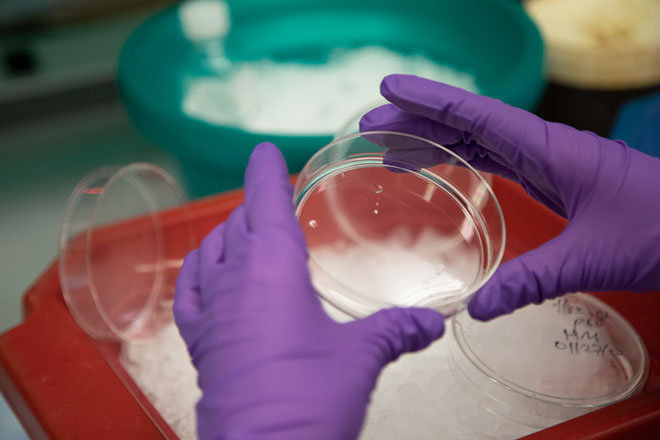
The Kimmel Cancer Center spans 34 departments and 5 schools across Johns Hopkins University. At the centerof that growth is our research component. How we conduct our research and translate those results aims directly at the core of our mission: Improved patient care.
Patient Stories How Cancer Research is Savings Lives and Shaping the Future
Discover how cancer research has made a difference in real lives. Read inspiring patient stories and see the hope that new treatments can bring. Click on a story below to read more!
-
Bill's Story
See how one breakthrough changed a life forever!

-
Elena's Story
A story of resilience: how one treatment brought new hope!

-
Jonathan's Story
Hope, humor, family: Jonathan's triumph.

-
Susan's Story
Susan's battle with cancer proves that hope and the right care can change everything.

Milestones of Discovery
Milestones Timeline
2020
- The CancerSeek multicancer blood test was studied in nearly 10,000 women with no evidence or history of cancer and safely detected 26 undiagnosed cancers, enabling potentially curative treatment.
- The Convergence Institute, aimed at gathering expertise across Johns Hopkins to look at cancer in new ways and advance the understanding and ultimately treatment, is launched.
- A new mechanism invasive breast cancer cells use to evade the immune system to metastasize was discovered.
- The inflammasome—a protein signaling network that is activated to rid the body of virus or bacteria-infected cells—found to play an important role in triggering an immune response to cancer and causing cancers to respond to PARP inhibitors.
- Elizabeth Jaffee, Elana Fertig, and Luciane T. Kagohara were among the first members selected to the 10x Genomics Visium Clinical Translational Research Network (CTRN) aimed at advancing translational research in cancer and other world health problems.
- A combination of immunotherapy with a targeted therapy improved cancer control for biliary tract cancers.
- Researchers teased out the tumor microenvironment of types of sarcoma and found tumor-associated macrophages hamper the proper immune reaction against the tumors.
- A study found that it may be cost effective to begin colorectal cancer screenings at age 40.
- Stereotactic ablative radiation (SABR) slowed progression of disease in a subset of men with hormone-sensitive prostate cancers that spread to a few separate sites in the body.
- DeepLR computer algorithm showed promise as an accurate tool to help predict which people with lung lesions are likely to develop cancers and when.
- Immunotherapy before surgery used in patients with Merkel Cell Carcinoma eliminated cancer in nearly half of the study participants undergoing surgery.
- A blood test that predicts recurrence of gastric cancer in patients after surgery.
2019
- The Johns Hopkins National Proton Therapy Center opened.
- A new test called MANAFEST scours immense amounts of data to find the unique biochemical signatures in each patient’s cancer that can trigger an immune response.
- The Mark Foundation Center for Advanced Genomics and Imaging at the Johns Hopkins University was established.
- A program for managing side effects of immunotherapy piloted by the Bloomberg~Kimmel Institute received recognition from the National Comprehensive Cancer Network.
- Favorable five-year survival rates from the first multidose clinical trial of the immunotherapy drug nivolumab (anti-PD-1) as a treatment for patients whose previous therapies failed to control their advanced melanoma, renal cell carcinoma or non-small-cell lung cancer were reported.
- The largest pancreatic cancer genome-wide association study discovered changes to five new regions in the human genome that may increase the risk of pancreatic cancer.
- The Johns Hopkins Colorectal Cancer Research Center of Excellence launched.
- The first clinical trial of an immune checkpoint inhibitor before surgery in liver cancer began.
- A new test called CompCyst was developed to distinguish pancreatic cysts that will develop into cancer and need to be surgically removed from cysts that can safely be left alone.
- The only clinical trial among non-muscle invasive bladder cancer trials combined a standard treatment called BCG with a shortened, six-month course of immunotherapy.
- The Greenberg Bladder Cancer Institute launched a women’s bladder cancer program.
- Two studies showed that blood-based liquid biopsies can accurately track cancer treatment responses by measuring circulating tumor DNA during immunotherapy and related treatments for lung and other cancers.
- A broad interdisciplinary research effort at the Bloomberg School of Public Health and Kimmel Cancer Center is aimed at closing racial, economic, and social disparities in the prevention, detection, and treatment of cancer in the United States and worldwide.
- Our center became one of a few with MRI-guided brachytherapy for gynecologic cancers.
- A new blood test called DELFI detected breast, colorectal, lung, ovarian, pancreatic, gastric or bile duct cancers by spotting unique patterns in the fragmentation of DNA shed
2018
- Dr. Elizabeth Jaffee elected President of the American Society for Cancer Research.
- Skip Viragh Outpatient Cancer Building opens.
- CancerSEEK, a single blood test that screens for eight common cancer types and helps identify the location of the cancer, developed.
- Participate in first large-scale study of prostate cancer in African-American men.
- Anti-PD-1 immunotherapy before lung cancer surgery dramatically shrinks tumors.
- Higher mutational burden predicts which cancer types will respond to immunotherapy with checkpoint inhibitors.
2017
- Mismatch repair discovery leads to the first-ever FDA approval of a cancer drug based on a specific genetic profile without regard to where in the body the cancer started.
- Pediatric oncology site for first CAR-T immunotherapy clinical trials.
- Center to Reduce Cancer Disparities oversees increase in minority and female participation in clinical trials.
- Drug targets cellular machinery called POL1, on which cancer cells rely.
- New immunotherapy drug developed to kill cancer cells by disrupting cell metabolism.
- Development of blood test that detects tumor-derived DNA in patients with early-stage cancers.
2016
- The Bloomberg~Kimmel Institute for Cancer Immunotherapy launched.
- Mutations in mismatch repair genes found to be biomarker of response to immunotherapy.
- Anti-PD-1 immunotherapy shown to improve survival in non-small cell lung cancer patients; also used successfully to treat a rare type of virus-linked skin cancer, called Merkel cell carcinoma.
- A personalized cell therapy, called MILs, using immune cells grown from patients' own bone marrow, is used to treat multiple myeloma.
- The Sidney Kimmel Cancer Center at Sibley Memorial Hospital opened, adding medical oncology and surgical oncology to the already established and growing Radiation Oncology Program.
- Molecular method called BEAM distinguishes between women who only need routine mammography from those who are at high risk and need additional preventive measures to avoid breast cancer.
- Construction of the Johns Hopkins Proton Therapy Center at Sibley Memorial Hospital begins.
- The John Fetting Fund for Breast Cancer Prevention brings together leaders to launch research in cancer prevention and control.
- CT and MRI-assisted brachytherapy used to treat gynecologic cancers.