
Multiple Pregnancy
What You Need to Know
- Mothers carrying two or more fetuses need more calories, protein and other nutrients, including folic acid.
- You may need to see a maternal-fetal medicine specialist, also called a perinatologist, for special testing and ultrasound evaluations.
- The delivery method for your multiples will depend on many factors, including your health, and the health, positions and gestational age of your babies.
What are the symptoms of multiple pregnancy?
Each woman may have slightly different symptoms. But the most common symptoms of multiple pregnancy are:
- Uterus is larger than expected for the dates in pregnancy
- More morning sickness
- Greater appetite
- Too much weight gain, especially in early pregnancy
- Babies' movements felt in different parts of the stomach at the same time
How is multiple pregnancy diagnosed?
Many women think they are pregnant with more than 1 baby. The healthcare provider may diagnose multiple babies early in pregnancy. This is especially true if fertility treatments were used. The provider may make the diagnosis with a health history, physical exam, and the following tests:
- Pregnancy blood testing. Levels of human chorionic gonadotropin (hCG) may be quite high with multiple pregnancy.
- Alpha-fetoprotein. Levels of a protein released by the fetal liver and found in the mother's blood may be high when more than 1 baby is making the protein.
- Ultrasound. This is an imaging test that uses high-frequency sound waves to create images of blood vessels, tissues, and organs. Ultrasounds can be done with a vaginal probe (transducer), especially in early pregnancy. Or they can be done with an abdominal probe in later pregnancy.
Management of Multiple Pregnancy
Your health care provider will help manage your multiple pregnancy based on your:
-
Pregnancy, overall health and medical history
-
Number of fetuses
-
Tolerance for specific medicines, procedures or therapies
-
Expectations for the course of the pregnancy
-
Personal preference
Your prenatal care plan may include:
-
Increased nutrition. Mothers carrying two or more fetuses need more calories, protein and other nutrients, including folic acid. On average, a woman’s caloric requirements will increase at least 40 percent for a multiple pregnancy. But your physician’s weight recommendation will be based on your weight at the beginning of pregnancy rather than on the number of babies you’re carrying.
-
More frequent prenatal visits. A multiple pregnancy increases the risk of complications. More frequent visits may help your doctor find complications early enough to implement effective treatment or management. Your nutritional status and weight should also be monitored more closely with a multiple pregnancy.
-
Physician referrals. You may need to see a maternal-fetal medicine specialist for special testing, ultrasound evaluations or coordinating the care of complications.
-
Increased rest. Some women may also need bed rest. This can take place either at home or in the hospital, depending on pregnancy complications and the number of fetuses. While preventive bed rest has not been shown to prevent preterm birth in multiple pregnancy, reduced activity may be recommended and beneficial.
-
Maternal and fetal testing. Testing may be needed to monitor the health of the fetuses, especially if there are pregnancy complications.
-
Tocolytic medicines. If you experience preterm labor, you may be given tocolytic drugs to help slow or stop your contractions. These may be given orally, by injection or intravenously. Tocolytic medicines often include nifedipine.
-
Corticosteroid medicines. Corticosteroid medicines may be given to help mature the lungs of the fetuses. Lung immaturity is a major problem for premature babies because it may cause breathing issues.

Delivery of a Multiple Pregnancy
The method of delivery will depend on many factors, including the mother’s health, fetal health, fetal position and gestational age.
Vaginal Delivery
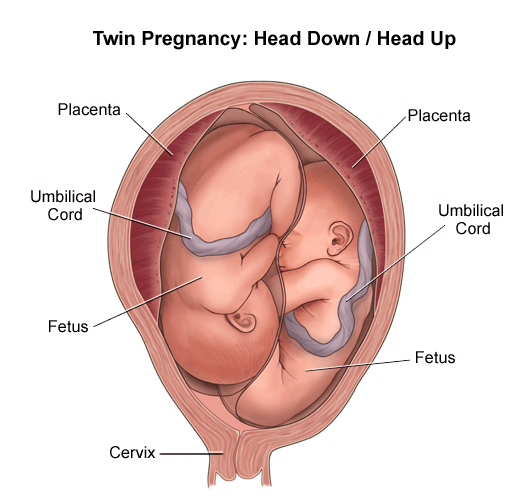
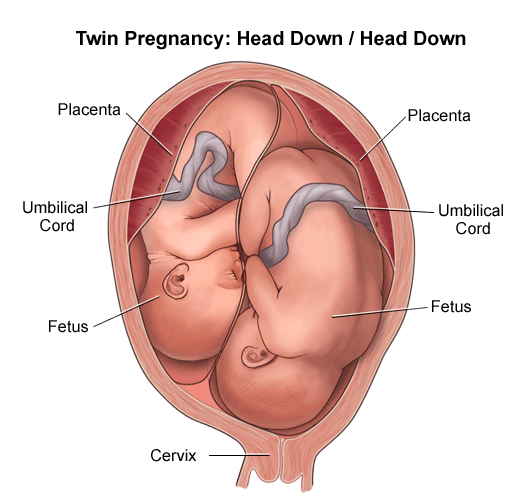
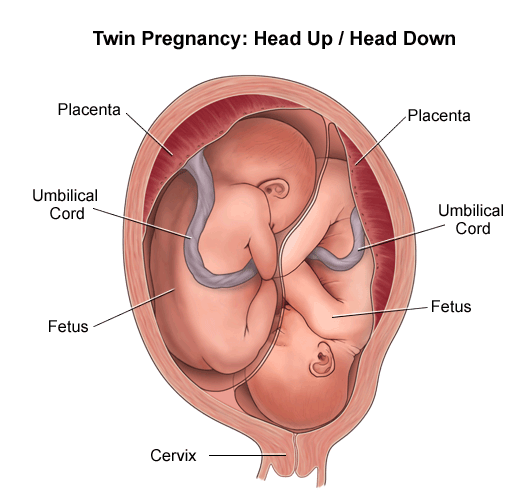
Generally, if you are carrying twins, you should be able to deliver them vaginally if both fetuses are in the vertex (head facing down) position and there are no other complications. Also, in many cases where the first twin is vertex, but the second twin is not vertex (head not facing down), you can still have a vaginal delivery. After the first fetus delivers vaginally, the doctor will either turn the second fetus to the vertex position or deliver it breech (buttocks or feet are presented first). Since these procedures can increase the risk of problems, such as prolapsed cord (when the cord slips down through the cervical opening), an emergency Cesarean section (C-section) for the second fetus may be needed.
Vaginal deliveries often take place in an operating room because of the greater risk of complications during birth and the potential need for a C-section when delivering multiples.
C-Section
In the case of twins, if the first fetus is not vertex, both babies will likely be delivered by C-section. Most triplets and other higher-order multiples are also delivered by C-section.
Delivery by C-section is usually needed:
-
To deliver babies in abnormal positions
-
When the mother has certain medical conditions
-
If the babies are in fetal distress
-
If the pregnancy is monochorionic
In the NICU
The NICU has advanced technology and trained healthcare providers to give special care for the tiniest patients. NICUs may also have care areas for babies who aren't as sick but do need special nursing care. Some hospitals don't have the personnel or an NICU, and babies must be moved to another hospital.
In most cases, you can be with your babies in the NICU at any time. The staff of the NICU will give you instructions on special handwashing methods before entering the area. In some cases, you may need to wear a mask. In some cases, during a procedure or when the hospital staff are making rounds, parents may be asked to wait for a few minutes before coming into the area. Most NICUs allow other family members to visit babies. But limiting visitors is a good idea. Many sick and premature babies are at high risk of infection. Siblings should be carefully checked for signs of colds or other illness. They should also be helped with handwashing before visiting their new siblings.
Most parents find that taking part in their babies' care gives them a sense of control. It also helps them bond with their babies. This is also important for the babies. It helps the babies feel secure and loved. Once the babies' condition is stable, parents are encouraged to hold and rock them. Staff in the NICU can show you how to care for your babies in many ways. Learning these ways of care will prepare you to take your babies home.
Once babies are able to feed, grow, and stay warm, they can usually be sent home. Other babies who are healthy at birth may need only a brief check in a special care nursery.
Breastfeeding Multiple-Birth Babies
Breastmilk is the perfect food for your babies. It gives your babies many advantages compared with formula. Your milk contains just the right amount of nutrients. And it's gentle on your babies' developing stomachs, intestines, and other body systems. It also has the best nutrients for brain and nervous system development and overall growth and development.
Getting used to breastfeeding more than one baby will take extra patience and persistence. How soon you and your babies can begin to breastfeed will depend on the maturity of your babies' brains and body systems. A baby's gestational age affects the development of stable body systems and the reflexes needed for oral feedings. A baby's physical condition may also affect when breastfeeding can start.
Lactation specialists can help you learn how to breastfeed your babies separately and together and to increase your milk supply. If your babies are unable to breastfeed because they're sick or premature, you can pump your breastmilk and store it for later feedings.
Families with more than one baby may need help from family and friends. The first 2 months are usually the hardest. This is the time everyone learns to cope with frequent feedings, lack of sleep, and little personal time. Having help for household chores and daily tasks can allow you the time you need to get to know your babies, for feedings, and for rest and recovery from delivery.