Print This Page
Share this page: More
 

Services

Tests and examinations

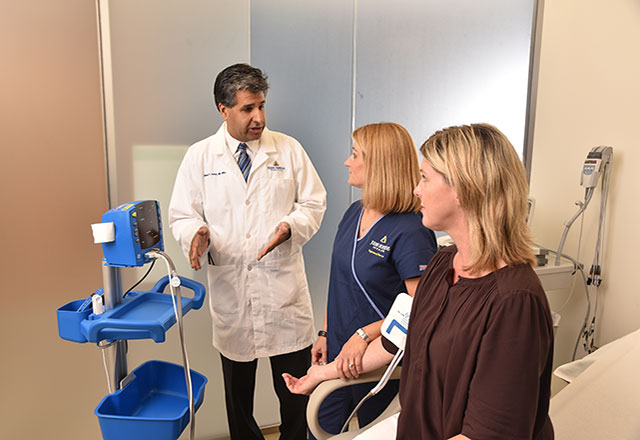
Your daylong visit to the Johns Hopkins Executive & Preventive Health program will be tailored to meet your individual health needs, based on personal preferences and your Patient Information questionnaire. Request an appointment today.

executive health services
  • Detailed medical history and physical examination – A thorough medical history is the cornerstone for effective assessment and diagnosis. It reviews any past problems and looks for susceptibilities based on your personal and family background, as well as your health habits. This is the opportunity for you to raise any medical concerns you may have. Your personal Johns Hopkins Executive & Preventive Health physician will perform an extensive physical examination.
  • Comprehensive laboratory screening tests – These detect anemia, diabetes, thyroid disease, liver and kidney disease, and include a lipid panel to assess cardiac and stroke risk factors. Testing for men also includes Prostate Specific Antigen (PSA) screening. The use of the PSA is controversial. We continue to begin testing men at age 40 if there is a family history or other risk factors and at age 45 in all other men. We discourage screening men over the age of 75 given evidence that it may do more harm than good.
  • Resting electrocardiogram (EKG) – Detects changes in the heart’s electrical activity. Patterns seen in the tracing indicate where tissue may have been damaged, if coronary arteries may be blocked, or if irregular beats occur frequently.
  • Chest X-ray – Assesses heart size (thickened walls may reflect decreased pumping ability) and pulmonary disease, including lung masses. A baseline chest X-ray will be obtained at your first visit. Subsequent studies may be needed if you have a history of respiratory symptoms, smoking or known lung disease.
  • Pulmonary function test (PFT) – Help diagnose emphysema, bronchitis, asthma or other pulmonary problems. PFTs are obtained at your first visit. Follow-up studies on subsequent visits may be obtained if you have a history of respiratory symptoms, smoking or known lung disease.
  • Audiogram – Performed by an audiologist who also makes recommendations to help preserve hearing or who may suggest sound amplification. Hearing loss of some degree affects 22 million Americans; high frequency loss, which impairs speech comprehension, is the most common form. An audiogram should be obtained at the first visit. Subsequent studies will be determined based on your needs.
  • Eye examination – Performed by uniquely trained optometrists at the Johns Hopkins Wilmer Eye Institute. This examination includes the external eye structures, pupils, eye muscle function, internal pressure, visual fields and visual acuity. An eye exam is appropriate on a biannual basis unless visual, ocular symptoms or known eye disease warrants reevaluation or a second opinion. Individuals over age 50 who have diabetes or a family history of glaucoma, or who are African American (due to greater risk of glaucoma), should have an annual examination—even if they have no ocular symptoms.
  • Nutrition counseling – Available for individuals who wish to seek advice and information from a registered dietitian. Specific nutritional issues related to health maintenance and disease prevention will be discussed based on the individual’s laboratory test results and nutrition assessment.
  • Skin Cancer Screening- A check for cancer, moles, rashes and other lesions is performed by  a member of our Dermatology faculty. Screening is recommended on an annual basis.
  • Final conference – Includes a review of test results, recommendations for any further testing or follow-up, and counseling about personal health habits. This may be the most important part of the day. A personalized, written summary will also be sent a few weeks later; a copy can be sent to your primary care physician if you desire. We encourage you to contact your Executive & Preventive Health physician if you have any questions about his/her findings or recommendations.
  • Optional Services

  • Exercise stress test – This treadmill test provides information about how your heart responds to physical activity. A baseline test is recommended beginning at age 50 (sooner if significant risk factors exist). Whether or not it should be repeated requires individualized review with your Executive & Preventive Health physician.
  • Exercise counseling – Available for individuals who wish to seek advice and guidelines from a certified exercise specialist on their present exercise regimen and ways to enhance it, as well as those interested in starting an exercise program. These guidelines will include the appropriate type, intensity, duration, frequency, and rate of progression relative to the initial level of fitness. 
  • Colonoscopy – Recommended by the American Cancer Society to screen for colorectal cancer in all Americans 50 years of age or older every 8-10 years. Greater frequency of colonoscopy is appropriate for individuals with a family or personal history of colorectal cancer or polyps. This procedure requires thorough cleansing of the bowel and intravenous sedation. It’s necessary to schedule an additional day and have a chaperone accompany you home after the procedure.
  • Body fat analysis – Higher levels of body fat have been shown to be associated with numerous medical conditions, including diabetes, heart disease, sleep apnea, and certain cancers. Measurements are taken to estimate your current overall body fat.
  • Travel medicine consultation – If your travel includes international destinations, we can arrange a consultation to discuss risks, update travel immunizations and provide appropriate prescriptions.
  • Abdominal aortic ultrasound – This test is utilized to screen for enlargement of the abdominal aorta (aneurysm). Early detection can potentially prevent the catastrophic consequences of aneurysm rupture. We currently recommend this test for patients over age 65 who have ever smoked, since cigarette use is strongly associated with the development of aneurysms.
  • Peripheral arterial disease (PAD) screening – Recent evidence suggests that PAD is quite common, affecting 20% of adults over 70 years of age. Additionally, patients with PAD have a dramatically increased risk of stroke and heart attack. The American Heart Association recommends screening with an ankle-brachial index for: patients who are over age 70; patients who are between age 50 and 70 and have a history of smoking or diabetes; patients who are under 50 with a history of diabetes and one other cardiovascular risk factor; and patients with known cardiovascular or cerebrovascular disease.  
  • Human immunodeficiency virus (HIV) testing – The Centers for Disease Control and Prevention (CDC) recommend HIV testing for all adults under the age of 65. 
  • Mammogram – Despite the recent controversy regarding mammography in patients under the age of 50, the Johns Hopkins Executive & Preventive Health Program continues to recommend a screening with mammography at least every 2 years beginning at age 40. Women who have had mammograms outside of Johns Hopkins should bring copies of their most recent films to their appointment.
  • Cervical cancer screening – Recommended for women under the age of 65 every 1-3 years. Women over the age of 65 may benefit from screening depending upon their risk factors.
  • Bone density screening – Osteoporosis is a very common condition that increases the risk of fractures that can be debilitating. The National Osteoporosis Foundation recommends a bone density scan for all women aged 65 and older, all men aged 70 and older, postmenopausal women under the age of 65 with risk factors for osteoporosis, and for men aged 50-70 with risk factors for the condition. Younger patients may also benefit from screening if they have certain medical conditions or take certain medications.
  • Whole-body CT scan screening – Computerized tomography (CT) is an indispensable tool in the evaluation of many medical questions and disorders. Aggressive marketing by for-profit facilities promoting the supposed advantages of screening asymptomatic people with whole body computerized tomography (WBCT) has prompted many patients participating in the Executive & Preventive Health Program to ask whether this is a test that they should have as part of their evaluation.

    Although its proponents portray it as a study we should all want to have, it is important for patients to know that there is no current evidence that WBCT screening in the asymptomatic person is effective. Furthermore, it is equally important for the public to know that there is an undisputed downside, including significant radiation exposure, the frequent demonstration of benign abnormalities that require further additional expensive and possibly risky studies, often lengthy follow-up or monitoring for inconclusive initial results, and the generation of significant patient anxiety. The Johns Hopkins Executive & Preventive Medicine Program agrees with most of the major medical societies and does not recommend routine screening with CT. Your physician will be happy to discuss this further with you if you have any questions or desire more information.


© The Johns Hopkins University, The Johns Hopkins Hospital, and Johns Hopkins Health System, All rights reserved.

Privacy Policy and Disclaimer