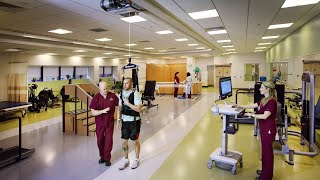
Additional Information People who have had limb amputations face a major challenge in maintaining their independence and functioning after enduring the loss of a limb and its complications. To meet these rehabilitation challenges, Johns Hopkins Physical Medicine and Rehabilitation has assembled an interdisciplinary team of rehabilitation professionals including physiatrists (rehabilitation physicians), physical therapists, orthotists, prosthetists and nurses who work together to manage the unique needs of amputee patients. Inpatient services. Rehabilitation begins immediately after amputation occurs (or, if the amputation surgery is elective, even beforehand). Patients are educated about what to expect in terms of pain, recovery and ultimate functional status. In the immediate postoperative period, prevention of contractures, deconditioning and edema control are of major importance. Team members may make recommendations regarding positioning, wound dressings and wound management. Patients begin physical and occupational therapy within 48 hours after surgery. Individuals requiring intensive postoperative rehabilitation may be admitted to our comprehensive inpatient rehabilitation facilities at Good Samaritan Hospital or Johns Hopkins Hospital. While in the hospital, efforts focus on optimal wound healing, maintaining and increasing strength and range of motion, and preparation of the residual limb for prosthetic wear. Outpatient services. The rehabilitation team continues to work with the patient long after hospital discharge. Patients are seen at an outpatient clinic at Good Samaritan Hospital, The Johns Hopkins Hospital, or Johns Hopkins Bayview Medical Center coordinated by Johns Hopkins physiatrists, where team members work with patients to help them make the transition to wearing a prosthetic limb and living more independently. When the residual limb is healed, the optimal prosthetic prescription minimizes discomfort and allows advanced gait training. Prosthetic training is often a slow process for the dysvascular amputee, and our clinics provide a continuum of care throughout the stages of training and prosthetic fitting. Patients who require particularly intensive training may be considered for inpatient admission. Having all health care professionals involved in one clinic and including the patient in all discussions and recommendations ensures smooth communication, close cooperation and the best possible outcome. Orthotics. Patients who use orthoses (orthotics, braces, splints, supports) for the legs, arms or spine as part of their daily activities and/or part of the rehabilitation program require a multi-disciplinary evaluation and prescription, as well as routine follow-up for changes or replacement. Johns Hopkins Physical Medicine and Rehabilitation has assembled an interdisciplinary team to provide this service and assist with achieving maximum functional independence and comfort. Special populations requiring orthoses include people with stroke, spinal cord injury, multiple sclerosis, sports-related or traumatic injuries, diabetic foot problems and spine or extremity post-operative devices. For more information, please contact: Rosemarie Filart, MD, MPH Bayview Medical Center Phone: 410-550-2240
Mark Hopkins, PT, CPO The Johns Hopkins Hospital Phone: 410-614-4030 Fax: 410-614-4033 To schedule an appointment, contact the clinic of your choice: The Johns Hopkins Hospital Mark Hopkins, PT, CPO Phone: 410-614-4030 Fax: 410-614-4033 Bayview Medical Center Prosthetic and Orthotc Clinic Rosemarie Filart, MD, MPH Phone:410-550-2240
Good Samaritan Hospital Kathleen M. Eaton, M.D. Phone: 410-532-4714 Fax: 410-532-4943 |