JOHNS HOPKINS MEDICINE


Search

Black spacer

ABOUT JOHNS HOPKINS MEDICINE

HEALTH INFORMATION

PATIENT CARE

RESEARCH

EDUCATION

Hopkins Medicine Home Page


Photograph of Physician and child

Photograph of blood cell

Photograph of xray

What's New at Rehab

Print This Page

Welcome
PATIENT CARE SERVICES
Program Brochures
FACULTY
EDUCATION & TRAINING
PHYSIATRIST
PSYCHOLOGIST

Therapist
RESEARCH
CAREER OPPORTUNITIES
Physician Education
Physical Therapist Education
PSYCHOLOGIST

Occupational Therapist Education
CHARITABLE GIVING
OUR LOCATIONS
CONTACT US
INTERNET RESOURCES


More JHM Information

JHM Organizations
dotted line
JHM Academic Depts & Institutes
Administrative Departments


Vertical Rule

Gait and Mobility Disorders

Gait is a series of patterned movements of the limbs and trunk that move a person across the ground or floor. An adult pattern (although not the stride length) has developed at least by age six, possibly as early as age four. The normal gait, at the individual’s self-selected walking speed (SSWS) on smooth, level ground, is highly efficient and effortless, such that it can be sustained for minutes to hours.

Requirements for normal gait include normal muscle strength, joint and muscle flexibility and motor control, as well as freedom from pain. Certain deviations from these requirements produce predictable alterations in the patterns, which are referred to as limps. For example, mild weakness of the gluteus medius, the prime abductor of the hip, produces an "uncompensated gluteus medius limp." Severe weakness of that muscle produces a "compensated gluteus medius limp." Some conditions, such as depression, do not produce a limp, but do decrease the SSWS. In fact, SSWS has been shown, in numerous independent studies, to be highly sensitive to changes in the mechanical, physiological, cognitive and emotional condition of subjects. The English language intuitively recognizes this in the expression, "The spring is back in my step."

Some conditions, such as cerebellar disorders and others, affect not only walking, but also the movement and usage of the hands and entire upper limbs. A high degree of spatial-temporal resolution is needed to determine small, but functionally important, changes in movement of the upper limbs.

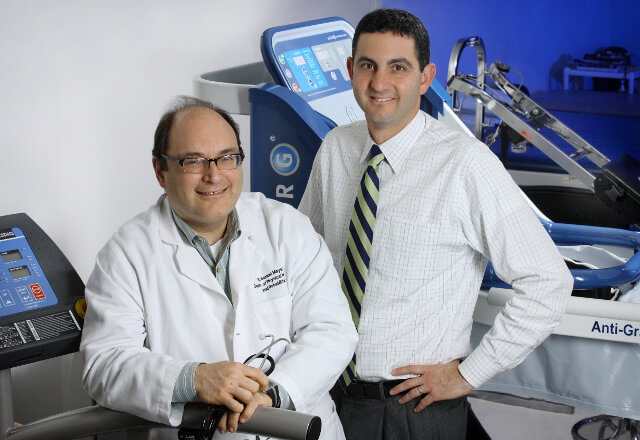
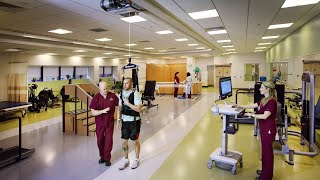
Our collective, multi-site laboratories include everything from a stopwatch for measuring SSWS to the GaitRite system, which is portable and able to see changes in patterns of footfalls, to the laboratories of Amy Bastian and Kathy Zackowski, where kinetics (force measurements) and three-dimensional kinematics (movements in space as well as time) can be studied.

Ongoing studies include comparison of regional block versus narcotic medications in post-operative knee replacements, augmented excercise programs for patients with major burns, normal pressure hydrocephalus before and after therapeutic interventions, Rett Syndrome interventions, interventions for spasticity and other tone abnormalities, muscle tone studies, obesity studies and cerebellar disorders.


AddThis Social Bookmark Button .
 .

FAQs | Maps & Directions | Privacy | Intranet | Contact JHM | Media Inquiries | Fund For JHM | Science Calendar

JOHNS HOPKINS HOSPITAL AND HEALTH SYSTEM
JOHNS HOPKINS UNIVERSITY
JOHNS HOPKINS MEDICINE

.

U.S.News & World Report - Best Hospital

U.S.News and World Report - Best Grad Schools

ANCC Magnet Recognition

 
 Â© The Johns Hopkins University, The Johns Hopkins Hospital and Johns Hopkins Health System, All rights reserved